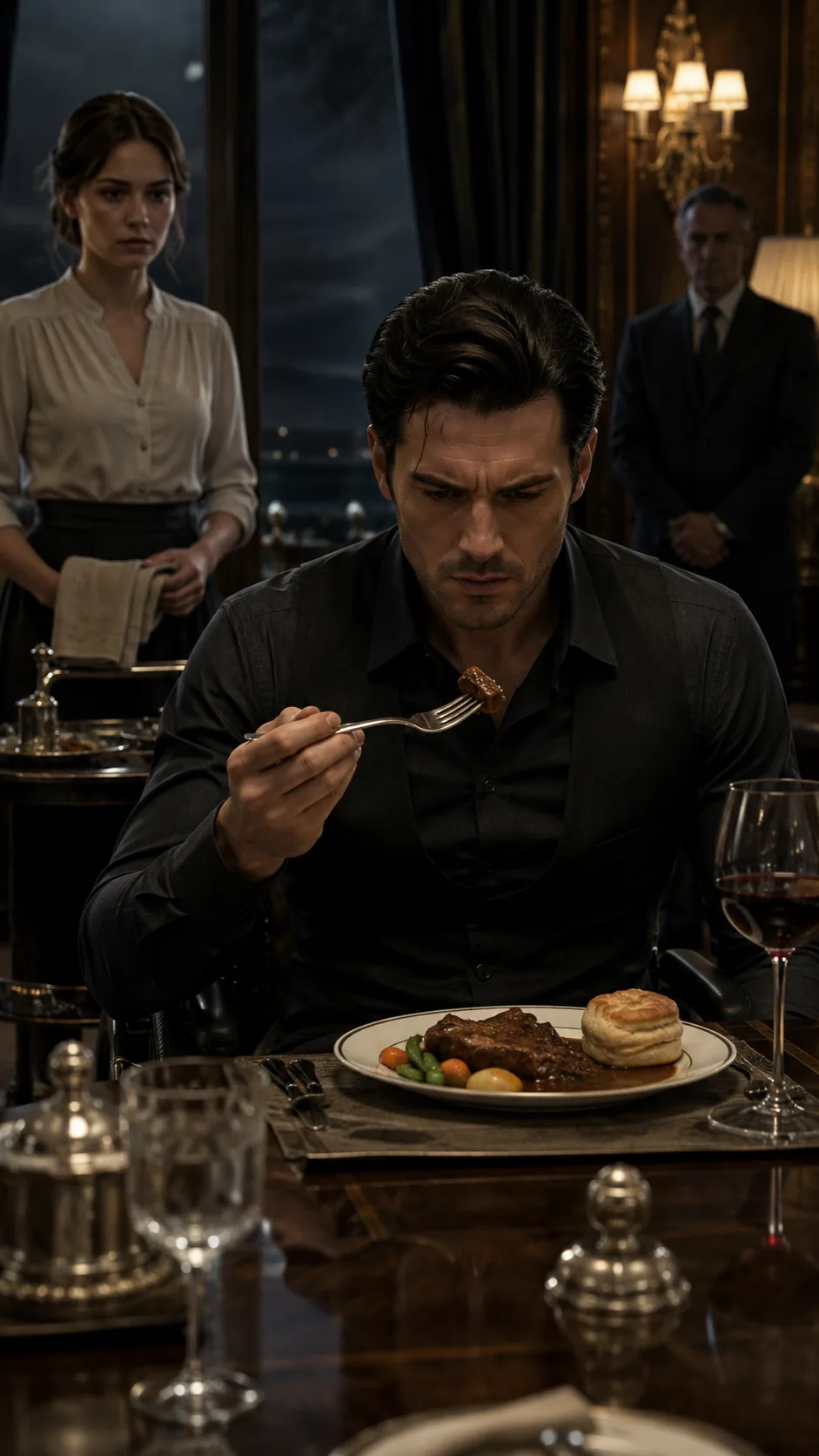
Samuel sighed.
Chapter 2
Samuel sighed.
“I already did.”
“Do it better.”
“You think she’s dangerous?”
Caleb looked toward the dark windows.
“I think people rarely arrive in my life without wanting something.”
Samuel knew better than to argue.
So he investigated.
He found Mara’s wages flowing toward June’s medical bills.
He found years of rent paid on time.
Returned wallets.
Volunteer shifts at a food pantry.
A dismissed parking citation.
Nothing hidden.
Nothing glamorous.
Nothing useful to an enemy.
Just an ordinary woman who had been forced to become unusually strong.
“Nothing?” Caleb asked when Samuel returned.
“Nothing.”
“Everyone has something.”
“She worries about her sister.”
“That isn’t a secret.”
“She owes money.”
“That makes people vulnerable.”
“It also makes some people work two jobs instead of selling themselves.”
Caleb’s gaze hardened.
“You trust her.”
“Yes.”
“That could get you killed.”
Samuel smiled sadly.
“Distrusting everyone has not exactly made you happy.”
Caleb looked at
him.
Samuel wisely left.
Days passed.
Mara discovered an old phonograph in a storage room and a box of records labeled in Edith’s handwriting.
One afternoon, she played a song called “Moonlight in Vermont.”
Edith stopped speaking halfway through a sentence.
Her eyes filled.
Then she began humming.
Mara reached for her hand.
Edith whispered, “Caleb hated thunderstorms.”
Mara froze.
The older woman smiled faintly.
“When he was six. He would climb into my bed and pretend he came because I was frightened.”
At the doorway, a shadow moved.
Caleb.
He had heard everything.
Edith noticed him.
For one breathtaking second, clarity entered her face.
“My boy.”
Caleb’s grip tightened around the wheel.
“Hi, Mom.”
“You’re too thin.”
Mara looked away to give them privacy.
Edith held out her hand.
Caleb crossed the room.
His mother touched his cheek.
Then the fog returned.
She frowned.
“Where’s Claire?”
Caleb stopped breathing.
Mara saw the pain move through him like something physical.
He withdrew.
“I have work.”
He turned his chair toward the door.
“Mr. Vane.”
He stopped.
Mara did not offer sympathy.
She merely said, “She remembered you.”
Caleb did not turn around.
“I heard her.”
That night Mara understood why the mansion felt like a building holding its breath.
Someone had died here without dying here.
A family had lost a woman named Claire, and everyone else had apparently been living inside the echo ever since.
Then came the dinner.
Chef Nolan collapsed with a stomach virus shortly after noon.
The assistant cook prepared an elaborate meal Edith refused even to look at.
At six, Samuel found Mara in the kitchen making biscuits.
“You’re not supposed to use the family stove.”
“She hasn’t eaten since breakfast.”
“Caleb doesn’t allow anyone in here.”
“Then you cook.”
Samuel glanced at the pot.
“What is that?”
“Sunday braise.”
“It smells familiar.”
“So does soap. That doesn’t mean it’s dangerous.”
Samuel rubbed his forehead.
“You are going to shorten my life.”
“Would you rather Mrs. Vane go hungry?”
That ended the argument.
Mara served Edith.
Then the assistant cook, panicking because dinner had been ruined, asked whether there was enough for Caleb.
Mara should have said no.
Instead, twenty minutes later, a plate was carried into the dining room.
Caleb ate one bite.
Then another.
By the fourth, he was no longer in that room.
He was two years younger.
Claire was standing barefoot in their kitchen, laughing because she had burned the first batch of biscuits.
She was pregnant.
Music was playing.
His mother was complaining that Claire used too much thyme.
Caleb was pretending to hate the chaos while secretly wishing the night would never end.
He finished the entire plate.
Then he asked who had cooked it.
And Mara Holloway said her grandmother’s name.
Ruth Holloway.
Now Caleb sat outside a locked door on the mansion’s west wing while Samuel placed an old brass key into his hand.
“Are you sure?” Samuel asked.
“No.”
Caleb unlocked it anyway.
The room smelled faintly of cedar and dust.
Claire’s room.
Not a bedroom.
A small private sitting room where she had painted, kept journals, wrapped gifts, and hidden from parties when Caleb’s business associates became unbearable.
After her death, he had ordered the door locked.
Nothing moved.
Nothing touched.
Nothing remembered.
Mara remained near the entrance.
“You don’t have to do this because of me.”
“I’m not.”
It was an obvious lie.
Caleb rolled toward a bookshelf.
His hand stopped over a wooden recipe box.
He opened it.
Inside were cards covered in Claire’s handwriting.
Mara watched his face as he sorted through them.
Apple pie.
Cornbread.
Roast chicken.
Then his hand froze.
He pulled out a card.
Sunday Braise.
At the bottom, beneath Claire’s handwriting, were four words.
Ruth Holloway taught me.
Mara stepped closer.
“That’s impossible.”
Caleb turned the card toward her.
Mara touched the edge.
“My grandmother ran a church kitchen near Rogers Park for almost twenty years.”
“Claire volunteered at one in college.”
Mara looked at him.
“Harbor House?”
Caleb’s eyes widened.
“Yes.”
Mara opened her recipe notebook and flipped through old pages until she found the braise.
There, beside Ruth’s handwriting, was a note Mara had seen a thousand times without questioning.
Pretty college girl says more thyme.
Mara laughed through sudden tears.
“My grandmother never remembered names.”
Caleb stared at the note.
For the first time since Mara had met him, he smiled.
It was small.
Painful.
But real.
Then something slipped from the recipe box and fell to the floor.
An envelope.
Caleb stopped smiling.
On the front, Claire had written his name.
Caleb.
His hand shook before he reached for it.
The envelope had never been opened.
Inside were three pages.
The first was personal.
Claire wrote that she knew Caleb hated when she involved herself in his business, but a charitable housing project she supported had been manipulated by someone inside Vane Holdings.
Families were being pressured out of buildings through fraudulent debt claims.
At the bottom of the second page was a name.
Grant Mercer.
Caleb’s face hardened.
Mara watched him read the final paragraph.
If anything happens to me, do not become the man Grant believes you already are. That is how he wins.
Caleb stopped.
For several seconds, there was only the sound of wind against the windows.
Mara whispered, “Who is Grant Mercer?”
“A man I should have buried two years ago.”
She stiffened.
Caleb shut his eyes.
When he opened them again, he corrected himself.
“A man I should have stopped.”
That distinction mattered more than Mara understood at the time.
Grant Mercer had once been Caleb’s closest business ally.
Charming, patient, and ambitious, Grant handled development projects Caleb considered too small to watch personally.
Claire had apparently discovered that Grant was using some of those projects to crush vulnerable property owners and funnel money through false debts.
Caleb had never known.
Weeks after Claire wrote the letter, the Vane car had been forced from a winter road after leaving a restaurant.
Claire died.
The child she carried died with her.
Caleb survived with severe spinal injuries.
Police called the crash suspicious but never proved who ordered it.
Caleb had always suspected betrayal.
Now he had a name.
Mara expected fury.
What she saw was worse.
Guilt.
“I never opened this room,” Caleb said.
“You were grieving.”
“I was hiding.”
“You were surviving.”
“No.”
His voice hardened.
“I built an empire because I believed knowing everything made me untouchable. My wife found corruption under my own roof and was too afraid of what I would become to tell me face-to-face.”
Mara looked at Claire’s final words.
“Maybe she wasn’t afraid of what you would become.”
Caleb looked at her.
“Maybe she was afraid you’d believe revenge was the same thing as love.”
He said nothing.
Mara closed the recipe notebook.
“You get to decide whether she was right.”
That night became the first night Caleb Vane seriously considered changing the world he had built instead of merely controlling it.
But change did not arrive cleanly.
It rarely does.
Two weeks later, Mara received the call she had feared.
June’s heart had deteriorated.
Her surgical team recommended moving forward quickly.
Even with assistance, the uncovered costs would devastate Mara.
She listened in the pantry, said she understood, and ended the call.
Then she sat on the floor between bags of flour and cried into both hands.
She did not know Caleb was outside.
He had come looking for coffee.
He heard June’s name.
He heard Mara whisper, “Please don’t leave me too.”
Caleb backed away before she could see him.
That night, he made three calls.
Four days later, Lakeview Heart Institute informed Mara that the remaining treatment costs had been covered through a private charitable fund.
June’s surgery was scheduled.
Mara demanded the donor’s name.
The coordinator could not provide it.
Mara suspected immediately.
She found Caleb in the library.
“Was it you?”
He kept reading.
“Was what me?”
“My sister.”
He turned a page.
“You’ll have to be more specific.”
“Caleb.”
He looked up.
She had never called him by his first name before.
“You paid for June’s surgery.”
“I made a contribution to a medical fund.”
“You made a contribution that happened to equal exactly what she needed.”
“Coincidences occur.”
Mara’s eyes filled.
“Why?”
His expression changed.
Because the question frightened him more than anger ever had.
Finally he said, “Because I could.”
“That isn’t an answer.”
“It is the only one you’re getting.”
She walked closer.
“I can’t repay you.”
“I don’t want repayment.”
“You can’t buy my gratitude.”
“I don’t want gratitude.”
“Then what do you want?”
Caleb went silent.
Mara waited.
His voice came quietly.
“I wanted you not to receive the phone call I received two years ago.”
Click the blue “PART 3” below to read the next part: 👉 PART 3 👈
Chapter complete
You have reached the end of this chapter.
Continue reading
A few more worlds to get lost in after this chapter.




