I drove back to Savannah instead of flying.
Chapter 3
I drove back to Savannah instead of flying.
Fourteen hours on the road gave me room to breathe. By the time the moss-draped oaks appeared along the familiar streets, Newport felt like a fever I had survived.
My Victorian house welcomed me with old-floor creaks, sunlit bookshelves, and the faint scent of Charles’s roses drifting through an open window.
Behind a false panel in my antique writing desk rested the Coleman collection: first editions of Thoreau, Emerson, and Whitman; correspondence between nineteenth-century writers; handwritten pages linked to Melville and Hawthorne.
Veronica had once called the desk shabby.
William had never asked what it contained.
The next morning, an unfamiliar number called.
“This is Vanessa Bennett,” the woman said. “Veronica’s sister.”
I knew of her only through wedding photographs. Unlike Veronica, Vanessa taught at a public middle school in Seattle and rarely appeared in society pages.
“I’m calling to apologize,” she said. “The seating arrangement was cruel. I saw
what my mother and sister were doing, and I stayed silent.”
“You did not create the chart.”
“No, but silence can become participation.”
Her honesty surprised me.
Vanessa told me Robert had confronted Elizabeth about the prenup and the trust. William had moved into his old friend Marcus’s small Boston apartment. Veronica had returned to Manhattan.
“William sounds different,” Vanessa said. “He asked me about my students. He listened to the answer.”
“That sounds like the boy I raised.”
Before we ended the call, she added, “What you did was painful, but it may have saved him.”
Two weeks later, a black town car stopped outside my house.
Veronica stepped out wearing a linen dress and expensive sunglasses. She looked perfectly assembled, but less certain than before.
We sat on my porch with sweet tea.
“William filed for an annulment,” she said.
“I’m sorry.”
“I’m angry, humiliated, and relieved. I
do not know which feeling is honest.”
She removed a tissue-wrapped package from her handbag.
Inside was a rare first edition of Walden from the Coleman collection.
My breath caught.
“William gave it to me as a wedding gift,” she explained. “I displayed it because his colleagues would recognize it. I never understood why it mattered.”
“Did you read it?”
“I tried. I thought choosing a simple life was ridiculous.”
Her gaze moved across the old porch, the hand-restored floors, and Charles’s garden.
“I still like beautiful things, Mrs. Coleman. I am not going to pretend I suddenly want a different life. But I understand that I treated you cruelly. My behavior revealed my character, not your worth.”
Her apology carried no demand this time.
“I accept it,” I said.
She gave me an envelope from William and left for the airport.
His letter said he was not ready to
come home, but he was finding his way back to himself. The annulment papers had been filed. Marcus reminded him who he had been before status became an obsession.
Inside the envelope was a velvet pouch containing an antique silver compass.
The inscription read:
For Martha, who always helps me find my way home. Love, Charles.
I held it until tears blurred the garden.
Charles must have hidden it before his final heart attack. Somehow, years later, our lost son had delivered it exactly when I needed it.
Summer passed into autumn.
William took a position at a Boston community hospital.
“Less money, more medicine,” he told me. “Patients who need help, not people buying prestige.”
Our conversations became real again. He asked about my classes. He listened when I spoke about his father. He stopped requesting money.
Vanessa occasionally joined his calls. Their friendship grew slowly through museum visits, coffee, and volunteer work. Neither called it romance, but a mother can recognize hope even when it hides behind careful language.
Then, one October evening, my doorbell rang.
William stood on the porch with a duffel bag at his feet.
“Hi, Mom,” he said. “Is that kitchen table seat still available?”
I pulled him into my arms.
“Always.”
Later, we sat over peach cobbler at the worn oak table where he had once studied spelling words and medical textbooks.
“I accepted a position at Memorial Hospital,” he said. “I’m coming home in January.”
Joy rose so quickly that I could not speak.
“There’s more,” he added. “Vanessa applied for teaching jobs here.”
I smiled. “Just friends?”
He blushed.
“Exploring possibilities.”
Then he placed a small blue box between us.
Inside was his grandmother’s sapphire ring, surrounded by tiny pearls.
“Dad gave it to me before he died,” William said. “He told me to give it to the woman I truly loved.”
“You are asking whether Vanessa will prefer something larger.”
“How did you know?”
“The woman who drives a ten-year-old Subaru and teaches middle school will understand exactly what that ring means.”
William laughed, then grew serious.
“Robert is coming next week to see the collection. I want to see it, too. Not because it is worth millions. I want to understand why Great-Grandfather built it and why Dad protected it.”
“The collection has been waiting for you to become ready.”
He reached across the table.
“So have you.”
Robert Bennett arrived the following Thursday and spent six hours examining the collection. He treated every book with reverence.
That visit led to an unexpected partnership. Selected pieces were loaned to museums and universities while the heart of the collection remained in our home. The income and donations created a scholarship for students who lacked the advantages William had once taken for granted.
The first $93,000 placed into the scholarship fund was the money never spent on the Maldives honeymoon.
William married Vanessa the next spring beneath the oak trees in my backyard.
There were sixty guests, homemade food, and no assigned seating. Charles’s records played while children ran through the garden.
Veronica attended.
She had begun working seriously for her father’s educational foundation. She still wore designer clothing and preferred Manhattan, but she had learned that another person’s simplicity was not an invitation for contempt.
Robert raised a glass during dinner.
“To Martha, who stood firm when surrender would have been easier.”
“To truth,” Vanessa added.
William looked at me.
“To kitchen tables, where real families stop performing.”
Five years later, our Sunday table had grown large enough for William and Vanessa’s twins, Robert and Charlotte, both energetic and usually covered in something sticky.
The scholarship supported thirty students each year. One of its first recipients, Maria, completed nursing school and joined the selection committee.
Robert gradually retired from business and devoted himself to education and rare books. Elizabeth changed more slowly, but grandchildren softened places pride never could.
Veronica adopted a son and surprised everyone by becoming a patient, protective mother. She and I were never close, but we learned to respect each other.
As for William, he became the steward of the Coleman collection.
Some evenings, after the twins fell asleep, he and I read aloud at the kitchen table. He used Charles’s different voices for every character, badly but enthusiastically.
One night, he closed a book and ran his hand over the old oak surface.
“I spent years ashamed of this house,” he said. “I thought wealth meant escaping everything ordinary.”
“And now?”
“Now I know ordinary is where life happens.”
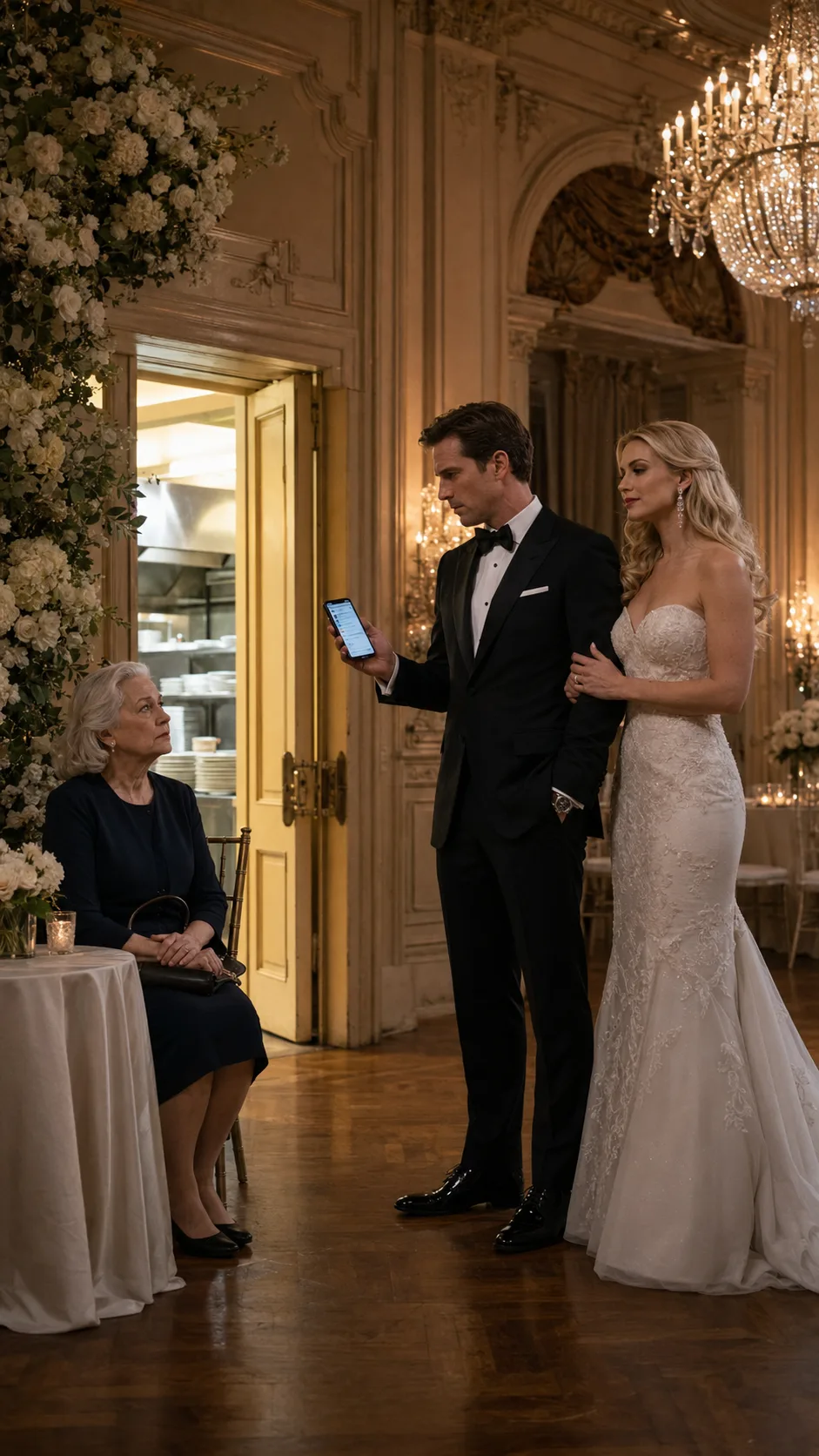
I thought of the Newport ballroom. The chandeliers. The carefully ranked tables. The kitchen doors swinging behind my chair.
They had placed me there to declare that I did not belong among important people.
But their insult reminded me that the kitchen table had never been a place of shame.
It was where Charles and I planned our future.
Where William studied.
Where our family ate, argued, mourned, forgave, and began again.
The table of honor at a wedding can display status.
A kitchen table reveals substance.
William had finally returned to the place that had always been his—not because I paid his way, protected his image, or rescued him from consequences, but because he had learned to arrive honestly.
I looked around at the scratches, stains, and small dents marking generations of Coleman life.
Every imperfection told the truth.
And in the end, truth was the inheritance worth preserving.
Not the table someone assigns you.
The table you choose.
Not the price of a journey.
Its purpose.
Not the appearance of wealth.
The richness of being known, forgiven, and welcomed home.
THE END
Chapter complete
You have reached the end of this chapter.
Continue reading
A few more worlds to get lost in after this chapter.




