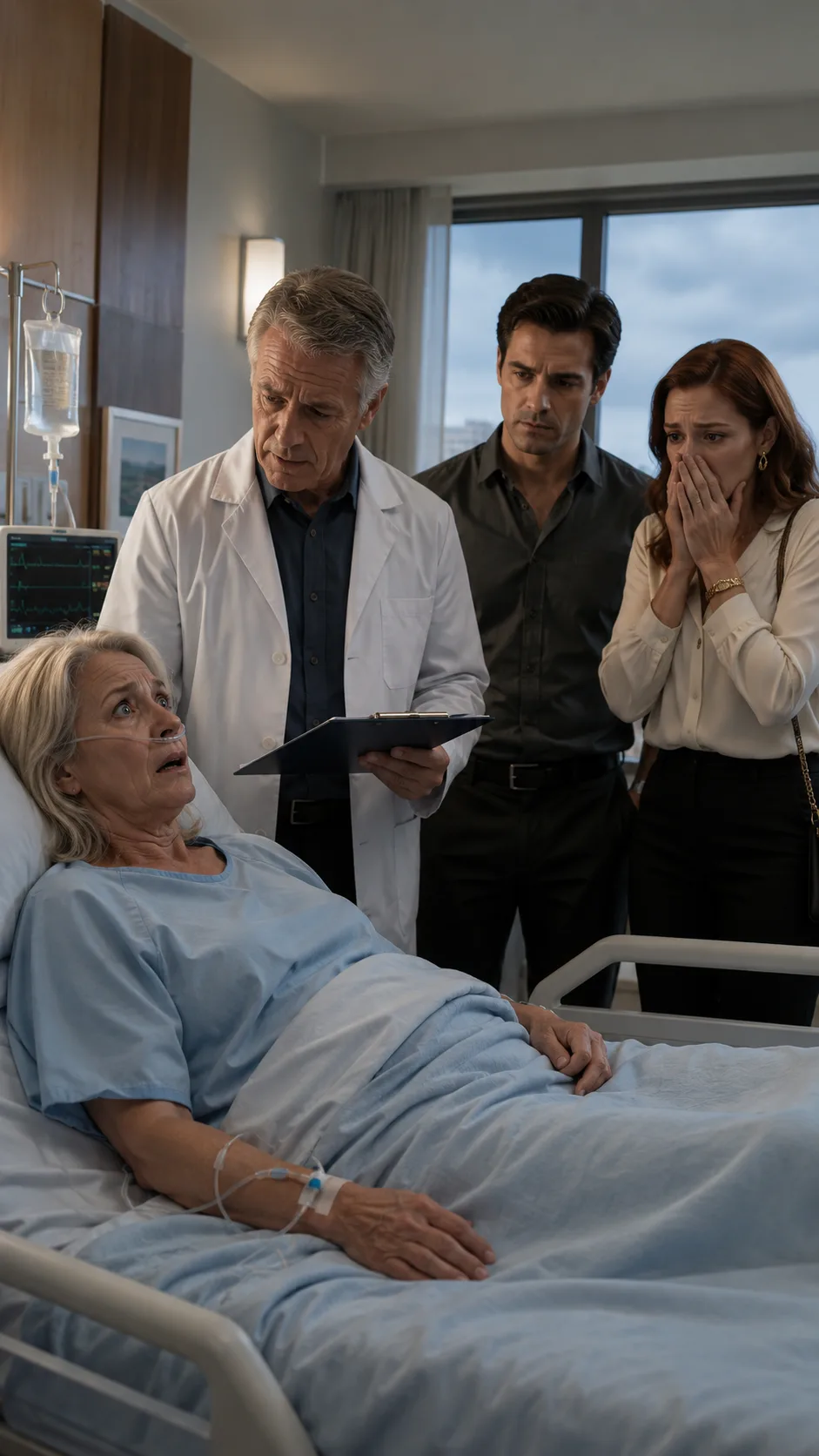
PART 2 — THE TRAP BEGINS
The revelation hit me like a second accident.
Chapter 2
PART 2 — THE TRAP BEGINS
The revelation hit me like a second accident.
Eight hundred thousand.
That explained the smile. That explained the urgency. That explained the joy upon hearing my death sentence.
“What can I do?” I whispered, feeling fear and rage mix in my chest.
Henry leaned forward.
“You can use this time. You can pretend you are worse than you are. You can observe, listen, gather evidence, and you can protect what you built.”
His words ignited something in me. A plan began to form in my mind—still blurry, but taking shape.
“I’ll need help,” I said.
“I’ve already thought of that,” Henry replied. “I know an excellent attorney—Sarah Jenkins—specializing in probate and family fraud. I can contact her discreetly.”
I nodded slowly.
“And I need you to keep up the diagnosis charade,” I added. “Mark and Rachel must continue to believe I only have days left.”
Henry smiled for the first time.
“That will be easy. In fact, I
can make the prognosis seem to worsen—more tests, more complications. Keep them confident.”
“Do it.”
That night, alone in the hospital room, with the constant sound of the machines and the dim light, I made a decision. I was not going to die a victim. I was not going to let my son and his wife destroy everything I had worked for.
If they wanted to play dirty, I was going to teach them who invented the game.
The next day, Mark and Rachel returned to the hospital. This time they brought a folder full of papers and that same fake excitement I could now see with total clarity.
“Mom, we brought some documents,” Mark said in a soft, almost affectionate voice.
What a good actor he was.
“Just formalities, you know—health insurance stuff, authorization for treatments, nothing important.”
But I could read, and though I pretended to be weak
with half-closed eyes, I saw the words on those papers.
Property transfer. Power of attorney. Bank account access.
“You can sign here, Mom,” he insisted, pushing a pen toward my trembling hand.
“I’m very tired,” I mumbled in a broken voice. “Tomorrow, son. Tomorrow.”
I saw the frustration cross his face for a second before the mask returned.
“Of course, Mom. Rest. Tomorrow it is.”
Rachel stayed, watching me with those cold, calculating eyes. Then she turned to Mark.
“How much do you think the vacation home in Aspen is worth?”
“At least one point five million,” Mark said. “It’s in a prime area. We could sell it fast. There are buyers waiting in that zone.”
They spoke as if I weren’t there, as if I were already dead and buried.
After they left, Nurse Brenda—a kind woman in her mid-fifties who had worked at this community hospital for fifteen
years—came in to check my vitals. She was honest, one of those people who still believed in doing the right thing.
“Miss Helen,” she whispered as she adjusted my IV drip. “I don’t want to get involved where I shouldn’t, but I overheard your son and daughter-in-law in the hallway. They were talking about pulling the plug early.”
My blood ran cold.
“What exactly did they say?”
Brenda looked toward the door, nervous.
“Your daughter-in-law said that if you slipped into a coma, it would be easier to convince the doctors there was no hope left—that they could accelerate the process. Mark said he knew someone at the hospital who could help.”
Rage burned inside me. They didn’t just want my money. They wanted to ensure I died quickly.
“Brenda, I need you to do me a favor,” I said, taking her hand. “I need you to be my eyes and ears. Listen to everything they say when they think no one is listening. Can you do that for me?”
She nodded without hesitation.
“Anything you need, Ms. Helen. Your son is not a good man. I see it in his eyes.”
On the third day in the hospital, Dr. Henry discharged me under the condition of absolute bed rest at home. Of course, in front of Mark and Rachel, the diagnosis remained terminal.
“Three days,” he repeated to them. “Perhaps less if there are complications.”
Mark insisted I stay in my master suite on the second floor.
“So you’ll be comfortable, Mom. You’ll have everything you need.”
But I knew the truth. They wanted me isolated, away from the main areas of the house, where they could do whatever they wanted without me seeing them.
My house was a large two-story mansion in a wealthy Los Angeles suburb that I had bought twenty years ago, when my real estate business took off. Five bedrooms, a large yard, a pool—all paid for with my sweat and tears—and now they walked through it as if it were already theirs.
On the fourth day, pretending to sleep, I heard footsteps in the hallway. Mark and Rachel didn’t know I had installed a baby monitor years ago, back when my grandchildren used to visit. The device was still working, hidden in a drawer in my nightstand.
Their voices came clearly from the living room.
“I called the appraiser,” Rachel was saying. “He’s coming tomorrow at ten. I told him to be discreet.”
“Perfect,” Mark replied. “And the real estate agent—I already sent him photos of the house. He says he can sell it in less than a month if the price is right. He’s talking about two point eight million.”
“Excellent. With that, we pay off my debts and we still have two million clean profit.”
“And the other properties,” Mark said, “three apartment buildings, the commercial space downtown, and the Aspen home. Altogether, that’s another four million easily.”
Rachel let out a laugh.
“Seven million, Mark. Seven million. Seven.”
“We won’t have to worry about anything ever again.”
“I know. And to think I almost felt bad when the doctor broke the news,” Mark said. “But it was the best news of my life.”
“Mine, too,” Rachel said. “Your mother was always so controlling, so nosy, always giving her opinion on how we should live, how we should spend, as if her money was untouchable. Now it will be our money, and we’ll do whatever we want with it.”
I gripped the sheets with my fists. Every word was a stab, but I needed to hear more. I needed to know the full extent of their betrayal.
“Did you talk to that contact of yours at the hospital?” Rachel asked.
“Yeah. Frank works the night shift,” Mark said. “He says if she slips into a coma, or if she seems to be suffering too much, he can… you know… help the process along faster. An extra dose of morphine. No one asks questions with terminal patients.”
My heart stopped for a second.
They were planning to murder me.
“And you trust him?” Rachel asked.
“I owe him favors,” Mark said, “and I offered him fifty thousand once we have the money. He accepted immediately.”
“Perfect,” Rachel said. “Because honestly, I don’t want to wait the full three days. Every day coming to this house pretending I care is driving me crazy.”
“I know, honey,” Mark said, “but it’s almost over. Just a little more patience.”
I heard the sound of a kiss, then footsteps moving away. They had probably gone out to the yard.
I lay there trembling with rage and disbelief. My own son had hired someone to kill me to speed up my death and collect his inheritance faster.
I took my cell phone—the one I had hidden under the pillow—and dialed the number Dr. Henry had given me.
“Attorney Sarah Jenkins?” I asked when she answered.
“Yes, speaking.”
“I need to see you urgently.”
“Dr. Henry contacted you about my case, Ms. Helen,” she said. “Yes, I’ve been expecting your call. When can we meet?”
“Tonight. You can come to my house at eleven. My son and his wife always go out around that time. They say they’re going to dinner, but I know they’re going to the local casino in Inglewood.”
“I’ll be there,” Sarah said. “And Ms. Helen, I’ll bring the documents we’ll need. We’re going to fix this.”
I hung up and closed my eyes. The plan was taking shape, but I needed more. I needed solid proof—evidence that would completely destroy Mark and Rachel.
That afternoon, when Nurse Brenda came to help me bathe, I gave her specific instructions.
“I need you to buy three small, discreet cameras,” I said. “The kind that can be camouflaged. One for the living room, one for the dining room, and one for the study. Here’s the cash.”
Brenda’s eyes widened.
“And Brenda—no one. Not a soul. No one.”
She took the money and nodded.
“Count on me, Ms. Helen. I’ll make it look like I’m going out for normal errands.”
“And one more thing,” I said. “I need you to record every conversation you hear between Mark and Rachel. Use your cell phone. It doesn’t matter if the quality isn’t perfect. I just need their voices, their words.”
“I’ll do it,” Brenda said.
When Mark came up to bring me dinner that night, I pretended to be worse. I coughed weakly. I let my hand tremble as I held the glass of water.
“How are you feeling, Mom?” he asked, that fake, acted voice in place.
“Very bad, son. Very weak. I don’t know if I’ll make it until tomorrow.”
I saw his eyes light up for a second—hope. Hope that I would die soon.
“Don’t say that, Mom,” he said. “You’re strong. You’ve always been strong.”
Liar. You damned liar.
“Mark,” I said in a broken voice, “if anything happens to me, I want you to know that everything I have is yours. It was always yours. I love you, son.”
I almost vomited saying those words, but I needed him to believe I was still the naïve mother who trusted him blindly.
“I love you, too, Mom,” he replied, kissing my forehead.
A cold, empty, calculating kiss.
When he left the room, I heard his muffled laugh in the hallway. I heard Rachel ask,
“How is she?”
“Worse,” Mark said. “I don’t think she’ll make it to the weekend.”
“Thank God,” Rachel replied. “I’m already tired of this charade.”
I closed my eyes and breathed deeply.
“Not yet,” I told myself. “It’s not time to show my cards yet. First the evidence, first the trap, then justice.”
At eleven o’clock that night, like clockwork, I heard Mark’s luxury sedan pull out of the garage. Just as I predicted, they were off to the casino. Rachel had told a friend on the phone that they had a winning streak and couldn’t waste it.
How ironic—winning at the casino while drowning in debt.
Fifteen minutes later, the doorbell rang.
Brenda, who had stayed with me under the excuse of being my night nurse, went down to open it. Sarah Jenkins entered my room with a leather briefcase and a serious but compassionate expression.
She was a woman in her mid-forties, impeccably dressed in a charcoal-gray suit, her hair pulled back, her gaze intelligent and direct.
“Ms. Helen,” she said, shaking my hand firmly. “I regret that we meet under these circumstances.”
“Me too,” I said, “but I’m glad you’re here.”
She sat in the chair beside my bed and opened her briefcase.
“Dr. Henry brought me up to speed on the situation. Your son and daughter-in-law believe you only have days to live and are preparing to inherit, but I need you to tell me everything from the beginning. Every detail matters.”
For the next hour, I told her everything—the accident, the false diagnosis, Mark’s reaction, the conversations I had overheard, the murder plot with the hospital employee, the gambling debts, the appraisers, everything.
Sarah took notes on her tablet, nodding occasionally.
When I finished, she looked up.
“This is more serious than I thought. We’re not just talking about greed, Ms. Helen. We are talking about conspiracy to commit murder. That’s prison time.”
“I want them to pay,” I said firmly. “I want them to face the consequences for every horrible thing they’ve planned.”
“And they will,” Sarah replied, “but we need to build a solid case. The conversations you overheard are valuable, but we need recordings, documents, physical evidence.”
“Brenda is installing cameras tomorrow.”
“Excellent. But there’s more we can do.”
Sarah pulled several documents from her briefcase.
“We need to revise your current will and trust. Who is the primary beneficiary?”
“Mark,” I admitted. “Everything is in his name. I thought it was the right thing to do. He’s my only son.”
“Not anymore,” Sarah said. “We are going to draft a new will and trust tonight—one that Mark and Rachel will never see until it is too late.”
We spent two hours working on the documents. Sarah was meticulous, explaining every clause, every legal protection.
The new will named my brother Michael, who lives in Oregon, as the principal beneficiary, established a trust for several charities focused on veterans, and left Mark a minimal fifty thousand dollars—the legal minimum—so he couldn’t challenge the document by claiming accidental omission.
“We will need witnesses for the signing,” Sarah said. “Brenda can be one. We need two, and preferably people who have no interest in your estate.”
“Dr. Henry,” I said. “He can be the second.”
“Perfect. I will contact them tomorrow to come and sign. In the meantime, this document remains in my absolute custody. Mark will not know of its existence until the exact moment we decide to reveal it.”
I signed the new will with a trembling hand—not from weakness, but from emotion. It was my first real strike against Mark, the first piece of the puzzle falling into place.
“Now,” Sarah continued, “I need you to give me access to your bank accounts, your properties, everything. I’m going to run a full audit. If Mark has been stealing—and I suspect he has—I’m going to find every penny.”
I gave her all the account numbers, all the passwords, all the documents I had stored in my private safe deposit box.
Sarah worked quickly, taking photos of everything with her phone.
“One more thing,” she said before leaving. “I need you to keep pretending. Keep being the dying, trusting mother. Every day they think they are winning is one more day we have to gather evidence.”
“I can do that,” I said. “I’m a better actress than they think.”
Sarah smiled for the first time.
“I know. The simple fact that you are planning this while they believe you are dying tells me you are an extraordinary woman, Ms. Helen.”
When she left after two in the morning, I felt something I hadn’t felt in days—hope, control, power.
Mark and Rachel returned at three, drunk and loud. I heard them stumbling up the stairs, laughing like teenagers.
“I won two thousand,” Mark was saying. “Two thousand damn dollars in one night. It’s a sign.”
“Things are turning around for us,” Rachel replied. “We’ll finally have what we deserve.”
They went into their bedroom across the hall from mine and continued talking. I turned up the volume on the intercom.
“When is the appraiser coming?” Mark asked.
“Tomorrow at ten. I told him to come through the back door to be discreet,” Rachel said. “Your mother can’t see him.”
“Perfect. And the transfer papers—I have them ready. We just need her signature. Even if she’s weak, even if she can barely write, a mark is enough. My cousin, the notary, already knows what to do. We’ll pay him five thousand to look the other way.”
“And what if she refuses to sign?” Mark asked.
There was a pause. Then Rachel said something that left me breathless.
“Then Frank does his job ahead of schedule. Either way, in four days maximum, she won’t be a problem anymore.”
“I like the way you think,” Mark laughed.
I recorded every word on my phone. Every single damn word.
The next day, Brenda arrived early with a grocery bag that no one checked. Inside were the three tiny cameras—small, button-sized, with a Wi-Fi connection directly to an application on my phone.
“Where should I install them?” she whispered.
“The main living room where they sit and talk—put it inside the floral arrangement on the mantelpiece,” I said. “The second one in the study behind the books on the shelf, and the third one in the dining room, stuck under the hanging chandelier.”
Brenda worked quickly and silently while Mark and Rachel had breakfast on the patio. In twenty minutes, all three cameras were installed and working.
I checked the app on my phone. The images were clear. The audio was perfect.
“Excellent work, Brenda.”
“To serve you, Ms. Helen,” she murmured. “These two don’t know who they messed with.”
At ten o’clock sharp, just as Rachel had said, the appraiser arrived—a man in his fifties with a briefcase and a professional camera. Mark led him in through the garden door.
From my room, through the cameras, I watched them move through my house like vultures. The appraiser took photos, made notes, evaluating every piece of furniture, every artwork, every detail.
“This lamp is an antique Tiffany,” he was saying, pointing to the crystal chandelier in the dining room that I had bought in New York. “It’s worth at least fifty thousand.”
“What about the piano?” Rachel asked.
“That’s an original Steinway. One hundred thousand, easy.”
Mark smiled as he totaled the figures.
“How much in total for all the contents of the house? Not counting the house itself.”
“You’re talking about four hundred thousand in furnishings, art, and objects.”
“Incredible,” Rachel whispered. “It’s more than I thought.”
“When can we proceed with the sale?” Mark asked.
The appraiser looked at him with some discomfort.
“Is your mother agreeable to this?”
“My mother is very ill. She has days left,” Mark said. “She gave me complete authorization to handle her affairs.”
The lie came so naturally from his lips.
“I understand,” the appraiser said. “Well, I’ll need legal documents to prove that authorization.”
“We’ll have them soon,” Mark assured him.
I recorded everything—every word, every gesture, every complicit glance between Mark and Rachel.
After the appraiser left, they came up to my room with papers in hand and fake smiles on their faces.
“Mom, you’re awake,” Mark said with nauseating sweetness. “We need you to sign these papers. They are for the health insurance so we can pay your treatments without issues.”
I looked at the papers. They were property transfers, documents that would give them total control of my estate.
“I can’t see well,” I murmured. “The letters are blurry.”
“It doesn’t matter, Mom. Just sign here.”
Mark put the pen in my hand. I let my hand tremble exaggeratedly.
“I can’t, son. It hurts too much. Tomorrow, please.”
I saw frustration in his eyes, but he nodded.
“It’s all right, Mom. Tomorrow.”
When they left, I heard them in the hall.
“She’s getting difficult,” Mark growled. “Call Frank. Have him come tonight. I’m tired of waiting.”
My heart pounded.
They were going to try to kill me tonight.
I immediately called Sarah.
“I need you to come now—with police if possible. They are going to try something tonight.”
“Calm down, Ms. Helen,” Sarah said. “I already anticipated this. I’ve been working with a private detective. We’ve been monitoring Frank, the hospital employee. We have recordings of Mark offering him money. He’ll be arrested today.”
“Today?”
“In two hours.”
“And when they do, Mark will get very nervous,” Sarah continued. “That’s when they make mistakes. That’s when we get more evidence.”
I hung up, feeling a mix of fear and satisfaction. The trap was closing, but something was still missing. I still needed more to completely destroy them.
That afternoon, Dr. Henry came to do a routine checkup. In front of Mark, his diagnosis was devastating.
“Ms. Helen is deteriorating rapidly. Her vital signs are weak. I estimate she has a maximum of three days left.”
Mark tried to look sad, but I saw the relief on his face.
Three days, he thought.
Three days until the end of his world, I thought.
At six in the evening, my phone vibrated with news that filled me with satisfaction. Sarah sent me a message.
Frank arrested. He confessed everything. Mentioned Mark’s name. The police want to talk to your son.
I smiled from my bed. The first domino had just fallen.
An hour later, two detectives knocked on my door. From my room, through the cameras, I watched Mark open it with a confident expression that turned to panic when he saw the badges.
“Mark Harrison?” one of the detectives asked.
“Yes, that’s me. What’s going on?”
“We need to ask you some questions about Frank Herrera. Do you know him?”
I saw the color drain from Mark’s face.
“Frank who? No, that name doesn’t sound familiar.”
“That’s strange,” the detective said. “He says you offered him fifty thousand dollars to accelerate the death of your mother, who is ill in this house.”
Rachel appeared behind Mark, her eyes wide.
“That’s ridiculous,” she said. “My husband would never do something like that.”
“We have recordings,” the detective replied. “Frank was smarter than your husband thought.”
Mark stammered.
“That’s a lie. Frank is lying. He probably wants money. He’s making things up.”
“So you completely deny knowing him?”
“Yes. I completely deny it.”
The detective nodded slowly.
“Interesting, because we have phone records showing seventeen calls between your number and Frank’s in the last two weeks. Also, some quite explicit text messages.”
Mark was sweating.
“I want to speak to an attorney.”
“You can do that,” the detective said, “but know that we are investigating attempted murder. If you have anything to tell us, now is the time.”
“I have nothing to say without my attorney.”
The detectives left, but they left a card.
“We’ll be in touch, Mr. Harrison. Detective Tavier. Don’t leave the state.”
As soon as the door closed, Mark exploded.
“Damn Frank. That idiot betrayed me.”
Rachel paced back and forth, hysterical.
“They’re going to arrest us, Mark. They’re going to put us in jail. What are we going to do?”
“Calm down,” Mark snapped. “They don’t have real evidence—just the words of a desperate orderly. Any good attorney can destroy that in court.”
“What if your mother finds out?”
Mark looked thoughtful.
“It doesn’t matter. She only has two or three days left anyway. By the time this goes to trial, she’ll be dead, and we’ll have the money to pay the best attorneys in the country.”
“What if she changes her will before she dies?”
“She can’t. She’s too weak. Besides, she doesn’t know anything that’s going on.”
How wrong my son was.
I recorded every word of that conversation—every admission of guilt, every twisted plan.
That night, Sarah returned with more documents. She had completed the audit of my accounts, and what she found made my blood boil.
“Mark has been stealing from you for two years,” she explained, showing me pages and pages of transfers. “He started with small amounts—five thousand here, ten thousand there. But in the last six months, he got bolder. He’s taken a total of three hundred and twenty thousand dollars from your accounts.”
“Three hundred and twenty thousand,” I repeated, feeling nauseated.
“It all went to casinos, debt payments, luxury purchases for Rachel. There are receipts for twenty thousand-dollar designer handbags, a forty-thousand-dollar watch, trips to Las Vegas.”
“How did he get access to my accounts?”
“He forged your signature on bank documents two years ago,” Sarah said. “I have the original copies. A handwriting expert can easily prove the fraud.”
“I want him prosecuted for every penny stolen.”
Sarah smiled.
“I’ve already prepared the lawsuit—fraud, theft, document forgery—but we will wait for the perfect moment to file it, when they are most confident.”
“What about the hospital employee—Frank?”
“He is cooperating completely. In exchange for a reduced sentence, he will testify against Mark. He has texts, call recordings, everything. Mark even sent him a ten-thousand-dollar advance via bank transfer.”
Sarah’s eyes hardened.
“That single transaction is sufficient evidence of conspiracy to murder.”
I leaned back on the pillow, processing everything. My son didn’t just wish for my death. He had financed it. He had paid in advance to ensure I died.
“When do we present everything to the authorities?” I asked.
“Not yet,” Sarah said. “We need the final blow. We need to catch them attempting something else—something so unquestionable that no attorney can defend them.”
“What do you have in mind?”
Sarah leaned forward.
“Will you sign those transfer papers they want so badly? But you will sign fake versions that I will prepare—documents with no legal value. They will think they won, that they have total control of your estate. They will become careless. They will openly celebrate. They will talk without filtering, and the cameras will record everything.”
“Their own arrogance will be their condemnation,” I said.
“Exactly.”
The next day, I pretended to be worse. I could barely speak. I barely opened my eyes.
Dr. Henry came and gave an even more grave prognosis in front of Mark and Rachel.
“Twenty-four hours. Forty-eight at most. Her body is shutting down.”
“Will she suffer much?” Mark asked.
The doctor looked at him with a mix of disguised disgust and professionalism.
“We will do everything possible to keep her comfortable.”
When Mark and Rachel left the room, Henry approached me.
“This is coming to an end, Helen. Are you ready?”
“More than ready,” I said. “I want to see their faces when they find out the truth.”
That afternoon, Brenda helped me sit up in bed. Sarah had prepared the fake documents perfectly. They looked legal, official, with seals and notary signatures that were, of course, completely invalid.
Click the blue “PART 3” below to read the next part: 👉 PART 3 👈
Chapter complete
You have reached the end of this chapter.
Continue reading
A few more worlds to get lost in after this chapter.




