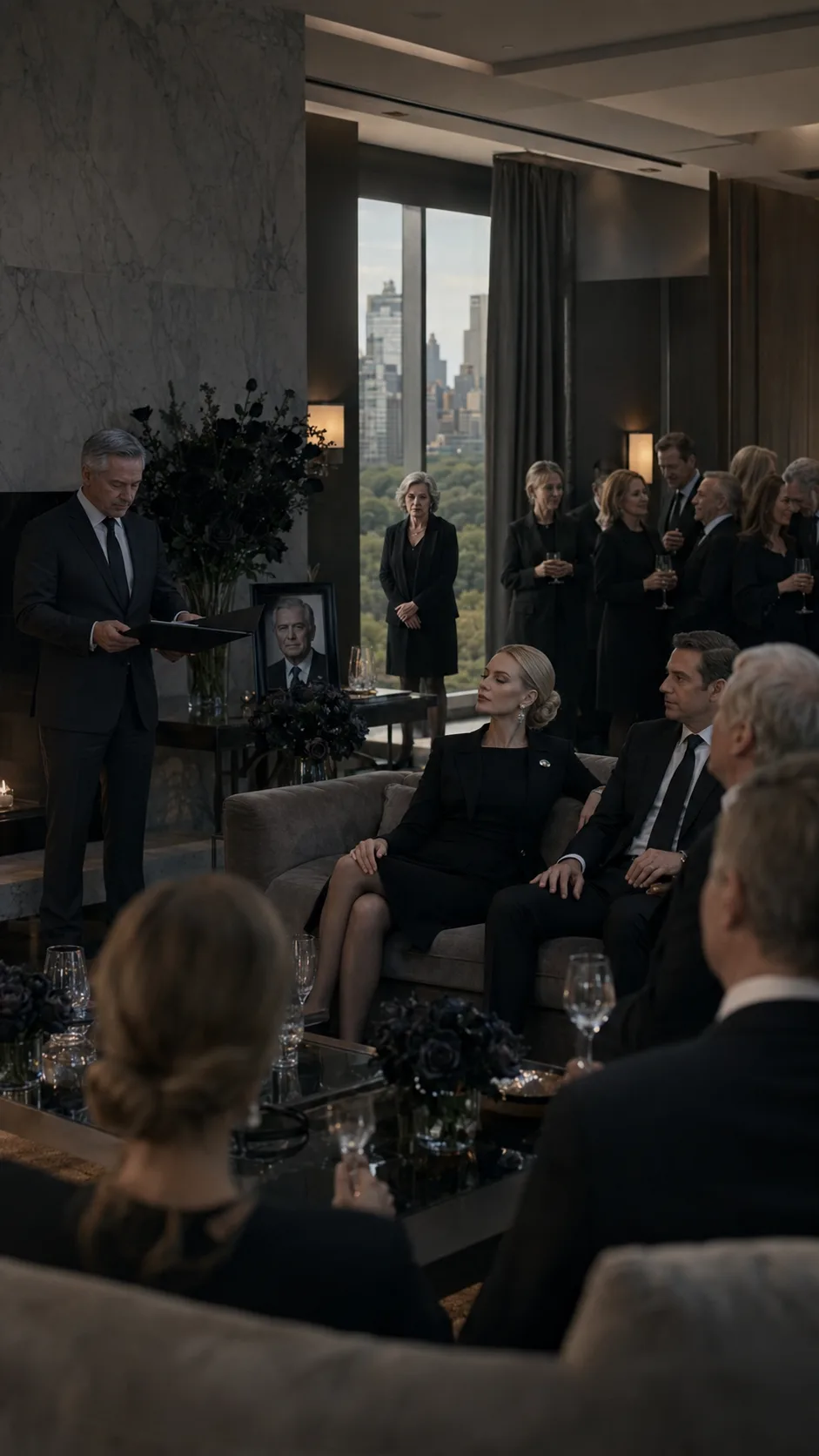
Part 2 — The Man Who Had Been Waiting In France
As the gathering returned to its inappropriate festivities, I slipped out unnoticed.
Chapter 2
Part 2 — The Man Who Had Been Waiting In France
As the gathering returned to its inappropriate festivities, I slipped out unnoticed.
The envelope clutched in my hand like the last tenuous connection to my son.
In the elevator down to the lobby, I finally allowed the tears to fall—silent sobs that shook my body as I leaned against the mirrored wall.
Why, Richard?
Why would you do this to me?
What possible reason could you have for sending me to France and giving everything to a woman who never truly loved you?
Back in my modest Upper West Side apartment, the same one I’d lived in since Richard was a child, I sat at my kitchen table staring at the plane ticket.
San Michelle de Moren meant nothing to me.
I’d been to France once, decades ago as a college student, but never to this place.
Richard and I had never discussed it.
He’d never shown any interest in that region, yet he’d gone to the trouble of changing his will
specifically to send me there, making it clear that I had to go or forfeit some mysterious future considerations.
My sensible side said to ignore it, to contact another lawyer, to contest the will, to fight for what should rightfully have been mine.
But something deeper, some instinct I couldn’t name, told me to trust my son one last time.
The next morning, I packed a single suitcase, called a car service, and headed to JFK airport.
Whatever Richard had planned, whatever awaited me in San Michelle de Moren, I would face it.
I owed him that much.
As the plane lifted off American soil, I gazed out at the receding coastline, feeling as if I were leaving behind not just my home, but the shattered remnants of the life I had known.
Ahead lay only questions, an envelope’s mystery, and a tiny French village I’d never heard of until
yesterday.
“I’m coming, Richard,” I whispered to the clouds.
“Whatever you want me to know, I’m coming to find it.”
The journey to San Michelle de Moren was long and disorienting.
After landing in Lyon, I navigated the French railway system with my rusty college French, eventually boarding a regional train that wound its way into the Alps.
Outside the window, the landscape transformed from rolling countryside to dramatic mountains that seemed to touch the sky itself.
Tiny villages clung to hillsides—church spires and ancient stone buildings standing sentinel over valleys that grew narrower as we climbed higher.
What was I doing here?
The question repeated itself with each passing mile.
What could possibly await me in this remote corner of France that would explain Richard’s bizarre final bequest?
By the time the train pulled into the small station at San Michelle, my body ached with exhaustion and grief.
The
platform was nearly empty in the late afternoon light—a few locals, a family with hiking gear, and me, a sixty-two-year-old American widow clutching a crumpled envelope and dragging a suitcase that suddenly seemed far too heavy.
As the other passengers dispersed, I stood uncertainly, wondering what I was supposed to do next.
Richard’s ticket had brought me here, but there were no further instructions, no clue about where to go or whom to meet.
Then I saw him.
An elderly man in a crisp black suit and driver’s cap, holding a sign with my name written in elegant script.
Relief washed over me as I approached him.
“I’m Eleanor Thompson.”
The driver, his face weathered by time but his blue eyes remarkably bright, studied me for a long moment.
Then, in accented English, he said five words that stopped my heart.
“Pierre has been waiting forever.”
Pierre.
The name hit me like a physical blow, sending me staggering back a step.
The driver reached out to steady me, concern crossing his features.
“Madame, are you unwell?”
“Pierre,” I whispered, scarcely able to form the word.
“Pierre Bowmont?”
The driver nodded, his expression softening.
“Yes, Madame. Mr. Bowmont.”
“He sends his apologies for not meeting you himself, but he thought perhaps it would be too much after your long journey and recent loss.”
Pierre Bowmont was alive.
Pierre Bowmont was here.
Pierre Bowmont—the name I had buried so deeply in my heart that I had never spoken it aloud in forty years.
The man I had loved with the fierce passion of youth.
The man I had believed dead after that terrible night in Paris.
The man who, if my suspicions were suddenly horrifyingly correct, was Richard’s true father.
“How?”
I managed, my throat constricting around the word.
“How did Richard find him?”
The driver’s eyes widened slightly.
“Ah. I think perhaps Mr. Bowmont should explain—if you’ll allow me.”
He gestured toward a sleek black Mercedes parked nearby.
Numbly, I followed him, allowing him to take my suitcase and open the car door.
As I sank into the leather seat, my mind raced through calculations I had avoided for decades.
Richard had been born seven months after my hasty marriage to Thomas Thompson.
Everyone had assumed he was premature, a common enough occurrence.
Only I knew the truth—that he had been conceived in a tiny Paris apartment with blue shutters and a view of the Seine, with a French architecture student who had promised me the world.
The driver, who introduced himself simply as Marcel, seemed to sense my need for silence as we left the small town behind, winding up a mountain road bordered by pine forests and breathtaking vistas.
Under different circumstances, I might have been captivated by the beauty surrounding us.
Now, I barely saw it through the fog of memory and fear.
“We are nearly there, Madame,” Marcel said eventually, as we turned onto a private road marked only by an elegant wrought-iron gate.
“Chateau Bowmont has been in the family for twelve generations, though Pierre has modernized it considerably.”
Chateau Bowmont.
The name stirred something in my memory—a midnight conversation, limbs entangled in cheap cotton sheets.
Pierre’s voice, passionate as he described the ancestral home he would someday restore to its former glory.
I had laughed then, charmed by what I thought was youthful fantasy.
Apparently, it had not been fantasy at all.
As we rounded the final bend, the chateau came into view, and I gasped despite myself.
Built of golden stone that glowed in the late afternoon sunlight, it was a perfect blend of medieval fortress and elegant manor house.
Terrace gardens cascaded down the hillside below it, and beyond them, vineyards stretched into the distance, their neat rows creating patterns across the landscape.
“The vineyards produce some of the finest wines in the region,” Marcel commented, pride evident in his voice.
“Monsieur Bowmont is considered one of France’s premier vintners now.”
Of course he was.
Pierre had always been brilliant, driven, passionate about everything he touched.
While I had retreated into a safe, small life in New York, he had apparently built an empire here in the mountains of his homeland.
The car stopped in a circular drive before the chateau’s massive oak doors.
Before Marcel could come around to open my door, one of the doors swung open, and a tall figure emerged.
Time slowed, the moment crystallizing with impossible clarity.
Though his hair was now silver instead of midnight black, though lines now mapped his face where once there had been only smooth olive skin, I would have known him anywhere.
Pierre Bowmont, at sixty-four, was still unmistakably the man I had loved at twenty.
He stood utterly still, watching me as I emerged from the car on unsteady legs.
Neither of us spoke.
What could possibly be said after forty-two years of silence?
What words could bridge the chasm of a lifetime lived apart?
Of secrets kept and truths hidden.
“Eleanor.”
He spoke finally, my name in his mouth still carrying the same French inflection that had once made my young heart race.
“Pierre.”
My voice sounded strange to my own ears—thin and breathless.
“You’re alive.”
A shadow crossed his face.
“Yes. Though for many years I believed you might not be.”
Before I could respond to this bewildering statement, a wave of exhaustion and shock overcame me.
The world tilted alarmingly, darkness encroaching at the edges of my vision.
The last thing I remembered was Pierre rushing forward—his arms still strong despite the years—catching me before I could fall.
When I woke, I was lying on a sofa in what appeared to be a study.
Bookshelves lined the walls, a massive desk sat by the window, a fire crackled in a stone hearth.
Despite the mild spring weather, a blanket had been tucked around me, and someone had removed my shoes.
“You’re awake.”
Pierre’s voice came from nearby.
He sat in a leather armchair, watching me with an intensity that made me want to hide and draw closer simultaneously.
“Marcel has gone to prepare a room for you.”
“I thought perhaps we should talk first.”
I sat up slowly, my head swimming with questions.
“Richard,” I began, unable to approach any other topic until I knew.
“Did he? Was he?”
“Your son,” Pierre said gently.
“He came to find me six months ago.”
“He had discovered some medical anomalies during a routine physical that led him to question his paternity.”
“Through one of those DNA ancestry services, and some skilled private investigators, he traced a genetic connection to me.”
“So it’s true,” I whispered, the confirmation of what I had already guessed hitting me with surprising force.
“Richard was your son.”
Pierre nodded, his eyes never leaving mine.
“Biologically, yes. But in every way that truly matters…”
He hesitated.
“He was raised by you, and he—”
“Your husband Thomas died five years ago,” I said automatically.
“He never knew. I never told him that Richard wasn’t his.”
“Richard explained that.”
Pierre rose, moving to a sideboard where he poured two glasses of amber liquid.
“He said Thomas Thompson was a good father to him.”
“He was,” I confirmed, accepting the glass Pierre offered.
The cognac burned pleasantly as I took a small sip.
“He loved Richard as his own.”
“We married quickly after I returned from Paris, and Richard was born seven months later.”
“Everyone assumed he was premature, but you knew.”
There was no accusation in Pierre’s tone, only a deep sadness.
“You knew he was mine, yet you never tried to find me.”
The unfairness of this struck me like a slap.
“Find you?”
“I thought you were dead, Pierre.”
“After the accident, your roommate told me you died in the hospital.”
“I was twenty years old, pregnant, alone in a foreign country.”
“What was I supposed to do?”
Pierre went very still.
“What accident, Eleanor?”
The genuine confusion in his voice sent a chill through me.
“The motorcycle accident.”
“Two days before I left Paris, you were supposed to meet me at the café near the Sorbonne, but you never showed.”
“I went to your apartment and your roommate—Jean—told me you’d been in a terrible crash, that you died from your injuries.”
“There was no accident,” Pierre said slowly, his expression darkening.
“I was at the café at the exact time we had arranged.”
“You never came.”
“I waited for hours.”
“When I went to your pension, they said you had checked out that morning—left for America without a word.”
We stared at each other across forty years of misunderstanding, the truth dawning with horrible clarity.
“Jean-Luc,” Pierre spoke the name like a curse.
“He was in love with you, though you never noticed.”
“When I went to Marseille to visit my dying grandmother that weekend, he must have…”
He shook his head as if still unable to believe such betrayal possible.
“He told you I was dead and told you I had abandoned you,” I finished, the pieces falling into place.
“But why would he?”
“To punish us both, I imagine,” Pierre said grimly.
“He wanted you, but you chose me.”
“Rather than accept that, he made sure neither of us could have the other.”
The enormity of it was almost too much to comprehend.
A jealous young man’s lie had altered the course of three lives—mine, Pierre’s, and most tragically Richard’s—who had grown up never knowing his true father.
“All these years,” I whispered, tears filling my eyes.
“All these years lost because of a lie.”
Pierre moved to sit beside me on the sofa, close but not touching.
“When Richard found me, I didn’t believe him at first. It seemed impossible.”
“But then he showed me your picture, and it was like seeing a ghost.”
“You looked so much like the Eleanor I remembered—just elegantly matured.”
He smiled faintly.
“And Richard…”
“He had my mother’s eyes, my father’s chin.”
“Once I saw him, I knew he was telling the truth.”
“Why didn’t he tell me he’d found you?” I asked, the hurt fresh amid so many other emotions.
“Why keep it secret?”
Pierre’s expression grew troubled.
“He wanted to, initially.”
“But then he discovered something that changed his plans.”
“Something about his wife.”
“Amanda,” I said, the name tasting bitter on my tongue.
“Yes.”
“He hired investigators to confirm his parentage, but they uncovered something else entirely.”
“Evidence that Amanda was having an affair with his business partner, Julian.”
“Worse, they found financial irregularities suggesting the two were embezzling from Thompson Technologies, planning to eventually force Richard out of his own company.”
Julian—the man who had sat beside Amanda at the will reading, his hand on her knee in that proprietary way.
The pieces were beginning to align into a pattern I didn’t want to recognize.
“Richard’s death,” I said, my voice hollow.
“The boating accident.”
“You don’t believe it was an accident at all, do you?”
Pierre’s silence was answer enough.
Pierre’s silence confirmed my worst fears, crashing over me in waves of horror.
“The police said he fell overboard,” I managed, my voice barely above a whisper.
“That he’d been drinking.”
“Richard never drank when sailing,” Pierre said, echoing my own thoughts from the funeral.
“Never.”
“He was meticulous about safety on the water.”
“It was one of the first things he told me about himself.”
My hands began to tremble so violently that Pierre gently took the cognac glass from me before it could spill.
“Are you suggesting that Amanda… that she might have?”
“I don’t know,” Pierre admitted, his face grave.
“But Richard was afraid.”
“The last time I spoke with him—three days before his death—he told me he was gathering evidence against Amanda and Julian.”
“That he had discovered transfers of company funds to offshore accounts.”
“That he planned to confront them once he had everything documented.”
“And then he died.”
The words hung in the air between us, heavy with implication.
“And then he died,” Pierre confirmed.
“Out on the water alone—which Richard told me he never did.”
“He always took a crew member or a friend for safety.”
I pressed my hands to my face, trying to hold myself together as this new reality threatened to shatter me completely.
My son—my brilliant, kind-hearted son—might have been killed by his own wife for money.
The same wife who now controlled his entire fortune.
The same wife who had mocked me at his funeral.
The same wife who had already been openly flaunting her relationship with Julian mere hours after we put Richard in the ground.
“Why didn’t he go to the police?” I asked, dropping my hands to look at Pierre.
“If he had evidence of embezzlement—”
“He wanted irrefutable proof first,” Pierre said.
“And…”
Pierre hesitated.
“He was embarrassed, I think.”
“Ashamed that he had been so thoroughly deceived by a woman he thought loved him.”
That at least made painful sense.
Richard had always been private about his emotions, reluctant to show vulnerability.
It was a trait he had inherited from his father—his real father—sitting before me now with the same guarded expression I had seen so often on my son’s face.
“The ticket,” I said suddenly, remembering the envelope that had brought me here.
“Richard’s will.”
“He planned this, didn’t he?”
“He knew something might happen to him.”
Pierre nodded, rising to retrieve a folder from his desk.
“Richard came to me four months ago, shortly after discovering Amanda’s betrayal.”
“He revised his will, leaving everything visible to her—the penthouse, the yacht, the shares everyone knew about.”
He opened the folder, removing several documents.
“But he had been more careful with his money than anyone realized.”
“The majority of his actual wealth was hidden in investments, properties, and accounts that Amanda and Julian knew nothing about.”
He handed me the papers, which I recognized immediately as legal documents.
As I scanned them, my breath caught.
They detailed a second will, properly executed and notarized, that contradicted everything that had been read at the penthouse.
This will left the bulk of Richard’s fortune—an amount that dwarfed even the considerable assets Amanda had inherited—to a trust jointly administered by me and Pierre.
“He created a trap,” I whispered, understanding dawning as I read further.
“He let them think they had everything while actually securing his true legacy beyond their reach.”
“Richard was brilliant, Eleanor,” Pierre said softly.
“He knew that if Amanda suspected there was more, she would never stop searching for it.”
“So he created a spectacle.”
“The public will reading.”
“My apparent disinheritance.”
“The mysterious ticket that everyone witnessed me receive.”
“To throw her off the scent,” I said, the pieces falling into place.
“To make her believe she had won, while actually setting in motion his real plan.”
Pierre’s expression softened with pride and grief.
“The plane ticket was the key.”
“If you used it—if you came to me—it would activate the second will.”
“If you had refused, everything would indeed have gone to Amanda.”
I thought back to Palmer’s cryptic words about future considerations that would be nullified if I declined to use the ticket.
It had been a test of sorts.
Would I trust Richard one last time, even when it seemed he had betrayed me?
“But why the secrecy?” I asked.
“Why not just tell me about you, about the second will?”
“Richard said you were a terrible liar,” Pierre said, a small smile playing at the corners of his mouth.
“He feared if you knew the truth, Amanda might see it in your eyes—might realize something was amiss.”
“He wanted her to believe absolutely in her victory.”
The thought of my son planning all this—protecting me even as he faced unimaginable betrayal, ensuring his true legacy would remain secure—brought fresh tears to my eyes.
“There’s more,” Pierre said gently, drawing another document from the folder.
“Richard left this for you.”
“He asked that I give it to you once you arrived.”
With trembling fingers, I accepted the sealed envelope, recognizing Richard’s handwriting immediately.
Breaking the seal, I unfolded several pages covered in my son’s distinctive script.
“My dearest Mom,”
“if you’re reading this, then two things have happened.”
“I am gone, and you have trusted me one last time by following my unusual final request.”
“I’m sorry for the public charade at the will reading.”
“I needed Amanda to believe she had won completely.”
“I needed her confidence and arrogance to blossom fully, without suspicion that anything lay beyond her grasp.”
“I found Pierre, my real father, through one of those DNA testing services you always refuse to try.”
“I know who my people are, Richard. I don’t need a corporation to tell me.”
“Turns out you were right to be wary, because what I discovered led me down a path I never could have anticipated.”
“At first, I was angry that you had kept the truth from me.”
“That anger led me to seek out Pierre without telling you.”
“But when I found him—when I saw in his face the same features I see in the mirror each day—that anger dissolved into understanding.”
“He told me about Paris, about your whirlwind romance, about the cruel deception that separated you.”
“Neither of you was to blame.”
“I was planning to bring you together, to heal this decades-old wound.”
“But then I discovered what Amanda and Julian were doing.”
“The company funds they were siphoning.”
“The plans they were making to force me out.”
“And suddenly, I needed to be more careful.”
“I needed to protect what I had built—not just for myself, but for you, for Pierre, for the legacy that should have been ours all along.”
“If I die before I can resolve this situation legally, then you must assume the worst.”
“Trust no one except Pierre and Marcel.”
“They know what to do next.”
“The evidence against Amanda and Julian is stored in the blue lacquer box you gave me for my sixteenth birthday.”
“I’ve hidden it where only you would think to look.”
“Remember our treasure hunts when I was small?”
“The place where X always marked the spot.”
“I love you, Mom.”
“I’m sorry for any pain this causes you.”
“But know that in finding Pierre, I found a piece of myself I never knew was missing.”
“I hope that in time you might find the same healing I did.”
“All my love,”
“Richard.”
I lowered the letter.
My vision blurred with tears.
“He knew,” I whispered.
“He knew something might happen to him.”
Pierre reached out hesitantly and took my hand in his.
His skin was warm, the touch achingly familiar, despite the decades between our last contact and now.
“Richard was trying to protect everyone he loved,” he said softly.
“He spoke of you with such admiration, Eleanor, such love.”
“He wanted us to have a chance to know each other again.”
“Not to rekindle what was lost necessarily, but to heal the wounds caused by that long-ago lie.”
I looked at our joined hands, then up at Pierre’s face.
In his features, I could see shadows of Richard—the shape of his eyes, the angle of his jaw, the way his brow furrowed in concentration.
My son had found his father, had known him for only six brief months, and had still managed to forge a bond strong enough to entrust him with this elaborate plan.
“The blue lacquer box,” I said, wiping my tears with my free hand.
“I know exactly where he would have hidden it.”
“Where?” Pierre asked.
“X marks the spot,” I replied.
A faint smile formed despite my grief.
“The garden bench at the Cape Cod house—under the X-shaped trellis where I taught him to identify constellations.”
“It was our special place, our spot where all treasure hunts ended when he was a child.”
Pierre’s expression sharpened.
“We need to get to that box before Amanda does.”
“If it contains the evidence Richard gathered against her…”
“She already has the Cape house,” I realized with a sinking feeling.
“It was part of what she inherited.”
“She could find it at any time if she starts going through Richard’s things.”
“Then we must move quickly,” Pierre said, rising and pulling me gently to my feet.
“Marcel can have the jet ready within the hour.”
“The jet?”
I repeated, momentarily disoriented.
“Richard’s other jet,” Pierre explained with a small smile.
“The one Amanda doesn’t know about.”
“One of many assets he kept hidden from her.”
“Including, I might add, a significant ownership stake in this vineyard—which now belongs to you and me.”
The revelation struck me anew—the depth of Richard’s planning, the extent of his true wealth, the careful way he had arranged for justice, even from beyond the grave.
“We’re going back to America?” I asked, still trying to process everything.
“We’re going to get that evidence,” Pierre confirmed, his expression hardening with determination.
“And then, Eleanor, we are going to make sure that the people responsible for our son’s death face the consequences of their actions.”
Our son.
The words sent a shiver through me—grief and recognition and something like possibility, all tangled together.
Whatever came next, I would not face it alone.
The same cruel lie that had separated us decades ago had inadvertently brought us back together through the actions of the son neither of us had properly known.
As we stepped out of the study, the last rays of sunset illuminated the chateau in golden light, casting our shadows long across the ancient stone floor.
Ahead lay uncertainty—danger, perhaps—and the painful task of pursuing justice for Richard.
But in that moment, with Pierre’s hand still holding mine, I felt something I had not expected to find in this remote corner of France.
Purpose.
And perhaps someday, peace.
The Bowmont private jet was nothing like any aircraft I’d ever flown in before.
All buttery leather and gleaming wood, with just eight luxurious seats and a small but elegant sleeping cabin at the rear.
As we settled in for takeoff, I found myself marveling at this strange new reality where my son had secretly owned such extravagances, where Pierre Bowmont had become one of France’s wealthiest vintners, and where I—plain Eleanor Thompson, high school English teacher turned widow—was suddenly thrust into a world of private jets and international intrigue.
“The flight to Boston will take about seven hours,” Pierre explained as Marcel—now revealed as not just a driver, but Pierre’s trusted right-hand man for over thirty years—prepared for departure.
“We should arrive early morning, local time.”
“And then?” I asked, still struggling to grasp our hastily assembled plan.
“Then we drive to Cape Cod as quickly as possible.”
Pierre’s expression was grim.
“Hopefully, Amanda is still in New York—too busy enjoying her newfound wealth to visit the summer house yet.”
I nodded, my thoughts racing ahead.
“The box is hidden in a compartment beneath the garden bench.”
“Richard and I built it together when he was twelve—a secret place for his treasures.”
“No one else knows about it.”
“Let’s hope it stays that way for a few more hours,” Pierre murmured as the jet began to taxi.
As we ascended into the darkening sky, I found myself studying Pierre’s profile, noting the changes time had wrought on the young man I had once loved so passionately.
The years had been kind to him—silver threading through his once-black hair, lines etched at the corners of his eyes and mouth that spoke of laughter as much as age.
He was still handsome in that distinctly French way that had captivated me as a twenty-year-old American abroad.
“You’re staring,” he observed without turning, a hint of amusement in his voice.
“I’m sorry,” I said, embarrassed to be caught.
“It’s just… surreal. All of it.”
Now he did turn, his dark eyes meeting mine.
“Indeed.”
“If someone had told me yesterday that I would be flying to America with Eleanor McKenzie…”
“Thompson,” I corrected automatically.
“Of course.”
A shadow passed over his face.
“Thompson.”
Richard’s father—the man who raised him.
The awkwardness of that reality settled between us.
Thomas had been a good man, a kind husband, a loving father to Richard.
He had known from the beginning that the child wasn’t biologically his, but had never once thrown that fact in my face, even during our worst arguments.
He had simply loved Richard as his own—proud of every accomplishment, supportive through every struggle.
“Thomas was a high school science teacher,” I said, feeling a sudden need to acknowledge the man who had been my partner for over thirty years.
“He loved Richard completely.”
“Never once made him feel anything less than wholly wanted.”
“Wholly loved.”
Pierre nodded, his expression softening.
“Richard spoke highly of him.”
“Said he was patient, encouraging—that he never pushed too hard, but always believed Richard could achieve whatever he set his mind to.”
“That was Thomas,” I agreed, my throat tight with unexpected emotion.
“He was a good man.”
“And you?” Pierre asked quietly.
“Were you happy with him, Eleanor?”
The question caught me off guard with its directness.
“I…”
“We had a good marriage,” I said carefully.
“Comfortable. Kind.”
“We were partners. Friends.”
I hesitated, then decided that after forty years, I owed him honesty.
“We were not what you and I were to each other.”
“But few people ever experience that kind of passion, and passion doesn’t always build a stable life.”
“No,” Pierre agreed, a hint of sadness in his smile.
“It does not.”
“Though I would have tried, had I known you were carrying my child.”
The weight of what might have been hung between us—a life together, raising Richard as a family, perhaps other children, a different path entirely from the ones we had walked separately.
“And you?” I asked, turning the question back to him.
“Did you ever marry?”
“No,” Pierre looked out at the darkening clouds below us.
“There were relationships, of course—some lasting several years.”
“But marriage… it never felt right.”
He paused, then added so quietly I almost didn’t hear.
“They were never you.”
Before I could respond to this startling admission, Marcel appeared from the cockpit.
“We have a secure call from Mr. Palmer,” he announced, handing Pierre a satellite phone.
“He says it’s urgent.”
Pierre took the phone, switching to speaker so I could hear.
“Jeffrey. We’re on a secure line. Eleanor is with me.”
“Thank God,” Palmer’s voice came through clearly despite the distance.
“You need to accelerate your plans.”
“Amanda and Julian were at the office today attempting to access Richard’s private server.”
“When they couldn’t, they became agitated.”
“I overheard them mention the Cape house, saying they needed to check the obvious places first.”
My blood ran cold.
“They’re looking for something.”
“They suspect Richard had evidence against them.”
“It appears so,” Palmer confirmed.
“And they’ve already left for Cape Cod.”
“They took the helicopter about three hours ago.”
Pierre and I exchanged alarmed looks.
“We’re still at least six hours from Boston,” he said, calculating rapidly.
“Plus another two hours to the Cape, even driving at top speed.”
“They’ll beat us there,” I realized, despair washing through me.
“They’ll find the box.”
“Maybe not,” Pierre said, his mind clearly racing.
“Jeffrey, can you send someone to the house? Create a delay of some kind.”
“I’ve already dispatched the caretaker with instructions to report a water leak,” Palmer said.
“Shut off the main supply.”
“It should buy you a few hours while plumbers are called, but not much more than that.”
“It will have to do,” Pierre decided.
“We’ll call when we land.”
After ending the call, Pierre instructed Marcel to request permission to increase our speed—fuel considerations be damned.
Then he turned back to me, determination etched in his features.
“We’ll make it, Eleanor.”
“I promise you.”
I wished I could share his confidence, but dread had settled in my stomach like a stone.
If Amanda and Julian found Richard’s evidence before we could reach it, not only would justice for our son be compromised, but Pierre and I might find ourselves in danger as well.
People willing to kill for millions would certainly not hesitate to eliminate two more obstacles.
“What if…”
I began, then faltered, the thought too terrible to voice.
“What if they find it first?”
“Then we move to contingency plans,” Pierre finished for me, reading my fear.
“Richard was thorough, Eleanor.”
“He wouldn’t have placed all his evidence in one location.”
“How can you be so sure?” I asked.
“You only knew him for six months.”
Pierre’s expression softened.
“Because he was my son.”
“And apparently he inherited my tendency to prepare for all possibilities.”
He reached across the aisle, separating our seats, and took my hand.
“And because he was your son—which means he was both brilliant and meticulous.”
The simple confidence in his words steadied me.
He was right.
Richard had never been careless.
Even as a child.
If he had gone to the trouble of creating a second secret will, of bringing Pierre and me together, of arranging this elaborate posthumous plan, then he would have safeguarded the evidence in multiple ways.
“I wish I’d known,” I said suddenly, the regret overwhelming me.
“About you being alive. About Richard finding you.”
“I wish I could have seen you together even once.”
Pierre’s fingers tightened around mine.
“He recorded our first meeting,” he said quietly.
“Set up his phone on the table between us, said he wanted to document the moment.”
“I have it saved.”
“When this is over—when Richard has justice—I’ll show you.”
The thought of seeing that moment—my son meeting his biological father for the first time—brought fresh tears to my eyes.
What had Richard felt, coming face to face with the man whose features he bore?
What had Pierre experienced, suddenly confronted with the adult son he never knew existed?
So much lost time.
So many stolen moments.
And at the center of it all, the cruel lie told by a jealous young man four decades ago that had altered the course of all our lives.
“We should rest,” Pierre suggested gently.
“The confrontation ahead may require all our strength.”
He was right, though I doubted sleep would come easily with my mind racing.
Still, I reclined my seat and closed my eyes, Richard’s letter tucked securely in my pocket.
Whatever awaited us at the Cape house, I would face it—for my son, for the truth, for the justice he had carefully planned but not lived to see executed.
And perhaps, I admitted to myself, as exhaustion finally pulled me toward unconsciousness, for the chance to discover what might still exist between me and the man who had been my first love—the man who was now my unexpected ally.
Boston greeted us with a dreary dawn—low clouds, persistent drizzle, and a chill that seeped through my jacket as we descended the stairs from Pierre’s jet.
A sleek black SUV waited on the tarmac, the driver holding an umbrella and wearing a grim expression.
“Mr. Bowmont,” he nodded as we approached.
“Mrs. Thompson. We need to hurry.”
Inside the vehicle, the driver, who introduced himself only as Roberts, brought us up to speed as we navigated the early morning traffic out of the city.
“Mr. Palmer called again thirty minutes ago.”
“The plumbing diversion bought you some time, but Amanda and Julian arrived at the Cape house four hours ago.”
“They dismissed the caretaker once the water issue was resolved.”
“Have they found anything?” Pierre asked sharply.
Roberts shook his head.
“Unknown.”
“The security system Richard installed allows us to monitor the property’s perimeter, but not the interior.”
“We know they’re still there, but not what they’re doing.”
I closed my eyes briefly, picturing the Cape Cod house where Richard and I had spent so many summers.
It was smaller than the Manhattan penthouse—more modest in its luxury—but infinitely more personal.
Richard had loved that house: the weathered cedar shingles, the wide deck overlooking the water, the garden where we had spent countless hours together.
“They’ll search the house first,” I said with certainty.
“Richard’s office. His bedroom.”
“They won’t think to check the garden until they’ve exhausted the obvious places.”
“Then we may still have time,” Pierre observed, checking his watch.
“How much longer until we arrive?”
“About ninety minutes in this traffic,” Roberts replied, maneuvering skillfully through the congested highway.
“Less if it clears.”
Pierre nodded, then turned to me.
“We should prepare for all possibilities, Eleanor.”
“If Amanda and Julian are there when we arrive, what is our approach?”
I hadn’t considered this.
In my mind, we would somehow slip in unnoticed, retrieve the box, and escape with the evidence.
The reality of potentially confronting my daughter-in-law and her lover—my son’s possible killers—sent a shiver down my spine.
“I don’t know,” I admitted.
“I’m not…”
“I’m a retired English teacher, Pierre.”
“I don’t know how to confront killers.”
His hand covered mine briefly.
“You are much more than that.”
“You are Richard’s mother.”
“You are stronger than you know.”
He turned to Roberts.
“We need a distraction if they’re still present.”
“Something to draw them away from the property temporarily.”
Roberts nodded.
“Already arranged.”
“A delivery of mistakenly addressed furniture is scheduled to arrive at the neighboring house at precisely noon.”
“They’ll make enough of a commotion about the confusion that anyone nearby will be drawn to investigate.”
I marveled at the efficiency of this operation.
The private jet.
The waiting car.
The planned distraction.
Had Richard arranged all this, anticipating every contingency, or was this Pierre’s doing—evidence of the resources at his disposal?
As we drove, the cityscape gradually gave way to smaller towns, then to the coastal landscape of Cape Cod.
Familiar landmarks appeared: the ice cream shop where Richard had spent his allowance every Saturday, the bookstore where I had bought him his first astronomy guide, the marina where he had learned to sail.
Richard was everywhere here, his presence lingering in my memories of summers past.
And now he was gone.
His life cut short by betrayal.
I still struggled to fully comprehend.
“Eleanor.”
Pierre’s voice drew me from my thoughts.
“Before we arrive, there’s something you should know.”
His expression was troubled.
“Marcel received a call from our contacts in France while you were sleeping on the plane.”
“They’ve been monitoring Amanda’s financial transactions, as Richard requested.”
“And large sums have been moving from Richard’s accounts—the ones Amanda now controls—to offshore destinations.”
“But more concerning is this.”
He handed me a tablet displaying what appeared to be a property listing.
“She’s put the Manhattan penthouse on the market.”
“The Cape house as well.”
“She’s liquidating everything as quickly as possible.”
“She’s planning to run,” I realized.
“Once she has everything converted to cash, she and Julian could disappear.”
Pierre nodded.
“Which suggests they are indeed guilty of what Richard suspected.”
My grief crystallized into something harder.
More focused.
This woman had not only potentially killed my son, but was now erasing every trace of his life, converting his legacy into untraceable funds.
The thought was unbearable.
“We need to stop her,” I said, my voice steadier than I expected.
“Not just for justice, but for Richard.”
Pierre nodded, something like approval flickering in his eyes.
“Yes.”
“For Richard.”
As we approached the turnoff to the private road leading to the summer house, Roberts slowed the SUV, pulling onto a concealed side path.
“Their vehicle is still on the property,” he reported, checking a small device.
“We’ll wait here until the distraction arrives, then proceed on foot through the back path.”
The back path was a narrow trail through the dunes that led directly to the garden.
A route Richard and I had often taken for our early morning walks to the beach.
That it would now serve as our covert approach to retrieve evidence against my son’s killers felt like a terrible perversion of those innocent memories.
At precisely noon, Roberts received a notification on his phone.
“The delivery is arriving now.”
“Get ready.”
From our position, we could just see the neighboring property where a large truck had pulled up.
Men in uniform began unloading a substantial amount of furniture, arguing loudly with the confused homeowner.
As predicted, the commotion soon drew attention from our target house.
Through binoculars, Roberts confirmed that both Amanda and Julian had emerged onto the deck to watch the spectacle unfolding next door.
“Now,” he said simply.
Pierre and I slipped from the SUV, following Roberts down the familiar sandy path that wound through beach grass and scraggly pines.
The rain had tapered to a fine mist, but the ground was still damp—our footsteps thankfully silent on the soft terrain.
When the house came into view, my heart clenched at the sight of it.
So unchanged outwardly, yet now the scene of a frantic search for evidence by the very people who had betrayed Richard.
We crouched behind a dune, watching as Amanda and Julian stood on the deck, pointing and conversing about the noisy delivery next door.
“They’ll be distracted for ten minutes at most,” Roberts warned.
“We need to move quickly.”
I led the way around the perimeter of the property to the garden at the far side—a secluded space enclosed by tall hedges that blocked the view from both the house and neighboring properties.
In the center stood the wrought-iron bench beneath an X-shaped trellis covered in climbing roses.
Our special place, where Richard and I had spent countless evenings stargazing.
“There,” I whispered, pointing to the bench.
“The compartment is built into the concrete base.”
“You have to press the third rose detail from the left to release the mechanism.”
Pierre nodded, and we crept forward, constantly glancing toward the house.
The garden was mercifully empty, though signs of recent disturbance—trampled flowers, a displaced garden gnome—suggested Amanda and Julian had already begun searching here.
Kneeling beside the bench, I located the decorative iron rose on the base.
An embellishment that looked purely ornamental, but was actually an intricate latch.
I pressed it firmly, hearing the satisfying click as the hidden compartment released.
A small drawer slid outward from the concrete, revealing the blue lacquer box.
Exactly where Richard had promised it would be.
“You found it,” Pierre breathed, relief evident in his voice.
“They haven’t discovered the hiding place,” I confirmed, carefully lifting the box.
It was heavier than I remembered—about the size of a thick novel.
Its surface still pristine despite years in the concealed compartment.
“We need to go,” Roberts urged, his attention fixed on the house.
“They’re coming back inside.”
Clutching the box to my chest, I rose to my feet—only to freeze at the unmistakable sound of the garden gate latch opening behind us.
“Well.”
Amanda’s cold voice sliced through the misty air.
“Look who decided to join us after all.”
I turned slowly, the blue lacquer box still clutched against my chest.
Amanda stood at the garden gate, Julian just behind her.
The designer funeral outfit was gone, replaced by casual luxury: a cashmere sweater, tailored jeans, boots that probably cost more than my monthly pension.
Her blonde hair was pulled back in a sleek ponytail, her expression one of amused surprise.
“Eleanor,” she drawled, stepping fully into the garden.
“What a delightful surprise.”
“And you’ve brought friends.”
Her eyes flicked to Pierre, then to Roberts, narrowing slightly.
“Breaking and entering is a serious crime, you know.”
“Especially when the property belongs to me.”
“This house belonged to Richard,” I said, my voice steadier than I felt.
“A place he loved.”
“A place where he was happy.”
“And now it belongs to me,” Amanda replied with a tight smile.
“Along with everything else Richard owned.”
“Funny how inheritance works, isn’t it?”
Julian moved to stand beside her, his hand resting casually in the pocket of his expensive jacket—a posture that somehow seemed more threatening than casual.
He was taller than I remembered from the funeral, his features handsome in a predatory way that made my skin crawl.
“What’s in the box, Eleanor?” he asked, his voice deceptively gentle.
“Something valuable, I assume, given your clandestine little expedition to retrieve it.”
Pierre shifted subtly, positioning himself between me and the couple.
“Mrs. Thompson was retrieving personal items left to her by her son,” he said, his accent more pronounced under stress.
“Items specifically excluded from the main estate.”
Amanda laughed, the sound like breaking glass.
“And who exactly are you?”
“Eleanor’s gentleman friend?”
“I didn’t realize nursing homes allowed day trips for dating purposes.”
“My name is Pierre Bowmont,” he replied with dignity.
“I am Richard’s father.”
The statement landed like a physical blow.
Amanda’s carefully cultivated expression of mocking superiority faltered—genuine shock replacing it momentarily.
“That’s impossible,” she snapped, recovering quickly.
“Richard’s father died years ago.”
“Thomas something-or-other.”
“Thomas Thompson was the man who raised me.”
A new voice spoke from behind them, causing Amanda and Julian to spin around.
“But he wasn’t my biological father.”
To be continued… Click “PART 3” to read the final part: 👉 PART 3 👈
Chapter complete
You have reached the end of this chapter.
Continue reading
A few more worlds to get lost in after this chapter.




