PART 2 — How I Became Invisible in My Own Home
There are days when I can still smell the brewed coffee that I used to make every morning in that house.
Chapter 2
PART 2 — How I Became Invisible in My Own Home
There are days when I can still smell the brewed coffee that I used to make every morning in that house.
It was my sacred ritual. I would get up at six in the morning, when the sun was just beginning to peek through the kitchen curtains, and put the coffee maker on the stove. Cinnamon, brown sugar, and those coffee beans I bought at Mr. Johnson’s market. The aroma would fill the whole house, and it was as if it woke up not only the family, but also the memories.
My husband, Michael, and I built that house more than forty years ago, brick by brick, dream by dream. When we got married, we had nothing but love and the desire to get ahead. Michael worked at a shoe factory—double shifts, triple shifts. I sewed clothes for the neighbors, embroidered napkins, did whatever was necessary. We saved for ten years to buy the land and another five to put up the walls.
I remember the day we put the last
shingle on the roof. Michael carried me in his arms and crossed the threshold as if it were our second wedding. The children ran all over the house shouting with excitement. Robert was just eight years old and my daughter Lucy was six.
“Mom, is this house really ours? Is no one going to kick us out?” Robert asked me with those big eyes full of hope.
“Yes, my love. This house is ours. And here we are going to be happy forever.”
And we were. For many years, we were.
The house filled with life. The children’s birthdays, the Christmas parties, Sunday afternoons with the whole family gathered in the backyard. Michael installed a brick grill in the garden and every weekend we would barbecue meat while the kids played football. Lucy got married in that backyard. I still keep the photos—her in her white dress, dancing with her
dad under the lights we hung in the trees.
When Michael died twelve years ago, I felt like the house had lost its soul. But my children told me not to worry, that they would always be with me. Robert, my eldest son, was already married to Megan. They had two young children, Sebastian and Valerie. They lived in a small apartment on the other side of the city. And one day, Robert proposed something to me.
“Mom, what if we move in with you? The house is big. There’s room for everyone. That way, you’re not alone, and we can save for the future.”
I accepted without thinking twice. The idea of having my grandchildren running through those same halls where I had raised their parents filled my heart. I thought it would be like before. Laughter, meals together, afternoons with coffee, watching the children grow up.
And at
first, it was like that. Megan helped me in the kitchen. I taught her how to make turkey and dressing the way my mom did, with the exact touch of cream and spices. She taught me how to use the cell phone for video calls because Lucy lived in Dallas, Texas, and that way we could talk more often. On Sundays, I would make barbecue chicken, and after eating, we would all sit in the living room to watch movies. Sebastian would curl up on my lap, and Valerie would ask me to tell her stories from when her dad was a kid.
“Is it true that Grandpa chased him with a flip-flop because he broke the window playing ball?” Valerie would ask, dying of laughter.
“True. And your dad ran so fast that Grandpa got tired. And in the end, they laughed together.”
Those moments made me feel useful. They made me feel loved.
But little by little, without me realizing it, things started to change.
First, it was small details. Megan no longer asked for my opinion on cooking. If I suggested something, she would smile and say:
“Oh, mother-in-law, but that’s not how it’s done anymore.”
And she would do things her own way. Then she started moving my things around—the photos on the bookcase, the decorations in the living room, even the coffee maker where I made my coffee.
“I need space, Elellanena. This house is full of old junk.”
Old junk. That’s what she called the memories of my life.
I tried not to get upset. I kept repeating to myself that daughters-in-law always want to put their touch on the house, that it was normal, that I should be understanding.
Then she stopped telling me when they were going out. I would come home from the market and the house would be empty—without a note, without a message. Once I prepared macaroni and cheese for everyone. I was in the kitchen all day, and no one came home for dinner. I ended up eating alone in front of the television, watching the food get cold on the plates.
When Robert arrived that night, late, I asked him where they had been.
“We went out to eat with Megan’s parents. Mom, it was her mom’s birthday.”
“Son, but you could have let me know. I made macaroni and cheese.”
“Oh, Mom, don’t be like that. You’re always so sensitive.”
Sensitive. That word hurt me more than he ever knew. But I kept quiet because I thought complaining was being bothersome. Because I thought a good mother should understand, give in, adapt. Because I believed that true love was invisible, silent, without demanding anything in return.
I didn’t know that silence would cost me much more than I imagined.
The first time I felt that this house was no longer mine was on a Tuesday afternoon. I had gone to the doctor for a routine checkup. Nothing serious, just the checkups that women my age have. When I returned, I found two men loading my furniture into a truck. My favorite armchair. That blue armchair where Michael read the newspaper every afternoon, where I sat to knit while watching TV shows, where I had rocked my grandchildren when they were babies.
“Wait, what are you doing?” I shouted, dropping my purse at the entrance.
Megan came out of the house with a calm smile, as if nothing strange was happening.
“Oh, Elellanena, good thing you arrived. Look, we needed more space in the living room, so I sold some old furniture. It didn’t match the new decor anymore.”
I was paralyzed.
“You sold my armchair.”
“It was the house’s, wasn’t it?” she said, shrugging. “Besides, it was very worn out. With what I got, I bought that modern bookcase that’s in the corner. Have you seen it? It looks beautiful.”
The men kept loading. I saw them also take the coffee table which Michael had made with his own hands, the lamp we had bought on our fifteenth anniversary, the mirror with the gold frame that had belonged to my mother.
“Megan, those things have sentimental value to me.”
“Oh, mother-in-law, but we can’t live in a museum. We have to renovate, modernize. Besides, you always say that material things aren’t what’s important, right?”
She used my own words against me. I stood there watching pieces of my history being taken away, and I didn’t know what to say, because technically it was everyone’s house, right? They lived there. Robert paid for some utilities, and I was just the mom who was in the way.
That night, I waited for Robert to come home from work. I needed to talk to him. I needed him to understand what had happened.
“Son, I need to talk to you.”
“Tell me, Mom,” he replied as he took off his shoes, exhausted.
“Megan sold my furniture today. Your dad’s armchair, the table he made.”
“Oh, yeah,” he commented. “The living room looks really good, doesn’t it? It looks more spacious.”
“But, Robert, that furniture was important to me. They are memories of your dad.”
My son sighed—that sigh that people use when they feel you are exaggerating.
“Mom, I understand it’s hard for you, but Megan is right. The house needed renovating. We can’t stay stuck in the past. Dad is gone, and life goes on.”
I felt as if he had slapped me.
“Life goes on,” I repeated, my voice trembling. “Is it that easy for you to erase your father’s memories?”
“I’m not erasing anything, but I’m also not going to turn this house into a sanctuary. Megan lives here, too. She has the right to feel comfortable.”
“And I don’t?”
Robert looked at me with weariness.
“Mom, please don’t start. I had a really hard day at work. I don’t want to come home and have to deal with drama.”
Drama. My pain was drama to him.
I went to my room without saying anything else. I sat on the edge of my bed and looked at the photographs I had on my dresser—Michael smiling at our wedding, the little children in the garden, the house when it was still ours. That night I cried in silence, with the door closed so no one would hear me, because I realized something terrible. When we let others decide for us, when we keep quiet for fear of bothering, we begin to disappear. Little by little, without realizing it, we become invisible in our own lives.
The next day, things got worse. Megan changed the lock on the front door without telling me. When I came home from the market, my key no longer worked. I had to ring the doorbell as if I were a visitor.
“I gave the spare key to a neighbor and she never returned it,” Megan explained, handing me a new key. “It’s better to change everything for safety.”
But I knew the truth. It was her way of telling me that the house no longer belonged to me in the same way.
The children also started to change with me. Sebastian no longer sought me out to tell him stories. Valerie looked at me with pity, as if she knew her mom was treating me badly but didn’t dare to say anything.
One afternoon, while I was preparing dinner, I heard Megan talking on the phone with her mom.
“Yes, Mom, I know it’s exhausting. She’s always here, always giving her opinion on everything. I can’t even move a piece of furniture without her getting sentimental. No, Robert doesn’t say anything. He always defends her. But I swear that as soon as we can, we are going to—well, we’ll see.”
She stopped when she saw me standing in the doorway.
“Do you need something, Elellanena?” she asked with a false smile.
“No, nothing.”
I went back to the kitchen with a broken heart. “We are going to” what? Kick me out? Put me in an assisted living facility? Get rid of me like they got rid of the old furniture?
That night, lying in bed, staring at the ceiling, I understood that I had crossed a point of no return. The house I had built with so much love no longer felt like a home. I felt like an uncomfortable tenant, tolerated out of charity. But what I didn’t know yet was that the worst was still to come.
While I’m telling all this, I’m thinking about where you might be listening to me. Write the name of your city in the comments.
After that conversation I overheard, I decided that the best way to keep the peace was to become invisible. If Megan wanted to change the decor, I didn’t say anything. If she changed the menu I had planned for the week, I smiled and nodded. If the children no longer looked for me because their mom kept them busy with activities outside the house, I pretended it didn’t hurt. I became a shadow in my own house.
I started getting up earlier to make breakfast before Megan came downstairs so she didn’t have to deal with me in the kitchen. I washed my own clothes at night when everyone was asleep so as not to be in the way. I bought my own things at the market and kept them in a corner of the refrigerator that she had assigned to me, as if I were a roommate in a shared apartment.
One morning, Sebastian came down for breakfast and saw me preparing pancakes.
“Grandma, can you make me some?” he asked me with that eight-year-old boy face that still melted my heart.
“Of course, my love. With syrup, right?”
“Yes.”
I was flipping the pancakes when Megan walked into the kitchen. Her expression changed immediately.
“Sebastian, I already told you not to eat those things. They’re fattening and full of sugar.”
“But, Mom, Grandma makes them really good.”
“I don’t care. I’m going to make you a spinach and banana smoothie. It’s much healthier.”
The boy looked down, defeated. I turned off the stove without saying a word and left the pancakes on the plate. No one ate them. They ended up in the trash.
Later that day, while cleaning my room, I heard voices in the living room. It was Megan talking to a friend who had come to visit her.
“Yes. The truth is that living with your mother-in-law is a martyrdom. She’s always there, always getting involved where she’s not wanted. The other day, she wanted to teach me how to make rice. Can you imagine? As if I didn’t know how to cook.”
Her friend laughed.
“Oh, girl, that’s tough. But hey, at least you don’t pay rent, right?”
“Well, yeah, there’s that. But sometimes I think I’d rather pay and have my own house without having to put up with it.”
I moved away from the door. I felt like I couldn’t breathe.
That same afternoon, when Robert came home from work, I mustered up the courage and asked him to talk.
“Son, I feel like things are really tense here at home.”
“Tense? Why?”
“Megan and I… I don’t think we’re getting along well.”
Robert put his cell phone on the table and looked at me with that expression I already knew—exhaustion mixed with annoyance.
“Mom, what happened now?”
“Nothing specific. It’s just that I feel like I’m in the way. That my presence bothers her.”
“And what have you done so that it doesn’t bother her?”
The question froze me.
“What have I done?”
“Yes, Mom. Have you tried to adapt? Have you respected her space? Because Megan tells me that sometimes you are very nosy, that you have an opinion on everything, that you want to keep running the house as if she didn’t exist.”
I felt as if he had thrown a bucket of cold water on me.
“I would never… Robert, I just want to help. This is my house. I’ve been living here for forty years.”
“It was your house, Mom. Now it’s everyone’s. And if we want to live in peace, everyone has to compromise, including you.”
I was speechless. My own son was telling me that I was the problem.
“Look,” he continued in a softer tone, “I know it’s hard for you, but Megan is making a huge effort. She works, takes care of the children, maintains the house. The least we can do is not pressure her anymore.”
“And what am I? Don’t I take care of the children, too? Don’t I cook? Don’t I clean?”
“Yes, but… Oh, Mom, I don’t want to fight. Just try to be more understanding. Okay?”
I didn’t have dinner that night. I locked myself in my room and cried myself to sleep.
The following weeks were worse. Megan stopped talking to me unless it was absolutely necessary. When I walked into a room, she walked out. If I turned on the television in the living room, she turned up the music in her room. The children also started calling me “Grandma Elellanena” instead of just “Grandma,” as if they needed to put my last name to distance themselves.
One Sunday, Megan’s family came over for a meal. Her parents, her brothers and sisters, her nieces and nephews filled the house with laughter and music. I stayed in my room because no one had invited me out.
In the middle of the afternoon, there was a knock on my bedroom door. It was Megan’s mom.
“Elellanena, aren’t you going to come down? You’re missing the party.”
“I don’t want to bother.”
She walked in and closed the door behind her. She sat on the edge of my bed with a kind, maternal expression.
“Look, I know what you’re going through isn’t easy, but let me give you some mother-to-mother advice.”
“I just want to live in peace in my own house.”
“I know, I know. But think about Megan. She also needs to feel that this house is hers, that she can make decisions without someone questioning her all the time.”
“I don’t question her.”
“Elellanena, with all due respect, yes, you do. Megan tells me, and I understand that it’s not your intention, but sometimes your presence is heavy.”
That word—heavy.
“My daughter is a strong, hard-working woman, a good mother, but she lives under a lot of pressure, and having her mother-in-law always there watching, giving her opinion is difficult. Do you understand me?”
I didn’t answer, because I understood perfectly. They were telling me in the kindest way possible that I was a nuisance.
“Why don’t you take a vacation?” she suggested. “You have a daughter in Dallas, right? You could visit her for a couple of months. It would be good for everyone to have a little distance.”
After she left, I stayed sitting on my bed looking at the photographs I had on my dresser. At what point had I become the villain in this story? At what point had my mother’s love turned into a burden?
I started to seriously consider the idea of leaving. Maybe they were right. Maybe my presence was the problem. Maybe if I disappeared, everyone would be happier.
I called my daughter Lucy that night.
“Mom, what’s wrong? You never call me so late.”
“Honey, I need to ask you something. Do you think I could come visit you, stay with you for a while?”
There was a long silence.
“Mom, you know I would love to, but I’m at a very complicated time. My husband just lost his job. We’re looking to move to a cheaper place. It’s not a good time.”
“I understand.”
“Did something happen? Are you okay?”
“Yes, yes. I just wanted to hear your voice.”
I hung up before she could hear me crying. I had nowhere to go. I had no escape. So, I did the only thing I knew how to do: submit.
I stopped using the living room. I stopped cooking unless Megan expressly asked me to. I stopped giving my opinion on anything. I became a ghost that wandered the halls, that ate alone in the kitchen, that spent the afternoons locked in her room watching TV shows with the volume low so as not to bother anyone.
One afternoon, while watering the plants in the garden—the only thing Megan still allowed me to do—I felt a sharp pain in my chest. I sat down on the stone bench, breathing with difficulty. The pain passed after a few minutes, but it left me scared. The next day, I went to the doctor without telling anyone.
“Mrs. Nelson, we need to run some tests. I need to check your heart thoroughly.”
The tests showed something worse: a suspicious mass in my chest that required immediate surgery.
When I got home with the results, I looked for Robert.
“Son, I need to talk to you. It’s important.”
“Tell me, Mom.”
“I have to have surgery. They found something in the tests. It’s a delicate surgery.”
I saw his face fill with genuine concern. For a moment, I saw my little boy again—the son who hugged me when I had nightmares, who told me I was his superhero.
“What did they find? Is it serious?”
“They don’t know yet. That’s why they have to operate, to see what it is.”
Robert hugged me, and for the first time in months, I felt that I was not alone.
“Don’t worry, Mom. Everything is going to be fine. We are going to be with you.”
I told Megan that night during dinner. I expected some empathy, perhaps a gesture of concern.
“And when is the surgery?” she asked without looking up from her plate.
“In two weeks.”
“Right when I have that work conference. I hope you don’t need much help afterwards, because I’m going to be very busy.”
Robert looked at her, surprised.
“Megan, it’s serious surgery.”
“I know, but I have responsibilities, too. Besides, that’s what the nurses at the hospital are for, right?”
I got up from the table without finishing my meal. I didn’t want them to see me cry again.
The night before the surgery, I packed my suitcase—comfortable clothes, my medications, a photograph of Michael that I always carried with me. I checked that everything was in order in my room, as if I had a premonition that something was going to change.
Robert took me to the hospital early in the morning. Megan stayed home with the children.
“I’ll be waiting for you when you come out, Mom. Everything is going to be fine.”
The surgery lasted four hours. When I woke up, Robert was there holding my hand.
“How do you feel?”
“Aching,” I whispered.
“The doctor says everything went well, but you have to stay here for a few days for observation.”
I spent four days in the hospital. Robert visited me after work. The children came once, but Megan never showed up. When they finally discharged me, Robert told me he would take me home.
“Is Megan preparing my room?” I asked as we got into the car.
Robert didn’t answer immediately.
“Mom, you’re going to be fine. You just need to rest.”
Something in his tone made me nervous. The drive home was silent. Robert drove focused, his hands clenched on the steering wheel. I looked out the window, seeing the streets I knew by heart, feeling that something terrible was about to happen.
When we arrived, I saw a taxi parked in front of the house. Strange. Robert got out first and helped me out of the car carefully. Every movement hurt. The bandages on my chest felt tight, and the pain from the surgery was a constant stabbing.
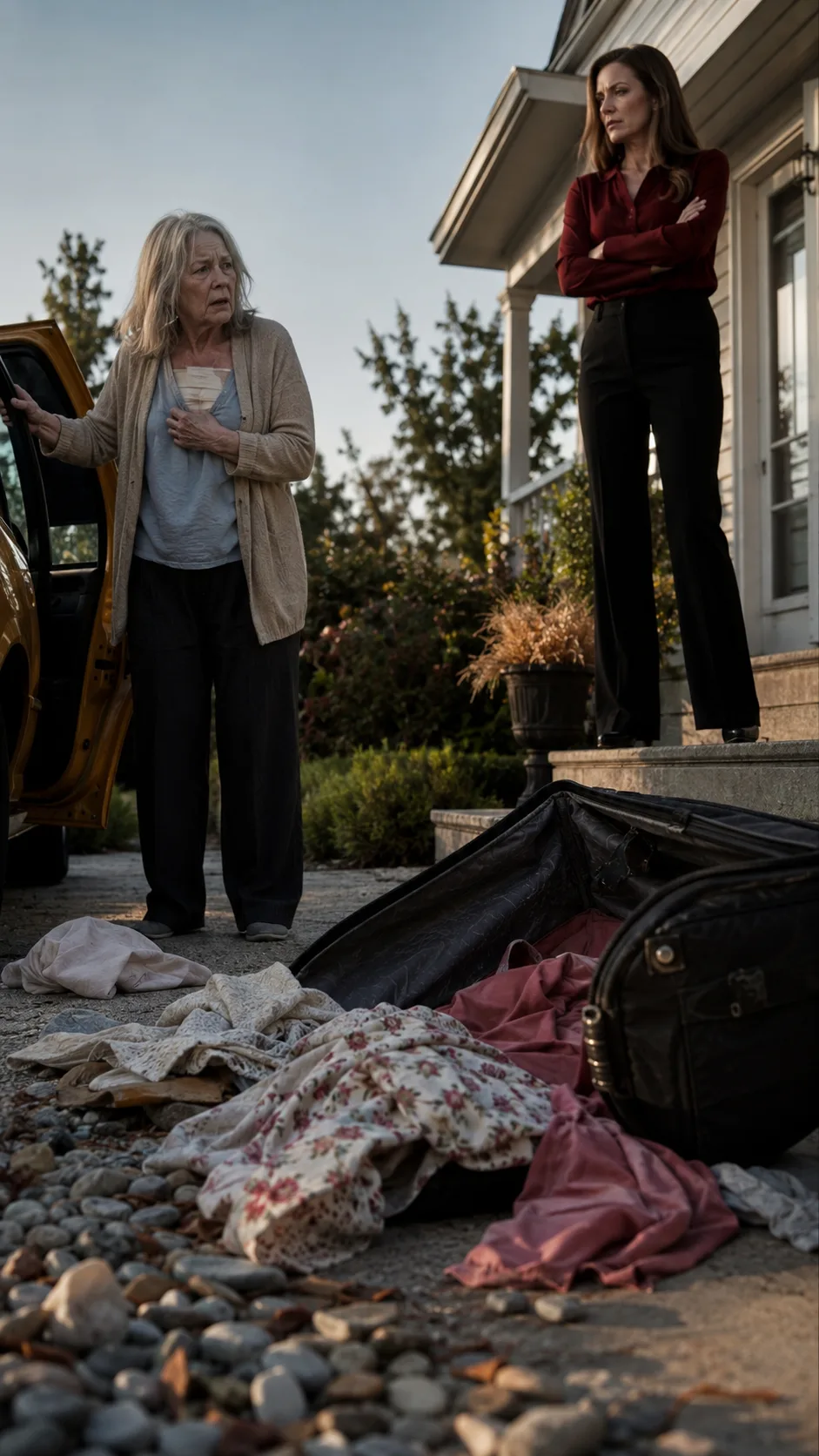
Then I saw it—my suitcase thrown on the sidewalk. And Megan standing in the doorway of my house with her arms crossed and a look I will never forget.
I still wonder if I did the right thing. And you? What would you have done in my place?
The taxi that had brought me from the hospital was still there, the engine running. The driver looked at me through the rearview mirror, confused, waiting to see what would happen.
Robert was paralyzed when he saw the suitcase on the sidewalk. I saw his face go from surprise to confusion and then to something I couldn’t decipher.
“Megan,” he said in a trembling voice. “What is this?”
She walked down the entrance steps with firm, determined steps. She was wearing that red blouse that she knew Robert liked. Her hair was perfectly styled, impeccable makeup, as if she had prepared for this moment.
“It’s exactly what it looks like,” she replied, without looking at me, only at him. “She can’t stay here anymore.”
“What do you mean she can’t stay? She just got out of the hospital.”
“Precisely because of that. She needs care that I can’t give her. I have my own children, my job, my life. I’m not going to become your mother’s nurse.”
I was still holding on to the car door, unable to move. The pain in my chest was intense, but the pain in my heart was worse.
“What are you talking about?” Robert raised his voice. “She is my mother.”
“And I am your wife. Or did you forget?”
Megan took another step toward him, lowering her voice, but with an intensity that chilled my blood.
“We’ve been living in this house for years, Robert. Years putting up with it, giving in, walking on tiptoes so as not to bother your mom. And you know what? I’m tired. I’m tired of feeling like a stranger in my own house, of everything having to be the way she says, the way she wants, the way she dictates.”
“No one has forced you to do anything.”
“Oh no? And who pays for the electricity? Who pays for the gas, the water, the internet, the food? We do. Your mother doesn’t contribute anything more than her complaints and her martyr size.”
Every word was a stab.
“That’s not true,” I tried to say, but my voice came out so weak that no one heard me.
“That house is not an assisted living facility, and I’m not a babysitter,” Megan shouted. This time, several neighbors looked out their windows. “Either she goes, or I go with the children. You decide.”
I saw Robert run out of breath. I saw how he looked at his wife, then at me, then back at her. As if he were making calculations, as if he were weighing what suited him best. And at that moment, something inside me broke. It wasn’t the suitcase thrown on the sidewalk. It wasn’t Megan’s cruel words. It was seeing my son hesitate, seeing in his eyes that he was genuinely considering the possibility of choosing her over me.
The taxi driver rolled down the window.
“Ma’am, are you okay? Do I need to call someone?”
I couldn’t answer him. I held on to the car because I felt like I was going to faint. The bandages were burning, my chest was throbbing, and the whole world was spinning. Then I heard the engine of another car. Robert heard it, too—his work car, which he had left parked further ahead. Someone had moved it. But he didn’t have time to react, because at that moment something happened that none of us expected.
Sebastian, my grandson, came out of the house. His eyes were red from crying so much.
“Dad, don’t let her kick Grandma out, please.”
Megan turned to him furiously.
“Sebastian, go inside right now.”
“No. You’re mean. I heard everything you said on the phone.”
The world stopped. Robert looked at his son, then at his wife.
“What did you say on the phone?” he asked in a dangerously calm voice.
Megan paled.
“Nothing. The boy is confused.”
“Liar,” Sebastian shouted. “You told your sister that as soon as Grandma had surgery, you were going to kick her out. That it was your perfect opportunity because she would be weak and couldn’t defend herself. I heard everything.”
I felt as if someone had ripped my heart out of my chest.
“You planned this,” Robert whispered. “You waited until she was sick to—”
“Oh, please, don’t be dramatic. Someone had to make the decision you were never going to make. We’ve been living uncomfortably because of her for years. She’s my mother, and I’m your wife. How many times do I have to tell you? How long are you going to be tied to your mom’s apron strings?”
Valerie also came out of the house crying and clung to her dad’s legs.
“Daddy, don’t let Mom be mean to Grandma.”
Robert was breathing heavily. I saw his hands tremble, how he clenched his fists. And then something happened that I will never forget. My son, that man who had hesitated just seconds before, walked toward me. He took my arm carefully, tenderly, and helped me sit down on the garden bench.
“Wait here, Mom. I’ll be right back.”
He turned toward Megan, and in his gaze I saw something I hadn’t seen in years: determination.
“You and I need to talk inside. Now.”
Click the blue “PART 3” below to read the next part:
Chapter complete
You have reached the end of this chapter.
Continue reading
A few more worlds to get lost in after this chapter.




