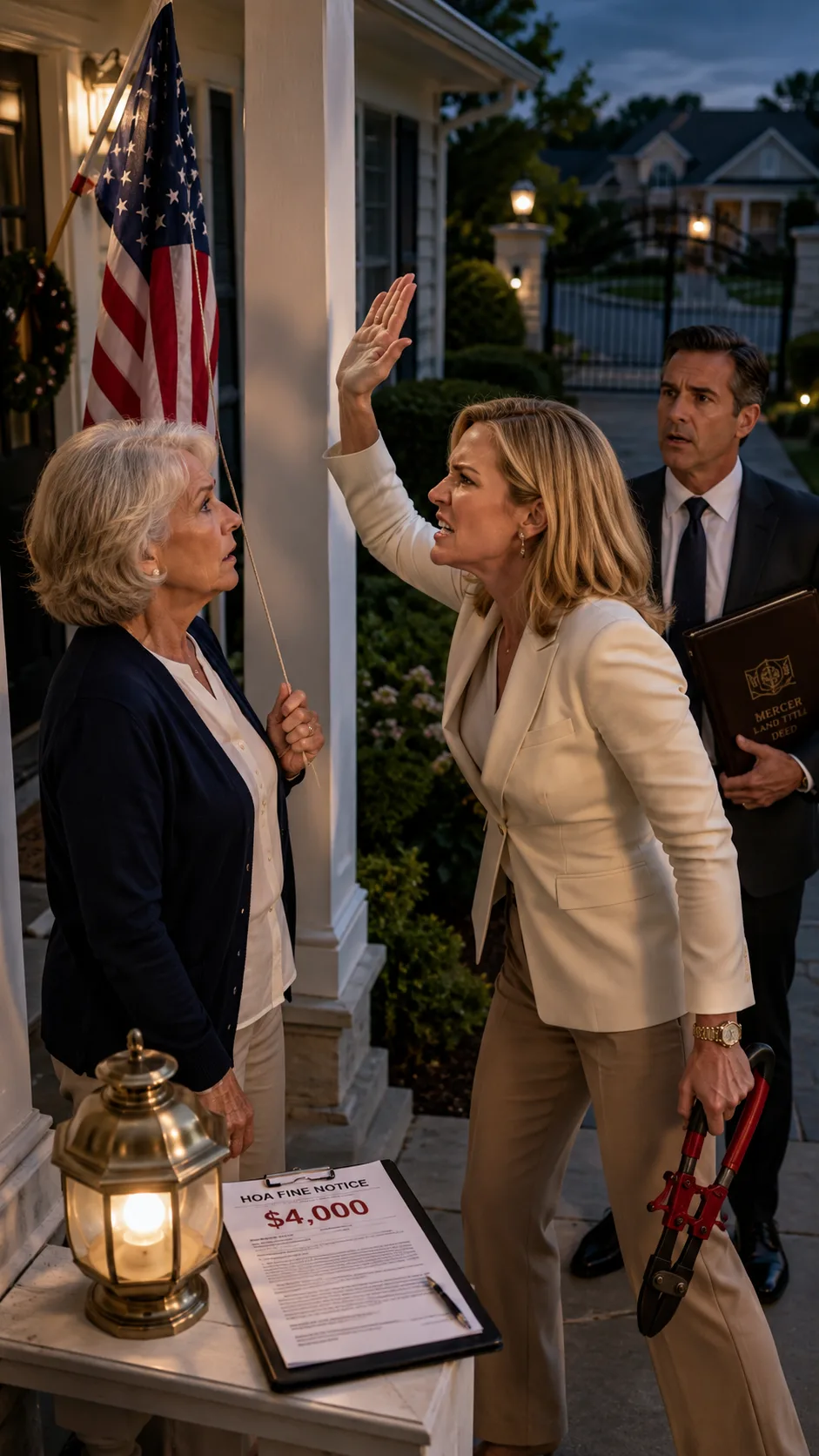
The sheriff’s car arrived before Cynthia found her voice again.
Chapter 3
The sheriff’s car arrived before Cynthia found her voice again.
Its headlights swept across the hedges, the white porch columns, and the flag still moving softly in the evening wind. A second vehicle pulled up behind it. Then a third.
For a woman who loved rules, Cynthia looked terrified of seeing them enforced.
Deputy Alan Briggs stepped out first. I knew him from Jack’s funeral. He had stood at the back of the church in uniform, hat pressed to his chest, eyes lowered during the final hymn.
When he saw me on the porch with one cheek red and one hand still wrapped around the flag rope, his jaw set.
“Mrs. Mercer,” he said, climbing the steps slowly. “Who struck you?”
Cynthia answered before I could.
“This is being exaggerated. We had a disagreement about a violation notice.”
Deputy Briggs looked at her. “I didn’t ask whether you had a disagreement.”
David handed him a business card, then the first
page from the folder.
“I witnessed the aftermath,” David said. “The two board members were present for the incident. Mrs. Blake was holding bolt cutters and attempting to remove a memorial flag from Mrs. Mercer’s porch.”
Harold raised both hands. “I didn’t know she was going to hit her.”
Cynthia snapped, “Harold.”
He shook his head. “No. I’m not taking the fall for this.”
Marjorie’s voice came out thin. “She slapped her. I saw it.”
Cynthia turned on her. “You’re the compliance chair.”
“And you just assaulted the landowner,” Marjorie whispered.
The word landowner seemed to strike Cynthia harder than any accusation of assault.
Deputy Briggs looked from David to me. “Landowner?”
David opened the survey map again on the porch rail.
Within ten minutes, the entire mood of Willow Creek Estates changed.
Porch lights flicked on across the street. Curtains moved. A few neighbors drifted toward the sidewalk, pretending
to check mailboxes or walk dogs that looked confused to be outside after dinner.
Everyone had seen Cynthia fine people.
Nobody had seen Cynthia afraid.
A black Mercedes stopped at the curb, and Milton Graves stepped out, the HOA treasurer. He wore golf clothes and the irritated expression of a man summoned away from a good bourbon.
“What the hell is happening here?” he demanded.
Cynthia rushed toward him. “Milton, don’t say anything.”
That was when I knew there was more.
Milton looked at the deputy, then at David, then at the folder.
His irritation disappeared.
David noticed it too.
“You’re familiar with the Mercer ground lease,” he said.
Milton adjusted his collar. “I know of it.”
“No,” David said. “You know it. Because your signature appears on two extension requests Jack declined to execute last year.”
Cynthia froze.
I turned slowly toward Milton.
“Jack declined what?”
David looked at
me. “Mrs. Mercer, your husband asked me not to burden you with this while he was ill. But last year, the HOA attempted to renew its favorable ground-use terms for another twenty years.”
Milton’s face turned gray.
“Jack refused?” I asked.
David nodded. “Not immediately. First he asked for three changes.”
He removed another document from the folder.
“One: stop excessive fines against elderly residents. Two: create an appeal process for hardship cases. Three: permanently exempt military memorial flags, funeral flags, and Gold Star family displays from aesthetic enforcement.”
The porch became utterly still.
I looked at the flag.
Jack had known.
While I was driving him to treatments, while he was losing weight and pretending soup tasted fine, while he was folding his hands over hospital blankets and telling me not to worry about neighborhood nonsense, he had been fighting Cynthia in legal letters.
Cynthia’s face had gone blank.
David continued.
“The board did not accept those terms.”
Milton muttered, “They were unreasonable.”
I looked at him. “Unreasonable?”
He avoided my eyes.
David’s voice cooled. “Instead, the board adopted stricter exterior display rules three weeks after Colonel Mercer entered hospice.”
Deputy Briggs looked up from his notes.
Even the neighbors across the sidewalk stopped pretending not to listen.
I took the fine notice from the railing and held it out to Cynthia.
“You waited until Jack died.”
Cynthia said nothing.
“You waited until the man who could stop you was in the ground,” I said, “then came for his flag.”
Her mouth opened, but this time there was no speech ready behind it.
Milton tried to recover. “Mrs. Mercer, we can discuss this in a proper meeting.”
“No,” I said.
The single word surprised even me.
For six weeks, I had moved through the house like a guest in my own grief. I had answered casseroles with thank-you cards, signed insurance forms, folded Jack’s sweaters, slept on one side of the bed, and let every person tell me what would be best for me.
But standing on that porch, with my cheek burning and my husband’s flag above me, I understood why Jack had left the folder with David.
He had not left me a weapon.
He had left me the truth.
I turned to David.
“What happens if the HOA violated the conduct clause?”
David looked at Cynthia, then Milton.
“You may terminate the association’s use rights over common areas subject to the lease, suspend enforcement authority tied to those grounds, demand an accounting of improperly collected fines, and pursue civil claims.”
Harold sat down on the porch step.
Marjorie covered her mouth.
Milton whispered, “That would destroy the association.”
“No,” I said. “You did that when you thought decency was optional.”
Deputy Briggs stepped toward Cynthia.
“Mrs. Blake, I need you to place the bolt cutters down and step over here.”
“They’re already down,” she said.
“Then step over here.”
Her eyes darted toward the neighbors. The woman who had once sent me a violation letter because my trash bin was visible from the street was now being led away from my porch in front of the entire street.
No handcuffs at first. Just questions. Just procedure.
But for Cynthia, public humiliation was worse.
As Deputy Briggs guided her toward the patrol car, she turned back.
“You’ll regret this,” she said.
I looked at the flag.
Then at the folder.
Then at every neighbor standing in the blue evening light.
“No,” I said. “I think this is the first thing I won’t regret.”
Three days later, David and I attended the emergency HOA meeting.
They had expected me to cry.
Instead, I wore Jack’s favorite navy dress and brought copies.
Copies of the land title.
Copies of the expired extension request.
Copies of the clause they had violated.
Copies of every widow, veteran, disabled resident, and elderly homeowner Cynthia’s board had fined into silence.
Milton resigned before the meeting began.
Harold handed over financial records.
Marjorie apologized to me in the hallway with tears running down her face.
Cynthia did not attend. Her attorney sent a letter.
David read it, smiled once, and placed it unread into his briefcase.
“She wants settlement discussions,” he said.
I looked around the clubhouse Jack’s land had supported for thirty years.
The walls were decorated with framed photos of summer barbecues, holiday parties, and ribbon-cutting ceremonies. In every picture, Cynthia stood near the center, smiling like she had built the place herself.
I walked to the front of the room.
The residents quieted.
I had written a speech, but I did not use it.
“My husband loved this neighborhood,” I said. “Not because the hedges were perfect. Not because every door was painted an approved shade of black. He loved it because he thought people could grow old here without being bullied.”
Several heads lowered.
“So here is what happens now. All fines issued for memorial flags, medical ramps, temporary hardship needs, veteran displays, and disability accommodations will be reviewed. Any improper fines will be returned.”
A murmur moved through the room.
“And until a new board is elected, the HOA’s enforcement authority over leased common areas is suspended.”
Someone began to clap.
Then another.
Then the whole room.
I did not smile until I got home.
The flag was still there.
I stood beneath it as the evening wind lifted the edge of the fabric. For the first time since Jack died, the house did not feel empty.
It felt guarded.
The next morning, a small envelope appeared on my porch.
Inside was Cynthia’s $4,000 fine notice, torn neatly in half.
No signature.
Just one sentence written across the back:
We should have known who we were standing on.
I folded the paper once, placed it inside Jack’s old desk drawer, and looked out at the flag moving in the morning light.
Then I called David.
“Start the refunds,” I said.
THE END.
Chapter complete
You have reached the end of this chapter.
Continue reading
A few more worlds to get lost in after this chapter.




