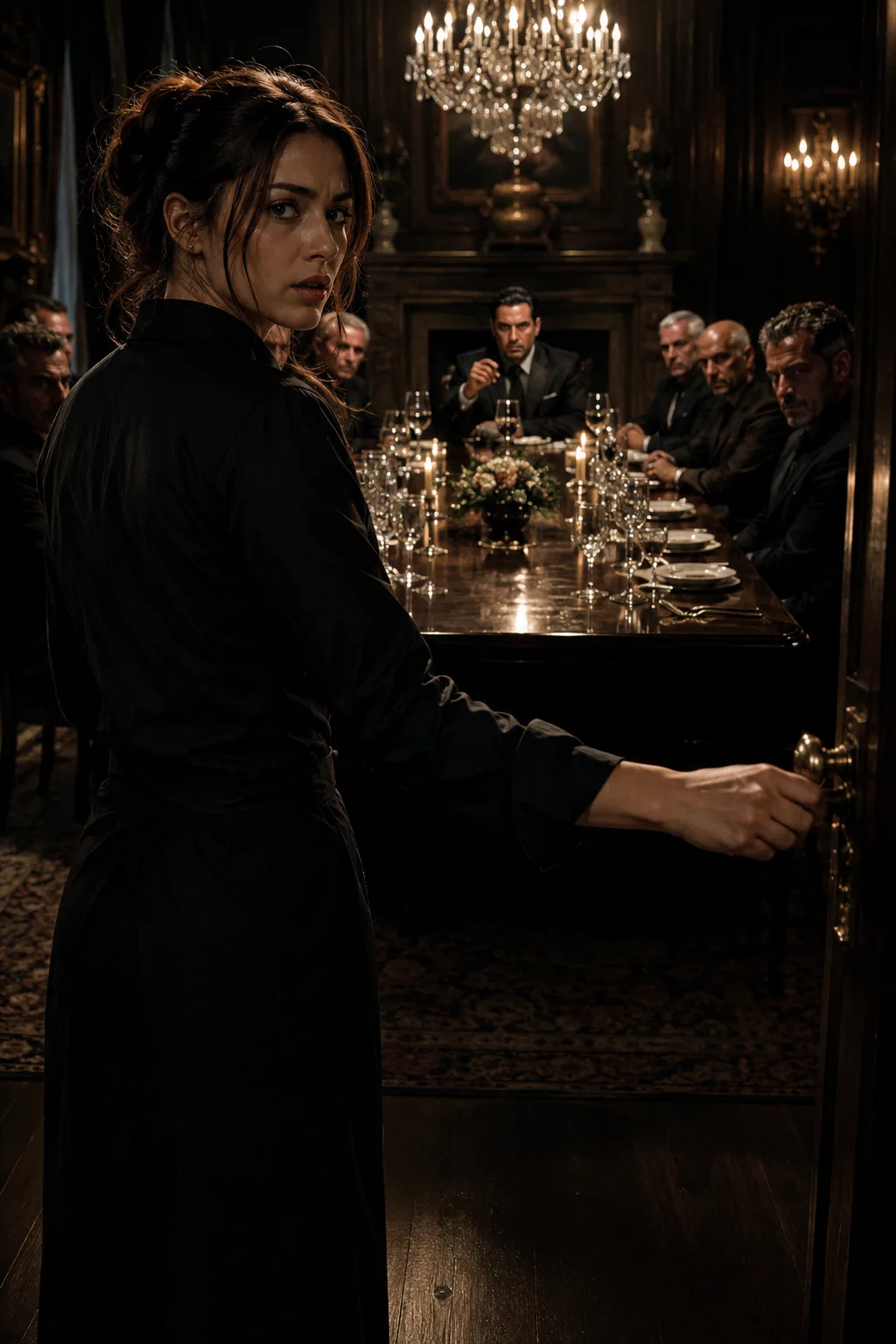
The shift was not even mine.
Chapter 1
The shift was not even mine.
Lena had called the agency at 4:00 in the afternoon, her voice thick with what sounded convincingly like a fever and was almost certainly a date. I took it because I needed the money, and because the only alternative was another empty Tuesday in an apartment. That was the arithmetic of my life then: necessity on 1 side, nothing much on the other.
The address took me north. The house, a compound was the word I would later understand applied to private residences like that 1, sat behind iron gates, stone walls, and security cameras positioned at angles that covered everything. It took 3 minutes to find parking, 2 more to locate the service entrance, and another 4 standing in the kitchen, tray in hand, to understand that I had walked into something I did not have vocabulary for.
Four staff members moved through the kitchen in complete silence. A
woman in her 60s, gray hair pinned with surgical precision, dark eyes assessing me in under 3 seconds and seeming inexplicably satisfied, pressed a tray into my hands without greeting.
Her voice was low and unhurried.
“You do not speak unless spoken to. You do not look at the table unless you are serving it. You leave when they leave, not before.”
I had worked enough catering jobs to know the difference between events where you dissolved into the wallpaper and events where the room itself made you want to disappear.
This was the 2nd kind.
The dining room was dark in a way that had nothing to do with the lights. Mahogany paneling. Candelabras burning low. A table long enough to seat 12, currently seating 10 men who occupied their chairs with the particular gravity of people who are never uncertain about where they sit. Crystal. Silver so old
it had gone slightly soft at the edges. The smell of something braised for 6 hours, and underneath it, colder and denser, the specific smell of a room that had held consequential conversations for 30 years.
They were speaking Italian.
I do not speak Italian.
I stood at the sideboard with a bottle of white Burgundy and did what I had been told. I looked at nothing.
Then the door opened.
I could not have explained afterward what was different about the way he entered. The other men had arrived in pairs before him, and each time the room had gathered a certain energy, coiled, sharpened, pointed toward something. But when he walked through that door, the energy did not gather.
It settled.
The way everything goes absolutely still in the seconds before a storm decides itself.
He was tall and lean, in a dark suit that had not been
made in any store I had ever been near. Dark hair. A face almost beautiful in the way certain pieces of architecture are beautiful: composed, cold, built to remain standing after other things have fallen.
He moved to the head of the table without acknowledging anyone, sat down, and the meeting began as though it had been waiting specifically for him to allow it.
I refilled glasses when they emptied.
I kept my eyes on the wine.
Twenty minutes in, 1 of the men, heavy, red-faced, running at a different internal temperature than everyone else in the room, began speaking faster. I do not speak Italian, but I understood the shape of it anyway. Someone asking for more time, or mercy.
The man at the head of the table let him finish.
Then he said something.
Three words, quietly.
The room went absolutely silent.
Not the silence of shock.
The silence of conclusion.
The sound a door makes when it closes on a room you will not reenter.
I set the wine bottle down. I had not realized I was still holding it. I set it on the sideboard, straightened, and thought with absolute crystalline clarity that I needed not to be in that room.
It was not panic, just fact. The way you step back from an open flame, not because you decided to be afraid of fire, but because you are a living thing, and living things move away from what will burn them.
I turned and walked toward the door at the far end of the room.
Not hurrying.
Not running.
Just leaving, the way you leave when the decision is already made, and the decision is the only thing left.
“Stop running.”
It was so low I almost did not hear it, a whisper that crossed 20 feet of charged air and landed directly in my chest.
My hand was on the door handle.
I did not move.
“I always find what belongs to me.”
I turned.
He was looking at me from the head of the table, and the 10 men around it were not moving. His expression had not changed at all. Still that architectural stillness, still that settled storm quality, but his eyes were on me with an attention that felt like being held in place by something that was not touching me.
“I do not belong to anyone,” I said.
I do not know where it came from, the kind of sentence that arrives before your better judgment catches up to it.
He did not answer.
He just looked at me, and somehow the looking was the answer, which was worse than anything he might have said.
Much later, I understood more about what that room had been. I also understood the profound meaning behind his silence. He eventually told me, in his economical way, that I was the 1st person in 10 years to simply walk away from him.
The departure was not defiance or theater. It was just motion. He had not known what to do with that.
So he kept me.
The woman with the gray hair, Ginevra, as I would learn, showed me to a room on the 2nd floor. She brought a glass of water, said nothing, and left.
The lock caught behind her with a sound like a sentence ending.
The room was nicer than my apartment.
That was the 1st thing I thought, which told me something about the state of my apartment and something I did not want to examine about the state of my life. The room had cream walls and a bed with linen that likely cost more than a week of shifts. A window overlooked a garden that, in the gray November dark, resembled a painted landscape.
I sat on the edge of the bed and did not sleep. I thought about the specific shape of the mistake I had made by taking Lena’s shift.
By morning, I had mapped it fairly clearly. Not the whole picture, because I did not have enough pieces yet, but the outline.
I had witnessed something I should not have in a room belonging to someone who did not tolerate witnesses. The red-faced man who had been pleading. The silence that had followed 3 Italian words.
I did not want to know what had happened to him after the dining room emptied.
I had grown up understanding that some knowledge is a liability. My mother had taught me that mostly by demonstrating the consequences of knowing too much about the wrong people. She died when I was 9 years old, and all the knowledge she possessed vanished with her. Whatever my father had known, which took him away at 12, disappeared into a story I was never given access to.
I had spent the years since becoming very good at not accumulating dangerous information.
I had failed the previous night.
Ginevra came at 7:00 with breakfast on a tray and the particular manner of a woman who had made peace with the nature of her employer’s world without being made numb by it. She set the tray down and looked at me. Really looked, the way people do when they are deciding something.
Then she pulled a chair from the corner and sat.
“You are scared,” she said.
Not a question.
“Yes,” I said, because lying seemed pointless.
“Good,” she said. “Fear is honest.”
She smoothed her apron with both hands.
“Eat. He will not see you until this afternoon. Being hungry makes everything worse.”
I ate because she was right and because the eggs were better than any eggs I had made for myself in the last 3 years.
She left.
I took stock of myself.
I was 26 years old, with $240 in a checking account, a lease I was already behind on, and a job that was technically 2 jobs and felt like neither. I had come to Chicago 4 years earlier, after stays in Pittsburgh and Indianapolis. Before Indianapolis, I had been in a foster home in Rockford, which was actually fine. It was fine in the specific way of things that are not harmful, but are also clearly not home.
I moved because staying in places had never prevented them from changing around me.
Better to change them yourself.
I thought about my father. I did that less often than people might expect. I had learned to think about him in a controlled way, the way you let yourself think about a sore tooth only when you are somewhere you can manage the response.
He had not left.
I had decided that years ago, the way you decide something you cannot prove because not deciding is worse. Something had happened to him. Something had been done to him. I had no evidence for this except that the alternative, that he had simply looked at me and chosen to go, was a thing I could not build a life on.
I did not know yet how precisely correct I was.
He came that afternoon.
I had been standing at the window, watching the garden, which in daylight resolved into something real. Bare-branched oaks, a stone path, iron benches. I heard the door open and turned.
He was there.
He was different in daylight. Still composed. Still possessed of that quality of a man who had never been surprised into showing something. But in the dining room, he had been a presence across a long table. There, he was a person in a room, standing 8 feet away.
The 8 feet felt negotiable in a way that scared me more than the distance had.
“Sit down,” he said.
“I would rather stand.”
A pause, not a long 1.
“Then stand.”
He sat, which I had not expected. Not expecting it made me feel slightly foolish standing.
So I sat.
He waited until I had and then looked at me directly.
“Your name.”
“Arya Fontaine.”
Something happened in his face. Not much. The way a controlled surface registers a tremor. The vibration is real, but the surface holds. His eyes stayed on mine, but something behind them changed.
“Fontaine,” he said, flat, like he was testing the weight of the word.
“Yes.”
“How old are you?”
“26.”
“Why does that matter?”
He did not answer. He looked at me for another moment, and I had the uncomfortable sensation of being a document he was reading rather than a person he was speaking to.
“You will stay here while I determine what to do with the situation.”
“I did not see anything.”
“You were in the room.”
“I was refilling wine glasses.”
“You were in the room,” he said again, and his voice did not change.
That was the point. The repetition was not argument. It was simply fact stated again for clarity, the way you state a mathematical principle to someone who has tried to disagree with it.
I looked at him.
He looked back.
I wanted to say something else, something with edges, but I could not find it. The silence stretched out between us like something with weight.
The door opened, and a man came in. He was younger than Lorenzo, mid-30s, in a dark jacket, with the economical build of someone who had kept himself useful on purpose. He glanced at me with the flat professional attention of someone cataloging a situation.
“Marco,” Lorenzo said, and nothing else.
Marco understood something from just the name, nodded, and left.
Lorenzo stood.
“You will have everything you need. Do not test the locks.”
He walked out.
The door closed.
I sat in the chair he had vacated and noticed without meaning to that it was still warm.
I had been there 4 days before I understood the shape of the thing I was inside. Ginevra was my primary source of information, though she parceled it carefully, enough to orient me, not enough to either truly frighten me or give me anything that could be useful for leaving.
She was very good at this.
I suspected she had been good at it for a long time.
On the 3rd morning, she walked me through the estate like a tour guide showing a guest. She named rooms by function and described the outdoor grounds as objects of appreciation. Yet I knew they should be memorized as potential escape routes, which they absolutely were.
The house had 17 rooms that I knew of. It was staffed by 6 people who lived elsewhere and arrived and departed through the service entrance at times I was beginning to clock. Security consisted of 4 men I could identify and probably others I could not, positioned at intervals that suggested training and ongoing assessment.
The perimeter was a 10-foot stone wall with something wired at the top that I did not look at directly.
On the 4th day, Marco found me in the library.
I had gone there because it was the room least occupied by anyone who made me feel the way the security staff made me feel, like a variable someone was tracking. He sat in the chair across from mine without being invited and looked at me with that flat cataloging attention.
“You should understand what you have walked into.”
“I am getting there,” I said.
“No.”
He said it patiently, like he corrected this misapprehension often.
“You are getting the surface of it. The Vitelli family has run Chicago’s north side for 31 years. Lorenzo has been don for 8 of those. Before him, his father. The empire is substantial.”
He paused on the word in a way that suggested it was the most economical version of several larger words.
“Cesare Marchetti was his father’s right hand for 20 years. He is not currently Lorenzo’s right hand. That distinction is important, and it is not a peaceful 1.”
“Why are you telling me this?”
He looked at me for a moment.
“Because you are still here, and you keep looking at the perimeter, and I would rather you understood what is outside the walls before you tried to find out for yourself.”
I sat with that.
“What is outside the walls?”
“Cesare’s people. Three incidents in the last 6 weeks. Two of our men in the hospital. One message that was not subtle.”
He stood.
“You are safer in this house than you would be in your apartment right now, and not because of the locks.”
He left before I could ask what he meant about my apartment.
That night, Lorenzo was in the sitting room adjacent to the library when I came down from my room, which surprised me. I had not thought of him as a man who sat in sitting rooms in the evening.
He was reading something, a document rather than a book, and he looked up when I came in but did not indicate that I should leave. I sat in the chair farthest from his. The fire was going, and the room smelled of wood smoke and the particular dense wool scent of old furniture. Underneath it was something colder, the trace of outdoor air still on his jacket, the smell of a man who had been outside in the dark that night and had not been standing in a garden.
We did not speak for several minutes.
“Your father,” he said finally, not looking up from the document.
My whole body went still in the specific way it had learned to go still when his name came up.
“What about him?”
“His name was Henri Fontaine.”
“Yes.”
He set down the document and looked at me.
“He worked for my father.”
The fire made a sound.
I did not.
“He was our accountant,” Lorenzo said. “For 11 years. He was very good.”
He paused on this the same way Marco had paused on substantial, with the weight of things he was not saying stacked behind it.
“He left the family’s employ in 2008.”
“I was 12 in 2008.”
He did not respond.
“He did not leave,” I said.
Lorenzo looked at me with something in his expression that I could not read and have since spent years understanding.
It was not cold.
It was careful.
The difference matters.
“No,” he said. “He did not.”
That was all he said.
The fire burned down. I sat with the ruins of every story I had told myself about my father for 14 years, and he sat across from me with whatever he knew and did not say.
The distance between us felt like it was made of something specific and real.
The next morning, Ginevra made coffee strong enough to be structural and set it in front of me.
“He is not easy, piccola,” she said. “He is not supposed to be.”
She sat across from me.
“But he is not what you think he is either.”
“What do I think he is?”
She considered.
“Everyone who comes into this world decides first what he is before they know him. They decide on something simple, something they can carry.”
She wrapped both hands around her own cup.
“The truth of him is harder to carry than the simple thing. But it is the truth.”
From the east corridor, muffled through 2 closed doors, came the sound of men speaking Italian in lowered voices. Not anger. The specific frequency of planning.
Something was already moving.
I could feel it the way you feel weather change before you can see it, in the quality of the air, in the way everyone who worked in the house moved through it that day with a fraction more care.
At dinner, Lorenzo looked at me once across the table.
Just once.
Then he looked away.
I noticed where his hands were when he did it.
I told myself I had not.
On the 6th day, there was a problem in the garage.
I heard it from my room. Not shouting, which I now understood was not how violence occurred there. Instead, there was rapid movement and low-volume commands, a quality I had learned was far worse.
I came down the stairs because I am apparently the kind of person who moves toward things instead of away from them when she is not scared enough yet. I was in the ground-floor corridor when the side door opened and 2 men came through it.
The 2nd man was Lorenzo.
There was blood.
Not a lot. His left forearm. A cut from somewhere. His jacket was pushed up, and his shirt sleeve was dark with it.
He looked at me in the corridor with absolutely no change in expression except a single fractional pause in his movement, the kind you do not notice unless you are already watching for it.
Then he continued walking toward the study.
I followed him.
He did not tell me to leave. He sat at the desk and pressed a cloth to his arm. I stood in the doorway and looked at the room: bookshelves, floor to ceiling, a desk that had been there before he was born, the particular smell of old paper and something mineral underneath it, cold stone and metal.
A room that meant something.
You could feel it.
“Sit,” he said without looking up.
I sat.
He pressed harder on the cloth. A muscle in his jaw moved once. He was breathing in a controlled way that told me the control was deliberate.
“It needs stitches,” I said.
“It needs pressure.”
“It needs stitches and then pressure.”
I had worked 2 years as a clinic receptionist in Indianapolis, and I knew what a cut looked like when it had decided it was not going to close by itself.
“Is there a kit somewhere, or do we wait for someone to bring 1?”
He looked at me.
That pause again. Fractional. The 1 I was beginning to identify as the closest thing he had to visible surprise.
He opened a drawer and took out a flat black case, setting it on the desk between us.
I moved the chair around the desk without asking. I opened the kit. Antiseptic. Curved needle. Suture thread. Gauze. Someone had stocked it thoroughly, and not recently.
I took his arm without announcing I was going to do it because I suspected announcement gave him the opportunity to refuse. I cleaned the cut and threaded the needle and felt him go very still. Not flinching still. Letting me still.
I worked.
He watched.
Several minutes in, I became aware of the particular quality of his watching. Not analytical. Not the cataloging attention of Marco. Something older than that. Something I recognized in myself.
The way you watch something you are surprised to find you want.
I did not look up.
When I tied off the last suture, I saw it on the inside of his forearm, above where I had been working. An older scar that had not been made by any knife. Too wide, too deliberate, the kind of mark that has a history.
I did not ask.
But I looked 1 second longer than I should have.
“Viola,” he said unprompted, very quiet. “My sister. There was a time when she needed someone to hold on to.”
He stopped there, the sentence complete in a way that was not grammatically complete.
“I let her.”
I did not say anything. There was nothing to say that would not cost him something to receive.
“She has been gone for 6 years,” he said.
I set the needle down. I put my hand very carefully over the old scar. Not the new 1. The old 1. I held it there for a moment, the way you cover something not to hide it, but because uncovered things need tending sometimes.
I felt him go absolutely still beneath my hand.
Not pulling away.
Not moving at all.
Then I took my hand back, picked up the gauze, wrapped the new stitches efficiently, and set his arm down with the care you use for something that has been handled enough.
He let out a slow breath that was not quite audible.
Neither of us spoke for a long time. The fire in the corner of the study breathed. Outside, the wind came off the lake, found the gaps in the old stone house, and made itself heard.
“You are not afraid of blood,” he said finally.
“I am,” I said. “I just know what to do when I am afraid.”
He looked at me for a moment. Something shifted in his expression. Not much, but I was learning to read the small currencies of his face.
“Most people who end up in this house develop a particular kind of fear.”
“Of you?”
“Yes.”
I thought about this.
“I am afraid of the situation,” I said carefully. “Not specifically of you.”
“Is that a meaningful distinction?”
“I think so.”
He said nothing, but the quality of his silence changed, the way the quality of a room changes when someone decides to stay in it instead of passing through.
I got up and took the kit to the small bathroom off the study to rinse what needed rinsing. When I returned, he stood at the window, arm at his side, gazing at the dark garden. He had the look of a man who often stood alone in that room, familiar with its solitude. It was a comfort akin to the particular shape and nature of 1’s own grief.
I went to the door.
“Thank you,” he said, still facing the window.
The words sounded like they cost him something, but not so much that he would not pay it.
“You are welcome,” I said.
I meant it simply, which felt like the strangest thing I had said in days.
Part 2
On the 9th day, the FBI came.
Not to the estate.
To me.
A phone call first, from a number I had been ignoring for 3 weeks to a phone I had stopped keeping charged because I was avoiding a different conversation entirely. I found it in my jacket pocket after Ginevra returned my jacket from the house laundry. The device had 22% battery and 7 missed calls from a 312 area code.
There was also 1 voicemail, which I played with my thumb over the speaker to keep the volume low.
“Miss Fontaine, this is Agent Korea. We have spoken before. I understand you may be in a complicated situation right now. Please be aware that the offer we discussed remains on the table. Call me.”
I sat on the edge of the bed and held the phone. I thought about how uncomplicated my life had been in its own way 3 weeks ago.
The offer we discussed had been made 4 months earlier in a Michigan Avenue coffee shop. Agent Korea, professionally pleasant, had explained they were building a case where my father’s records could be relevant, though I did not have those records. She implied my cooperation would be both appreciated and protective. She had given me a card.
I had not called.
I had not called because I did not have the records.
Because I genuinely did not know what my father had or had not done.
Because my instinct, trained over years, had taught me not to engage with things larger than myself until I fully understood their shape, and I did not yet understand the shape of this.
I understood it better now.
Lorenzo found me 20 minutes after the call. I had not gone to him. He had come to me, which meant someone had told him about the phone, which meant the house had information I did not, which I supposed I should have assumed.
He sat across from me in the chair by the window and looked at me directly.
“Tell me what you know.”
So I told him.
The coffee shop. Agent Korea. The offer I had not taken. The records I did not have. I told him all of it without managing it or shaping it because I was tired of managing things, and because something about him, the quality of his attention, the way he received information without reacting to it visibly, made the management feel unnecessary.
When I finished, he was quiet for a long time.
“Your father kept copies,” he said finally. “Not at the estate. Somewhere else. The FBI believes they came to you.”
“They did not.”
“I know.”
He said it with the certainty of someone who had already established this.
“He was protecting you. He did not leave you anything that would make you a liability.”
A pause.
“He did not leave you much else either.”
The fire in the room made a sound.
I looked at my hands.
“He turned evidence,” I said. “Against your family.”
“Yes.”
“And then he—”
“Yes.”
The word landed with finality.
With weight.
He was not trying to minimize. He looked at me directly when he said it, which cost him something. I could see it cost him in the small, specific price of it in the set of his jaw.
“My father ordered it. I argued against it. I was overruled.”
He stopped.
“I was 24. It was the 1st order I refused and then could not prevent.”
I sat with this for what was probably a long time, long enough that the light in the room shifted as the November sun moved behind a cloud and the room went colder.
“He left me,” I said. “But not the way I thought.”
“No.”
“He was protecting me, and it killed him.”
Lorenzo said nothing.
There was nothing to say that would help, and he seemed to understand this in the way he understood most things immediately, without requiring demonstration.
I did not cry.
I wanted to and did not, which was its own kind of education.
“I am not angry at you,” I said.
He looked at me. Whatever he had expected, it was not that.
“I am not,” I said again, testing whether I meant it and finding that I did, which was its own kind of strange. “You were 24. You refused.”
“It did not prevent anything.”
“No. But it matters that you tried.”
I looked at him.
“It matters to me.”
The silence between us shifted.
Something had been put down between us and was still there: the history of my father and his, the weight of a death neither of us chose. But sitting alongside it now was something else, something that had been moving toward us for 9 days and had just gotten close enough to be felt.
I looked away first.
The room felt too small for whatever was building in it.
That evening, Marco came to tell me something was wrong with the timeline. Cesare had moved earlier than expected. There was a meeting tomorrow that had not been on anyone’s calendar. Three of the estate’s external contacts had stopped responding.
“Someone close is talking,” Marco said almost to himself, and looked at me in the way you look at something when you are not accusing it, but are accounting for all the possibilities.
I understood that I was 1 of the possibilities.
I let him look because there was nothing else I could do.
“It is not me,” I said.
“I know,” he said.
I believed that he did.
“But something is very wrong, and I do not know yet where it is coming from.”
He left.
The house settled into its specific nighttime silence. I lay in bed and thought about my father trying to protect me from inside a story he could not leave. I thought about Lorenzo at 24, refusing an order he could not prevent. And I thought about how much history there was in this house that I was only now, 9 days in, beginning to see the real shape of.
I fell asleep with the window cracked and the lake wind coming through it.
In the morning, everything was different.
The car they put me in was armored. I knew this because of the sound the door made when it closed. Not the ordinary thud of metal and glass, but a deeper, denser sound, the kind made by something built to absorb rather than give way.
Marco drove. A man I had not seen before sat in the front passenger seat with his right hand in a specific position that told me his right hand was not resting. Lorenzo sat beside me in the back.
We did not speak.
We were 20 minutes from the estate, heading to what Marco had told me was a secondary residence. The main estate had been flagged in the preceding 12 hours: 2 vehicles doing passes, something in the east wall’s perimeter system that should not have been there.
The secondary residence was somewhere I had not been, and Lorenzo had not named it.
The explosion came before we reached the highway.
Not our car.
The lead car ahead, 40 feet in front, was a vehicle I had not even known was there. In 1 second, it transformed into a wall of light, concussive sound, and falling debris.
Marco had already turned the wheel before my mind could fully process what my eyes had seen.
What happened next took approximately 11 minutes and felt like a different country’s version of time.
Three vehicles. They came from 2 directions, coordinated. The kind of coordination that had been planned over weeks by people who understood how Lorenzo moved.
Marco was extraordinary.
I understood that immediately in the specific way you understand someone’s competence when it is the only thing between you and the alternative. He drove like the road was his to redesign. The man in front fired twice through the passenger window, and I heard the sounds those shots made when they landed.
Then Lorenzo very quietly told me to get down.
So I immediately did.
What happened in the next 4 minutes was mostly experienced as sound, pressure, and the cold smell of gunpowder in that closed space.
When the car finally stopped in a loading bay I could not identify, everything was still.
I sat up.
Lorenzo was already out of the car.
I opened my door.
What I saw was not the man from the dining room, nor the 1 who had sat across from me in the study while I sutured his arm and he told me about Viola with the careful demeanor of someone handling something fragile. That man was composed, measured, still water over depth.
What stood in that loading bay was the depth itself.
He had a man by his collar against the wall, 1 of the attackers, apparently captured in the scrambling confusion, and his voice when he spoke was still low, but it had shed everything that made it human. No inflection. No temperature. Just the flat statement of someone to whom consequences are mathematics, and the math had already been done.
I watched him.
I stood by the car and watched him, and I understood for the 1st time that the quietness I had found reassuring was not the absence of violence.
It was violence at rest.
It was the stillness of a thing that had already decided it could move at any moment and was choosing not to for now.
The man against the wall said something. Lorenzo listened. Then he looked across the bay at Marco and said something in Italian. Marco nodded, and the man was taken away.
Lorenzo walked back toward me.
He stopped 3 feet away. His eyes found mine, and I saw him register what was in my face. Not fear of him exactly, but the aftermath of seeing something true, the particular expression of someone who has just been shown a room they were not supposed to see.
“You are all right,” he said.
“Yes.”
He looked at me for a long moment.
“I know what you just saw.”
“Yes,” I said again.
“Are you—”
“I am not going to pretend I did not see it,” I said before he could offer me the pretense. “I do not…”
I stopped, started again.
“I saw it. I am still here.”
He was very still, the specific loaded stillness I had learned meant something was moving through him that he would not put into words.
Lorenzo.
She was still standing there.
That was the thing.
They always moved back from him in moments like that. Even the men who worked for him, the ones who had seen worse and created more of it themselves, made distance after he was that version of himself. There was an instinctive calibration of space.
She had not moved.
He had known her 11 days, and since the 1st night he had been in the process of understanding what to do about her. He had told himself it was the security question, the exposure question, the complication of her father’s history creating obligations he had not chosen.
This situation was different.
He had known it since the 1st night, when she had stood at his dining room door and simply turned and walked, leaving him to sit at the table with 10 men.
He had felt a specific panic then, unknown for years, watching something leave without permission. Not defiance, not theater, just movement. A decision quietly made, quietly enacted, not requiring his acknowledgment or response.
He had called it strategy when he had her brought upstairs.
He had been lying.
Watching her in the loading bay with the cold smell of aftermath and her real, unmanaged face, he felt something. It was a specific terror he had not felt since Viola, the raw fear of caring whether someone was all right.
He had not planned for that.
“I am still here,” she said again, more quietly, like she was reminding herself as much as telling him.
He crossed the 3 feet between them and very carefully put his hand against her jaw. He looked at her face as if checking for damage, knowing the inspection mattered most right then.
“I know,” he said.
I did not move away when he touched me.
I should have. I had approximately 14 good reasons organized in order of rationality, ready to deploy.
I did not deploy any of them.
I stood in the cold loading bay, his hand against my jaw, gunpowder smell in the air, and looked at him.
“I do not know what I am doing,” I said.
“No,” he said. “Neither do I.”
It was the most honest thing I had ever heard from him, and it was more dangerous than the shooting had been.
He pulled me into him slowly, giving me every opportunity to step back.
I did not step back.
When his arms came around me, I stood in the circle of them and thought this was the most afraid I had been since I arrived. Not afraid of him. Not afraid of the violence outside. Afraid of the fact that I did not want him to let go.
He held me for a long time.
Nothing happened.
The holding was the thing.
Later, in the car, Marco said, “Cesare has declared.”
Lorenzo said nothing.
“It is not coming anymore,” Marco said. “It is here.”
The estate was relocated.
Not the building, but the operation, the staff, the rhythms of how the Vitelli family functioned day to day. We moved to a different property, a townhouse in the Gold Coast that had the feeling of being lived in for this purpose specifically. Every room was functional. None of them were warm.
I missed Ginevra’s kitchen.
I missed the garden I had never once gone outside to sit in.
Marco was shot on a Tuesday.
He was not supposed to be at the exchange point. He had gone because 1 of the younger men had hesitated. I learned this afterward in pieces from Ginevra, who knew because she knew everything. Marco had taken the position instead, because that was the particular way he was loyal. He substituted himself for people he was responsible for without announcement or ceremony.
The bullet took him in the shoulder.
He survived.
When they brought him in, I saw him on the Gold Coast townhouse couch, his jacket cut away while Ginevra pressed a cloth efficiently to his wound, clearly having done this before.
I understood then how deeply attached I had become without truly noticing it. I had been watching him for 2 weeks: the dry humor deployed at careful intervals to keep rooms livable, the way he spoke to the younger men, not warmly, but with a kind of sustained seriousness that was its own form of care. The way he had looked at me and told me the truth about Cesare when he did not have to, and had done it as a form of respect.
I sat beside him while Ginevra worked, and I held his hand because I did not know what else to offer.
He looked at me with considerable surprise.
“You do not have to do that.”
“I know,” I said.
He was quiet for a moment.
“You have gotten good at saying that.”
“Saying what?”
“I know. Like it is enough.”
He winced as Ginevra pressed harder.
“It usually is enough. That is the surprising part.”
Lorenzo was not in the room. Lorenzo was in the other room. The quality of sound shifted from low voices to quiet. Then a specific silence suggested a decision had been made, meaning events had entered a new phase.
When he came in, he looked at Marco on the couch, and something crossed his face that he did not manage in time. A fraction of an instant. The particular expression of a man looking at someone he cannot afford to lose and doing the mathematics of what that means.
Then he looked at me.
I was still holding Marco’s hand.
I watched Lorenzo see this and file it somewhere.
“We need you upstairs,” he told me.
“I am staying here.”
A pause.
Not the kind that preceded argument.
The kind that preceded acceptance.
“Five minutes,” he said.
I stayed for 20.
Then Ginevra took my chair, and I went upstairs.
The war, because that was what it was now, officially, in the word’s plainest sense, was not the chaos I had imagined violence to be. It was organized. It had schedules. It had the quality of a problem being solved by people who were very good at solving problems and were applying that competence to the elimination of other people.
The gap between those 2 facts was something I was learning to sit inside without letting it destroy me.
I made a mistake that afternoon.
A significant 1.
Elio, Ginevra’s son, drove supply runs and had developed a habit of checking in on me. His friendliness was reassuring, and he asked which room Lorenzo was working from that afternoon.
I told him.
I do not know why I told him.
He had a face that invited the casual sharing of information, a manner that felt like background noise, and I was tired and worried about Marco and not thinking about what information cost.
I said it without considering it.
Three hours later, Lorenzo walked into that room and found it had been compromised. A device behind the bookshelf, the kind so small it almost required knowing where to look. He found it immediately, being the kind of man who reflexively scanned rooms. He held it in his palm, looked at it, then met my gaze in the doorway where I had followed him up.
I watched him understand something.
He did not ask me in that moment.
He just looked.
“I did not know,” I said.
“I know you did not.”
There was no anger in his voice.
Flat.
Terribly controlled.
“Go back downstairs.”
“Lorenzo—”
“Please go,” he said.
I went downstairs. Ginevra was in the kitchen. I sat at the table, and she put tea in front of me without being asked and did not say anything.
I thought about Elio, his friendliness, the way I had been grateful for it, the specific stupidity of needing someone to be kind to me so badly that I answered his questions without thinking.
I thought I had been careless with something that was not mine to be careless with.
I thought I needed to say this to him.
I thought he already knew, and that was somehow worse.
They separated us that night.
I was moved to a different floor, a different room with a different lock. It was not because I was suspected. I believed he knew I had not known. However, I had become a vector they did not understand, requiring containment in his world until fully mapped.
The new room had a window that faced a different direction. I sat on the bed, thinking about everything I had put at risk with 1 careless sentence. I felt sick, specifically with the disappointment of letting down someone whose opinion mattered more than I had planned.
The lock was on my side this time.
I noticed this.
He had moved me for my safety, not for his.
The distinction mattered.
I was not sure what to do with it yet.
They took me on a Wednesday morning.
I had been allowed a walk in the small walled garden behind the Gold Coast townhouse, supervised by 1 of the younger men. He was serious and in his 20s, not Marco. I was 3 feet from the garden door when the exterior wall made a sound, and 2 men came over it. The young man beside me did what he had been trained to do, which was put himself between me and the threat.
The sound that followed was 1 I will carry in my body for the rest of my life.
I ran.
Not toward the house.
I could not get there.
Toward the alley gate.
I was fast. I had always been fast, which turned out to be the specific skill my childhood of moving had prepared me for. I reached the gate and got it open and got through it and almost made it to the street.
Almost.
The car was waiting.
What I remember of the next several hours is organized by my feelings, not by what I saw. They covered my head, and the experience of not seeing became its own distinct kind of data. Cold air and then warm air. Then a room that smelled of old stone and something chemical underneath it. A smell that told me the room had other purposes. Hard chair. My hands behind me. A single light.
I was afraid.
I want to be precise about this because it matters.
I was genuinely, profoundly afraid in a way that was not managed or strategic or useful. I was afraid the way you are afraid when the thing you were afraid of finally arrives, and all the preparatory fear you carried in advance turns out to have been practice for something worse.
But I did not break.
I want to be precise about this too.
I think of it now as a kind of stubbornness that had nothing to do with bravery. I had been alone in bad situations before. I had been in rooms I could not leave before. The specific skill of not showing the inside of yourself to someone who would use it, I had been practicing that since I was 12 years old. Since the 1st foster home where I understood that grief displayed is grief exploited.
I gave them nothing.
Cesare came after what felt like 4 hours.
He was not what I had built in my imagination. I had built something loud or brutal or visibly dangerous. He was 60, silver-haired, with the measured bearing of a man who had conducted important conversations for 40 years and saw no reason to raise his voice.
He sat across from me, crossed his legs, and looked at me with what I can only describe as professional interest, the way a person looks at an object that has proven unexpectedly useful.
“You are not what I expected,” he said.
I said nothing.
“From Lorenzo’s history, I expected something different. The women he has been careful about have been a particular type.”
I said nothing.
He smiled.
Not warmly.
The smile of a man performing warmth for a purpose.
“You know, he is going to get you killed. Not intentionally. Not cruelly. He is simply the kind of man whose orbit is fatal to the things he values.”
He paused.
“His father was the same. His sister would confirm this if she were available to do so.”
The mention of Viola landed because it was meant to.
I kept my face where it was.
“I am not offering you a negotiation,” Cesare said. “I want to be honest with you about that. You are leverage and nothing more. But how comfortable the next few days are depends on what you are willing to—”
“I am not willing,” I said.
He stopped, tilted his head.
“To anything,” I said. “Whatever you are about to offer.”
He looked at me for a long moment, the professional interest curdling slightly into something less comfortable.
“That is a significant position to take before you know the offer.”
“It does not matter what the offer is.”
I do not know what I meant by this in the moment. I think I meant that I had found the place past which I was not going to negotiate.
The past week had been teaching it to me in pieces. Marco on that couch. Lorenzo standing in the loading bay with his hand against my jaw. The quality of the fear I had felt that night, which was not about myself.
I had crossed some line I had not known was there.
The door behind Cesare opened. One of his men came in, leaned down, and said something close to his ear.
Cesare’s face changed for the 1st time since he had sat down. Something moved through his expression that was not calculated. Something that might have been alarm.
“How many?” he said.
The man said a number.
Cesare stood, looked at me once more with the expression of a man recalibrating, then left.
The door closed.
In the silence, I could hear, distantly, through stone walls and locked doors, the sound of a demolition working its way toward me.
It was the sound I had been waiting for without knowing I was waiting.
I found out later the full picture.
It was Marco who broke the timeline. Half-healed, still in a sling. Marco, who reconstructed the supply chain backward and found Elio’s name in a location where it should not have been, at a timestamp that should not have existed.
Elio had been feeding Cesare information for 8 months. Supply routes. Safe house locations. The rhythm of the estate. Finally, my movements in the garden.
He had used my trust because I had been the easiest vector, which was true and which I had to live with.
What happened to Elio afterward, Lorenzo never told me directly.
I did not ask.
Ginevra learned what had happened the same night I was taken, and Lorenzo eventually brought me back to her, covered in the debris of a night I was still processing. She held me silently in the kitchen for a long time, and her hands were shaking.
It was not only about me.
She lost 2 things that night: her son to what he had become, and something in herself she had believed about him for 30 years.
I held her back and thought love is the most expensive thing in this world, and we keep spending it anyway, and none of us seems able to stop.
He came through the door with blood on his hands.
Not his own.
This was the distinction I registered first, before I registered that he was standing in front of me, before I registered the quality of what was on his face. It was something I had not seen there before. Not the controlled surface. Not the architectural calm. The thing underneath the surface when the surface has been stripped away by 11 hours of fear.
He stood in the doorway of the room Cesare had been using as a holding space and looked at me.
I could see him check me, the way you check something you love for damage, fast and thorough, while trying to hide how much it matters.
Then he crossed the room, and his arms came around me. I pressed my face into his chest. Neither of us said anything for a long time.
I was shaking.
I had not known I was shaking until I stopped.
“You are all right,” he said into my hair.
Not a question this time.
A statement insisting on itself.
“Yes,” I said.
“Arya.”
“I am all right. I am.”
I pulled back and looked up at him. What I saw on his face cost me whatever was left of the distance I had been maintaining between us. Not calculated distance. Just the ordinary distance of a person who has not yet let herself be sure.
He looked like someone who had come through 12 hours of his own particular version of hell and was still not finished paying for it. He looked like a man who had not permitted himself to consider the alternative to finding me because the alternative was not a thing he could survive considering.
“Ginevra’s son,” I said.
“Yes.”
Flat.
The same flatness as when he told me about my father, the flatness of facts that require more from you than anger.
“How is she?”
“She is. She will be. She is with Marco.”
He paused.
“He is asking for you, by the way. For approximately the 3rd time tonight.”
Something in my chest pulled loose.
“Of course he is.”
We stood there in the wreckage of a building that still smelled of Cesare’s men, cold stone, and my own fear drying off me. I looked at Lorenzo Vitelli and thought this was the person who had come through all of that for me. Not as obligation. Not as strategy.
The look on his face was not the look of a man protecting an asset.
It was the look of a man who had been afraid.
“One more night,” he said. “Cesare has moved from his main position. We know where he is. We finish it tomorrow.”
“We,” I said.
He looked at me, understanding what I meant.
“You will be safe,” he said.
“That is not what I meant.”
A pause.
“I know.”
I looked at him for a long time. Outside, I could hear the sound of his men moving through the building, clearing it, establishing the perimeter that would allow us to move. The specific organized sound of violence being managed by people very good at it.
“After tomorrow,” I said, “what happens?”
He was quiet long enough that I thought he was not going to answer.
Then he said, “I have made arrangements for you, if you want them. A place. Money. Documents. Safe passage to wherever you want to go.”
He looked at something past me.
“I have been making these arrangements since the 2nd week you were in my house.”
I stared at him.
“I did not,” he said carefully, “want you to stay because leaving was impossible. I wanted—”
He stopped, started again.
“I have never wanted anything from this life that I could not take. This is the 1st time I have wanted something that had to be given freely or not at all.”
I did not know what to do with this. I stood in the cold stone room with a man who had spent 3 weeks simultaneously keeping me and preparing my exit.
I thought about all the doors I had walked toward in my life. Apartment doors. City limits. The physical motion of leaving before I could be left. I thought about what it would mean to stop at 1 of them and not go through.
“I am not going anywhere,” I said.
He looked at me.
“Not because I cannot. Because I do not want to.”
I held his gaze.
“I want you to know the difference.”
He was still for a long moment. Then he crossed the remaining space and again put his hand against my face, like he had weeks ago in the loading bay. This time, I turned my face slightly into his touch, and I felt him breathe.
“Tomorrow,” he said.
“Tomorrow,” I agreed.
Outside, the city was quiet in the specific way it goes quiet at 4:00 in the morning.
Cesare was somewhere in it.
The final thing was coming.
Part 3
We went to him before dawn.
The warehouse was in the port district, a building that had been in use for legitimate purposes decades earlier and had since become the kind of structure that appears on no one’s active records. Lorenzo knew its layout because knowing layouts was part of what he was.
He had described it to me in the car briefly, with the economy of someone briefing a person who would be present rather than protected, which was what I had asked to be.
Not as a fighter.
I want to be clear about this.
I was not trained. I was not armed. I was not useful in a tactical sense.
But I remembered the prior command to wait in a car. That had been 12 hours earlier, in a different world, and I had seen what waiting in safe places cost. I was not willing to be the reason anyone went somewhere on my behalf while I sat in a car.
I was not standing behind him anymore.
That was all it was.
Cesare had 11 men. Lorenzo had Marco, who was half operational and stubbornly disregarding medical advice, plus 9 others. He also had the advantage of someone who had been planning this specific morning for 8 years. This planning had begun after his father’s death, accumulating understanding about Cesare’s supposed loyalty.
The fighting was not like the car. It was faster and more deliberate, and in the darkness of the warehouse, it had the quality of something architectural. Structured. Load-bearing. Each piece necessary.
I stayed where Lorenzo positioned me, at a side wall with a clear line to 2 exits. I watched it happen and did not look away because I had decided at some point, I think in Cesare’s holding room hours before Lorenzo found me, that I would see this clearly or not at all.
Cesare was the last.
He came out of the far corner with a composure that was almost admirable, the composure of a man who had understood since 4:00 a.m. how this morning would end. He had made peace with that outcome before the rest of us had even woken.
He looked at Lorenzo across the cleared concrete floor, and there was something in his expression that was almost relief.
“You are more your father’s son than you know,” Cesare said.
Lorenzo looked at him.
He said nothing.
“He made hard choices too. The accountant. And other things.”
Cesare paused.
“You hated him for it, and then you became it.”
“No.”
One word from Lorenzo.
Quiet and final.
“You are standing here, are you not?”
“I am standing here because you put her in a chair in a stone room. Not because of territory. Not because of power.”
He looked at Cesare with absolute clarity.
“That is the difference between us.”
Cesare looked at me. The professional assessment again, 1 last time.
“Is it?” he said.
Then it was over.
Not the way I will describe here, because some things do not need documentation to be real. Cesare was removed from the world’s accounting by the man he had spent 7 years trying to replace. The warehouse went quiet, and dawn light came through the high windows, making everything gray and specific and final.
Marco sat down on a crate because he had been standing on an injured shoulder for 4 hours and his body had finally submitted a formal complaint.
Ginevra was not there. She was back at the Gold Coast house in the kitchen, which was where she dealt with the world.
But I thought of her anyway.
Lorenzo stood in the center of the floor and looked at the space where Cesare had been. I went to him, not because he showed me he needed me to, but because I had learned to read the things he did not show.
I stood beside him.
I did not touch him.
I was just there.
After a while, he said, “It is over.”
Yes.
It was.
We mourned the young man from the garden privately and honestly, without theater, which was the only way Lorenzo knew how to mourn anything. Two other men had been hurt badly enough to require real time. The empire held in the way things built over 30 years hold, even when sections of them are tested to their limits.
Lorenzo looked like a man who had won something and was not yet sure what it had cost him.
I thought he would figure it out.
I thought I would be there when he did.
November became December.
The estate on the North Shore reopened. Ginevra aired every room and restocked the kitchen, never speaking of Elio. She mentioned him only once to me in the garden during the season’s 1st snow.
“He made his choices young and alone,” she said, “and no one helped him make better 1s. I do not know whose fault that is.”
She paused.
“I have stopped needing to know whose fault it is. It does not bring anything back.”
I held her hand in the snow for a while.
She let me.
Marco returned to work 3 weeks after the warehouse incident, against medical advice. This time, he limited himself to a desk for 2 weeks, an act of extraordinary restraint for him.
Over time, he and I developed a relationship without a clean name. Not quite friends. Not quite family. It possessed the specific weight of having endured the same bad situations and both emerging intact.
“You are staying,” he said to me 1 afternoon.
Not a question.
“Yes.”
He nodded slowly.
“Good. Then he has been different since you. I want you to know I noticed.”
“Different how?”
Marco thought about this for a long moment, with the seriousness he brought to things that mattered.
“He was starting to become only the job before you.”
He looked at the garden through the window.
“People like him, the 1s who are very good at this, they calcify. It happens slowly, and then it is done, and you cannot undo it. He was getting there.”
A pause.
“He is not anymore.”
I sat with this.
I thought about Cesare’s words in the warehouse.
You are more your father’s son than you know.
I thought about what it had cost Lorenzo to say there is a difference between us, and to mean it, and to have it be true.
I thought the difference was something I helped make possible.
That is not something I will ever take lightly.
Lorenzo found me in the library that evening. December dark had arrived early. Lamps were on, and the room held its familiar scent of wood smoke and old books. Underneath was a cold smell I no longer found ominous, but recognized like him.
He stood in the doorway.
I looked up.
He came in and sat in the chair across from mine, the same arrangement as that 1st afternoon when he came to my room and I was afraid in a room I was finding beautiful. He looked at me for a moment with the careful quality I had learned was not coldness but its opposite, something he handled carefully because it mattered enough to handle carefully.
“I have a question,” he said.
I waited.
He reached into the inside pocket of his jacket and set something on the table between us.
A ring.
Not enormous.
Not theatrical.
A dark stone, narrow setting, the kind of thing that had been chosen for its weight rather than its spectacle.
I looked at it for a long moment.
“I know what you are walking into,” he said. “I know what the rest of this life looks like. I am not asking you to take it without knowing.”
He paused.
“I have spent 11 years not asking anyone to take any of it. I am asking you because you have already seen the worst of it and you did not—”
He stopped, then started again differently.
“You stayed not because you had no other option. I want you to know I understand the difference.”
I looked at the ring.
I looked at him.
I thought about every door I had ever walked toward. My life’s geography was charted in exits. Indianapolis, Pittsburgh, and Chicago. Before those, at 12 years old, there was the door of the Rockford foster home and my father’s empty room.
I understood that landing in places was temporary, and permanence happened only to other people.
“Yes,” I said.
Not because the fear had gone. It had not and would not, and I think he knew this too. That was part of why I could say it. I made my choice not despite the darkness, but with full knowledge of it, like someone who examines a thing from every angle and deems it the truest in the room.
He picked up the ring and held his hand out for mine.
I gave it to him.
When he put it on, the motion was careful and deliberate, the way everything he did was careful and deliberate. Then he held my hand in both of his for a moment longer than necessary.
Outside, the snow came back and landed in the garden.
Everything was quiet.
“Finally,” Ginevra said from the doorway, which I had not known was open.
Lorenzo looked up.
“I have been waiting a long time,” she said with the composure of a woman who does not apologize for being right.
She disappeared back into the corridor.
I laughed.
It came out unsteady, which was fine.
He looked at me with the fractional softening I had come to understand was what a smile looked like on him, and I thought this was the most ordinary thing that had ever happened to me.
After everything, ordinary felt like the most radical thing in the world.
Eight months later, the estate in March looked different from the estate in November. The garden, which I had spent weeks observing from windows, became my morning coffee spot. I went there as the house woke, when light came low over the lake and everything remained still. The oaks had leafed. The iron benches were cold, but I sat on them anyway because I had discovered that I was a person who would sit on cold iron benches in March if the morning was clear enough.
My life finally had the texture of something settled.
Not uncomplicated.
I do not want to suggest the world had simplified itself. Lorenzo’s world does not simplify. It evolves. There were still nights when the sound of a phone at 2:00 in the morning meant something I had learned not to ask about until morning. There were still men at the gate. Marco still checked perimeters with the reflexive thoroughness of someone who would never fully unlearn it. Ginevra still moved through the kitchen with the specific efficiency of a woman who had survived things by staying useful.
But there was also breakfast together and the sound of Italian from the study phone. I had learned enough Italian to follow the general drift, finding it pleasant, not alarming. It felt like the weight of a life being built rather than 1 being abandoned.
I had finished the accounting certification I had started 2 years earlier and then dropped. I was doing the books for 2 small businesses in Wicker Park that had nothing to do with the Vitelli world, which was intentional on both our parts and which Marco found privately hilarious.
“The most guarded accountant in Chicago,” he had said, “for a cafe and a dry cleaner.”
It was a Thursday morning in March, and Lorenzo was at the desk in the study. I was going from the kitchen to the small room off the library for my certification coursework when I passed the doorway. The door was half open. I was going through it to get to the library.
That was all.
But I heard him from inside the study. The particular quality of stillness that precedes his voice, the breath before the word, and I stopped.
Not because I was afraid. Not because anything was wrong. Just because the door was there, and I paused at it the way I had paused at doors all my life.
The old reflex.
The survey of the threshold.
I did not go through it.
I stood for a moment, hand not quite on the frame. Then I turned back toward the kitchen to get more coffee because I had decided the coursework could wait and coffee could not. That was a decision that required no one’s permission and no announcement.
Lorenzo heard her pause at the door.
He had been on the phone, a conversation he had taken standing at the window rather than sitting at the desk, the kind of call that required staying in motion. He heard her footsteps approach and stop, then not go through the door, then move back toward the kitchen.
He knew the sound of that.
He would know it in any room, at any distance.
He had been knowing it for 8 months, through a warehouse, a winter, a ring, and the specific daily texture of a life that had reorganized itself around her presence in it.
She still paused at doors before passing through, making a quiet internal calculation. This was not fear, deference, or strategy. It was just her constant deciding. The private sovereignty of a person who had learned early that she controlled her own motion.
Months ago, on an evening they talked long into the night, he had revealed something. They talked as he had not talked to anyone in years, unhurried, with low lamps and the lake audible. He described what that 1st night had truly been, what he had seen from the head of his table.
He told her it was the only time in 10 years he had felt afraid in his own house.
Not of her.
Of what she represented.
Something that moved through his world without asking permission, without performing, without needing his acknowledgment.
“You just decided and went,” he had said. “I did not know what to do with that.”
She had looked at him for a long time.
“You still do not sometimes.”
She had not been wrong.
He was in the kitchen doorway when I turned from the counter with my refilled cup. I startled slightly, not badly, just the small reflex of not having heard him approach, which still happened because he moved with a quietness that was in his nature rather than his training.
He leaned against the frame, looking at me with a fractional softening I had spent 8 months learning to read. What others might call an ordinary expression, I understood to be everything he allowed himself to show.
I looked at him.
He looked at me.
“I paused at your door,” I said. “I decided to get coffee instead.”
“I know,” he said. “I heard you.”
A beat passed.
Then he crossed to me and took the coffee from my hands. He set it on the counter, then looked at me from a short distance. He still sometimes chose not to close that gap immediately, just as he had maintained small distances at the beginning.
Deliberate.
Giving me room.
Even now.
Even after everything.
“It still does it,” he said.
“Does what?”
He was quiet for a moment.
Then he said, “Every time.”
I understood what he meant.
The door. The pause. The small sovereignty of a woman who still decided things for herself. This was true in a world that had reorganized around her, and she would continue even if it reorganized again.
I understood it and felt the weight of it.
I did not look away from it.
“Good,” I said.
He held my face in his hands the way he had in the loading bay, the way he had 100 times since. He looked at me with everything he had, everything he was, and everything we had survived to get there.
I looked back.
Neither of us spoke.
There was nothing left to say. Eight months of mornings, the ring, and the cold iron bench in the March garden had said it all. So had all the doors I had stood at, then finally chosen not to go through.
Outside, the lake light came through the kitchen window and landed between us on the floor.
The house was quiet.
We were exactly where we had decided to be.
Chapter complete
You have reached the end of this chapter.
Continue reading
A few more worlds to get lost in after this chapter.




