The silence after my question was not empty.
Chapter 3
The silence after my question was not empty.
It was full of every answer Andrew refused to give me.
Nicole stood beside him with one hand still gripping his sleeve, her wedding ring flashing under the chandelier light. She looked less like a bride now and more like a woman guarding a locked door.
“Andrew,” I said again, slower this time. “Did you know?”
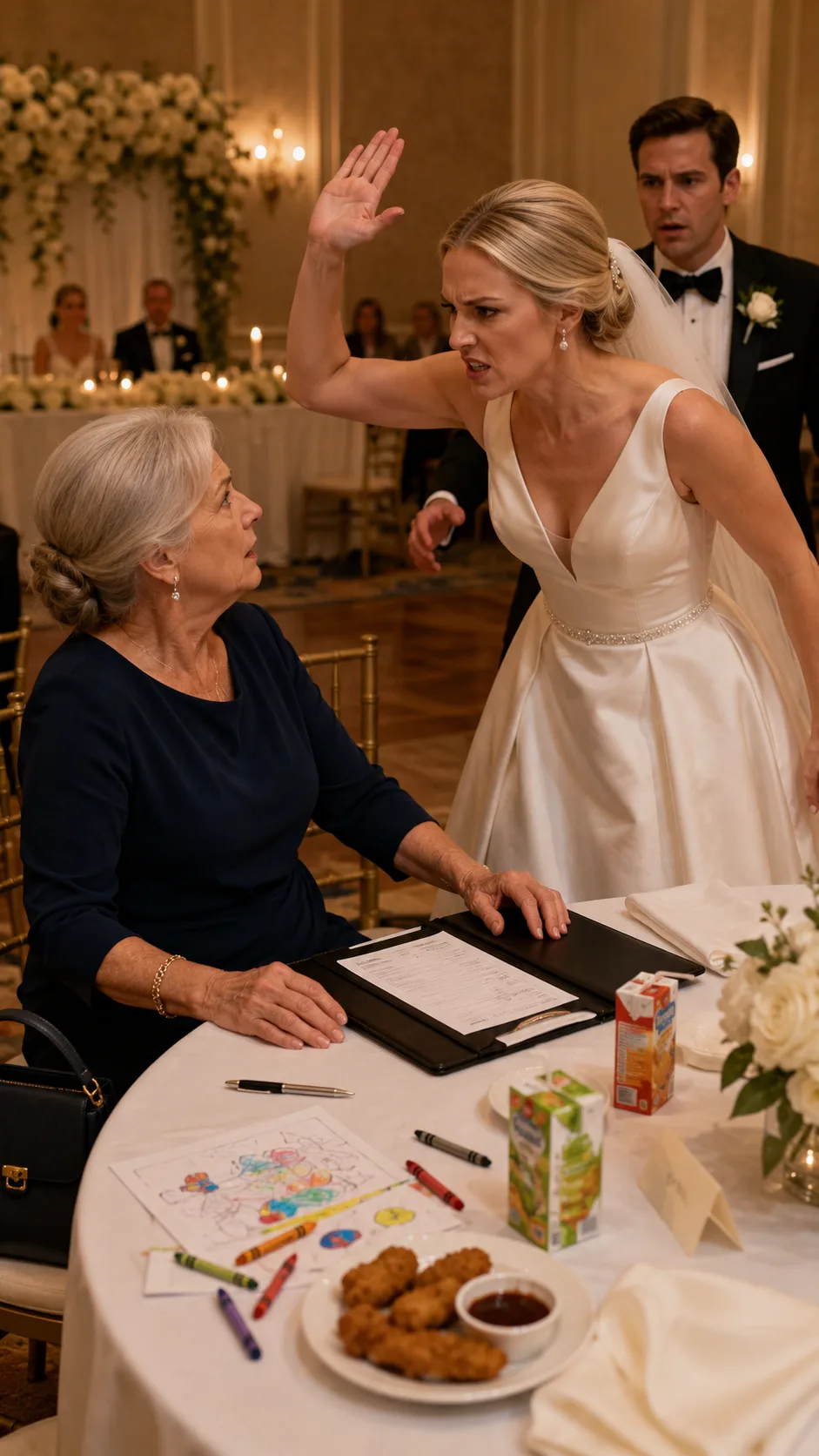
His eyes moved from my face to the contract, then to the children’s plate in front of my chair. Three chicken fingers. A small plastic cup of fruit. A folded napkin printed with cartoon flowers.
He saw it.
He understood it.
But still, he waited too long.
That was the answer.
I turned to the venue manager. “Please remove every charge I did not personally approve.”
Nicole made a small choking sound. “You can’t do that.”
The manager looked at me with the careful respect people use when they realize the quiet woman in
the corner is the only person holding the legal paper.
“She can dispute them,” he said.
“This is my wedding,” Nicole snapped.
“It is your reception,” I said. “But apparently it was my bill.”
Andrew stepped closer. “Mom, please don’t do this here.”
I looked at him. “Where would you prefer I do it? In the parking lot? Beside the trash bins? At the children’s table after dessert?”
His face twisted. “You’re angry. I understand.”
“No,” I said. “You understand numbers. You understand that I was useful when the deposit was due. You understand that I was embarrassing when the seating chart was made. But you do not understand what your silence did.”
Nicole threw her hands up. “Oh my God, this is exactly why I didn’t want her at the main table.”
A murmur moved through the room.
One of Andrew’s cousins stood near the bar, phone halfway raised,
then lowered it when I looked at him. Good. I did not need the internet to witness my humiliation. I needed my son to.
The manager quietly pulled the invoice closer and took out a clean copy.
“We can separate the charges,” he said. “The original contracted balance remains, but the additions can be reassigned to the bride and groom if Mrs. Bennett disputes authorization.”
Nicole stared at him. “We don’t have that kind of money tonight.”
There it was.
Not shock.
Not grief.
Not remorse.
Just money.
Andrew whispered, “Nicole.”
She spun on him. “What? We don’t. Your mother was supposed to cover it. That was the plan.”
The plan.
The word sat between us like a dirty plate.
I looked at my son. “That was the plan?”
His shoulders dropped. “It wasn’t like that.”
“Then explain it.”
He rubbed both hands over his face, careful not to meet
the eyes now watching from three nearby tables.
“Nicole thought,” he began, then stopped.
Nicole’s laugh was sharp enough to cut glass. “Don’t put this on me.”
I waited.
Andrew lowered his hands.
“She thought if the bill came directly to you, you’d pay it to avoid a scene.”
A woman near the floral arch whispered, “Oh, Andrew.”
I knew that voice. My sister Carol.
I had not seen her approach, but she was standing behind the children’s table now, one hand pressed to her chest, her eyes wet and furious.
Nicole saw her too, and panic flickered across her face.
Carol looked at Andrew. “Your mother sold her lake cabin to help you buy your first house.”
“Carol,” I said quietly.
“No,” she said. “No, Linda. I watched you excuse too much.”
Andrew’s face went pale.
Nicole blinked. “Lake cabin?”
I looked at my son. His mouth closed.
He had never told her.
Of course he had not.
The cabin had belonged to my late husband, David. It was small, old, and always smelled faintly of cedar and rainwater, but it was the place Andrew learned to fish, the place David carved our initials into the porch railing, the place I had planned to keep until my knees gave out.
Andrew came to me three years earlier with his voice shaking and his pride broken. He said the mortgage approval was falling apart. He said Nicole wanted a real home before marriage. He said he would pay me back.
I sold the cabin.
Not because I was foolish.
Because I loved him.
Nicole slowly turned toward Andrew. “Your mother gave us the down payment?”
Andrew swallowed.
I watched something shift in Nicole’s face. Not guilt. Calculation.
“Why didn’t you tell me?” she asked him.
He said, “Because you would’ve felt controlled.”
I almost laughed.
Controlled.
I had given them freedom and been repaid with a child’s meal.
The manager set the new invoice sheet on the table. “Mrs. Bennett, I need your initials beside each disputed charge.”
Nicole stepped forward quickly. “Wait. Linda. Let’s not be dramatic.”
I picked up the pen.
She put her hand over the paper.
Not hard, not yet. But possessive.
“This is between family,” she said.
I looked at her hand covering the invoice, the same hand that had struck my face minutes earlier.
“Move your hand.”
Her lips tightened. “I said this is family.”
“No,” I said. “Family does not hide you beside children and send you the bill.”
Andrew moved as if to touch my shoulder.
I stepped back before he could.
That hurt him. I saw it.
Good.
Pain was sometimes the only honest teacher left.
“Mom,” he whispered, “I’m sorry.”
I looked at him for a long moment.
I wanted those words to fix something. I wanted to feel the old pull in my chest, the mother’s instinct to smooth his hair and say he had made a mistake, not a choice.
But apology without action is just another place to hide.
I pointed to Nicole’s hand. “Then ask your wife to move.”
Andrew stared at Nicole.
She stared back at him, daring him.
The whole ballroom waited.
For once, so did I.
Andrew’s voice came out rough. “Nicole. Move your hand.”
Her face changed.
Not broken.
Exposed.
“You’re choosing her?” she whispered.
Andrew looked at me, then back at his bride. “I should have chosen what was right before she had to ask.”
Nicole pulled her hand away as if the paper had burned her.
I initialed the first disputed charge.
Then the second.
Then the third.
The pen sounded loud against the paper.
With each mark, Nicole’s perfect wedding became less perfect. Not ruined by me. Ruined by the truth she had trusted to stay quiet.
When I finished, the manager took the invoice.
“The revised balance due from Mrs. Bennett is the original contracted portion only,” he said. “The additional charges will be billed separately to Mr. and Mrs. Bennett.”
Nicole’s mouth opened. “We can’t pay that.”
I closed my purse.
“Then perhaps,” I said, “you should have seated your budget with the children.”
Carol made a sound behind me that was half sob, half laugh.
Andrew’s eyes filled.
“Mom,” he said. “Please don’t leave like this.”
I looked at the ballroom one last time — the flowers, the candles, the head table, the empty chair where I should have sat.
“I am not leaving like anything,” I said. “I am leaving exactly as you seated me.”
Then I turned and walked past the children’s table.
One little girl held out a blue crayon to me. “For your paper,” she whispered.
I took it gently.
“Thank you, sweetheart.”
At the ballroom doors, Andrew called after me.
This time, he did not say stop.
He said, “Mom, wait.”
So I did.
I turned back.
He was standing in the middle of the room, between his wife and his mother, between the life he wanted and the truth he had avoided.
Nicole’s veil slipped from one shoulder. Her flowers trembled in her hand.
Andrew walked toward me slowly.
Then, in front of every guest at his wedding, my son took off his boutonniere, placed it on the children’s table beside my untouched plate, and said, “I should have saved you a real seat.”
It was not enough to erase the slap.
It was not enough to restore the lake cabin, the years of excuses, or the quiet ways he had let me shrink.
But it was the first honest sentence he had spoken all day.
I nodded once.
Then I walked out of the ballroom with my contract in my purse, my cheek still red, and my dignity finally sitting where it belonged.
At the head of my own life.
THE END.
Chapter complete
You have reached the end of this chapter.
Continue reading
A few more worlds to get lost in after this chapter.




