PART 4 — The Life I Built After Saying No
At the end of the afternoon, I exchanged contact information with Christine and promised to keep in touch.
Chapter 4
At the end of the afternoon, I exchanged contact information with Christine and promised to keep in touch.
After she left, I stayed on the balcony watching the sunset and reflecting on our conversation.
Edward and Richard.
Father and son.
Both now out of my life.
One by death.
The other by prison.
Both leaving scars that I was still learning to heal.
That night, I wrote in my journal, a habit I had recently picked up.
The words flowed easily.
Today, at sixty-nine years old, I realized that I spent most of my life trying to be what others wanted me to be.
A devoted wife.
A selfless mother.
A personal bank.
Always available.
Always giving in.
Always afraid of displeasing.
Now finally, I’m learning to just be Elena.
And discovering that Elena is stronger, braver, and more capable than I ever imagined.
The money Richard extorted from me over the years, I can’t get it back.
The years I spent in a suffocating marriage to Edward,
I can’t have them back.
But the time I have left, that is all mine.
To live as I choose.
Without fear.
Without manipulation.
Without regrets.
The next day, I received an email from Christine.
She had talked to other women who went through similar situations and suggested forming a support group.
I accepted immediately.
Our first meeting was at a cafe near the beach.
There were five of us, all with stories of financial and emotional control by husbands, sons, and brothers.
We shared our experiences, our sorrows, our small and large victories.
At the end of the meeting, Marissa, who had accompanied me, suggested, “You should formalize this. Create a nonprofit organization or something. There are so many women out there who need to hear these stories, who need to know that it’s never too late to start over.”
The idea quickly took shape.
In a few months,
New Beginnings was officially registered as a nonprofit organization dedicated to supporting women victims of financial and emotional abuse.
Using my embroidery skills, I created our symbol.
A colorful phoenix rising from the ashes.
Our first public conference attracted more than fifty women.
I was nervous as I walked onto the small makeshift stage, but when I started to speak, my voice grew stronger.
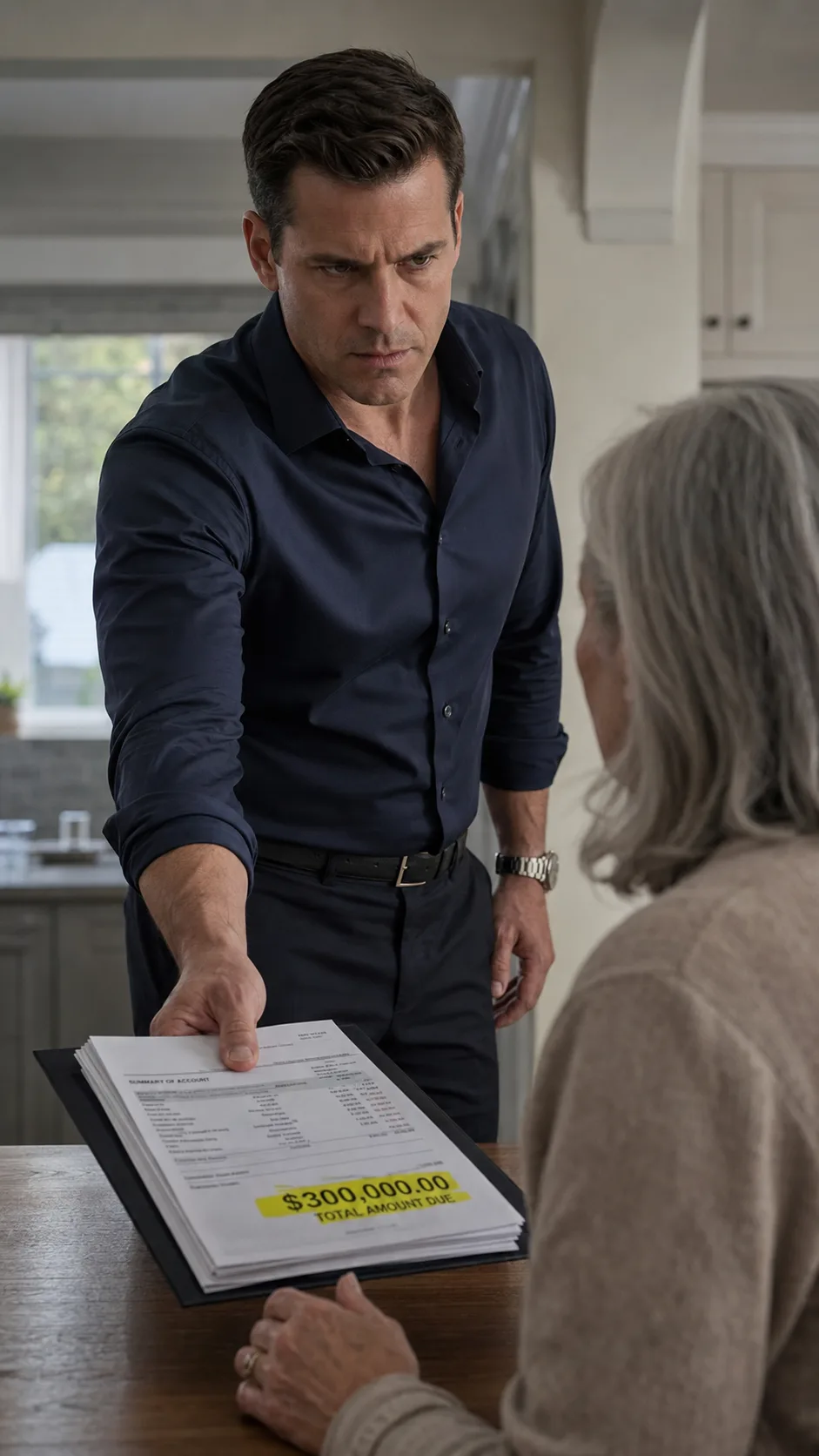
“My name is Elena Miller. I’m sixty-nine years old. For almost seven decades, I allowed others to control my life and my money. First my husband, then my son. Until one day, when my son demanded $300,000, almost everything I had, something inside me broke and mended itself.”
I looked at the attentive faces in the audience.
“It is never too late to say no. It is never too late to start over. And it is never, ever too late to find out who you really
are when you’re not living for someone else’s approval.”
The applause was deafening.
Two years after my escape, I received an unexpected letter.
It was from Richard, written in handwriting that seemed more contained, less impulsive than I remembered.
Mom,
It’s strange to write that word now. I think I’ve lost the right to use it. I’m writing not to ask for forgiveness. I know I don’t deserve it, but to say that I’m doing therapy here in prison. The therapist made me see patterns I couldn’t see before. How I repeated with you exactly what Dad did. How I learned to see people as resources, not as people.
I’m not apologizing. I’m just acknowledging the truth.
And the truth is that you were right to let me face the consequences of my actions.
I know you’ll probably throw this letter away. And I don’t blame you.
I just wanted you to know that despite everything, I’m proud of who you’ve become. I saw your picture in the newspaper speaking to those women. You looked different.
Stronger.
Richard.
I read the letter several times, feeling contradictory emotions.
Caution, because I knew Richard’s capacity for manipulation well.
Sadness, for what could have been.
And surprisingly, a touch of hope.
I did not answer immediately.
Instead, I took the letter to my next therapy session.
Another healthy habit I had acquired in my new life.
“What do you want to do?” my therapist asked after I read her the letter.
“I don’t know. Part of me wants to believe he’s really changing. Another part reminds me how many times I was fooled before.”
“What if both parts are right? What if he’s really trying to change, but it’s still not safe for you to reconnect?”
Those words stayed with me in the following days.
Finally, I wrote a brief response.
Richard,
I received your letter. I can’t say that I trust your words. Trust, once broken, is difficult to regain. But I acknowledge your effort to seek help and reflect on your actions.
My life now is focused on helping women who went through what I did. I’ve found purpose and peace in that work.
I sincerely hope you find your way too. If it is a true path of change, maybe we can talk again one day.
Not as the mother and son we were, but as two people trying to do better.
Elena.
I sent the letter without any great expectations.
I did not expect a response, and I did not receive one for months.
And that was okay.
My life had taken its own course, independent of Richard or the shadows of the past.
Spring came to Miami, transforming the city with vibrant colors.
Our organization, New Beginnings, had grown, now with a small office downtown and dedicated volunteers.
Twice a week, we offered free financial education workshops, something I myself had to learn from scratch at sixty-eight years old.
Fernanda had become a frequent collaborator, sharing her own journey of financial and emotional recovery.
My Saturday afternoons were reserved for my grandchildren, who now came to visit me regularly.
Ethan, almost ten years old, loved to fish at the pier near my apartment.
Mariana, at eight, had developed an interest in my embroidery.
“Grandma,” she asked me one afternoon as we worked on a piece together. “Are you happy now?”
The question took me by surprise.
I stopped embroidering and looked at my granddaughter, her curious eyes, her innocent face.
“Yes, honey,” I answered sincerely. “Happier than I’ve ever been.”
“Even without Grandpa and Dad?”
I chose my words carefully.
“Sometimes, Mariana, we need to move away from the people we love to find ourselves. That doesn’t mean we stop loving them. It just means we need to love ourselves too.”
She seemed to consider my words, her small eyebrows furrowed in concentration.
“Like when I need to be alone in my room sometimes, even though I like playing with Ethan.”
I smiled, admiring her childlike wisdom.
“Exactly.”
In June of that year, I received an unexpected call.
It was Detective Olivia.
“Mrs. Miller, I’m calling to inform you that your son will be transferred to a halfway house next month.”
The news caught me off guard.
“I thought with the additional charges…”
“He has demonstrated good behavior,” she completed, “completed rehabilitation programs, and his lawyers were able to get a sentence review. He’ll still have severe restrictions, but he’ll be able to work during the day.”
I thanked her for the information and hung up, feeling an uneasiness I had not experienced in a long time.
Richard would be partially free.
What would that mean for me, for Fernanda, for the kids?
I called Marissa immediately.
“Do you think I need to worry?” I asked after telling her the news.
Marissa, always practical, replied, “We’ll increase your apartment security just in case. But honestly, Elena, I doubt he’ll try anything. He would have too much to lose.”
A week later, I received another letter from Richard.
Unlike the previous one, this was formal, almost distant.
Elena,
I’m being transferred to a halfway house next month. I wanted you to hear it from me, not from anyone else. I’ll be working on a reforestation project during the day and returning to the facility at night and on weekends.
I have no intention of looking for you or interfering in your life in any way. I’ve learned my lessons the hard way.
The therapist here says that respecting boundaries is the first step toward healthy relationships. I’m trying to practice that.
I also wanted you to know that I’ve been corresponding with Fernanda about the kids. She agreed to let me write them letters under her supervision. Maybe one day I can see them again when she feels it’s safe.
Richard.
The absence of the word Mom at the beginning and end of the letter did not go unnoticed.
He was truly trying to establish a new dynamic, respecting that our old relationship was irrevocably broken.
I shared the letter with Fernanda on our next video call.
She confirmed that she was indeed allowing Richard to write to the kids.
“Their therapists believe it’s important not to completely demonize their father,” she explained. “And his letters have been different. He asks about their interests. He doesn’t try to manipulate. He doesn’t make empty promises.”
“Do you think he’s really changed?” I asked.
Fernanda shrugged.
“Maybe. Or maybe he’s learned to be more subtle. That’s why everything is supervised.”
She paused.
“Are you going to respond to this letter?”
I thought for a moment.
“I think so. To make it clear that I’m aware of the situation and that my boundaries remain intact.”
My response was brief.
Richard,
Thank you for informing me about your transfer. I wish you well in this new phase. I’m glad to know you’re in supervised contact with your children. They deserve a father who can be healthy and positive in their lives.
As I said before, I found my way. I sincerely hope you find yours too.
Elena.
July came with intense heat.
On a particularly sweltering Wednesday, I received an unexpected call.
“Mrs. Elena, this is Sophia from the correctional rehabilitation center. We have a situation with your son, Richard Miller.”
My heart raced.
“Is he okay?”
“Physically, yes. But there was an incident at the work site today. He had an argument with another inmate and, well, he refused to retaliate when he was provoked. In fact, he walked away and found a supervisor. The problem is that it makes him a target for other inmates, and we’re worried about his safety.”
“What does that have to do with me?” I asked, confused.
“Richard requested a transfer to another project, ideally one where he can work alone or with direct supervision. We have an opening in an urban rehabilitation program restoring a public park near your neighborhood, but we need your approval given the history between you.”
I was silent for a moment, processing the situation.
Richard had chosen not to retaliate, even when provoked, something the Richard I knew would never have done.
And now he needed my help.
“Did he specifically ask to work near me?” I asked cautiously.
“No, ma’am. In fact, when we mentioned the location, he hesitated and asked if there were other options. But this is the only project that meets his security needs right now.”
That surprised me.
Richard was really trying to respect my space.
“How far would his work site be from my apartment?” I asked.
“Approximately fifteen blocks. He wouldn’t have permission to leave the project area, which will be monitored.”
I took a deep breath.
“Okay. I give my approval.”
After hanging up, I questioned my decision.
Was I being naive again, or was I finally exercising compassion without compromising my boundaries?
I called Marissa and explained the situation.
“You did the right thing,” she assured me. “Keeping Richard safe while he tries to rehabilitate doesn’t mean lowering your defenses. It just means you’re human and you have compassion.”
The following week, Richard started his new job at the park.
On purpose, I changed my route to the market to pass by there, keeping my distance.
I saw him from afar, planting young trees under the scorching sun.
He was thinner, his posture less arrogant.
For a moment, he seemed to feel my presence and looked in my direction.
But I did not get closer.
In August, I received another letter.
Elena,
I know you saw me at the park a few weeks ago. Thank you for not approaching me, and thank you for approving my transfer to this project. The work has been therapeutic. There is something deeply satisfying about transforming an abandoned space into something beautiful and useful for the community.
I’m not asking for forgiveness or reconciliation. I just wanted to express gratitude for this small act of kindness that I don’t deserve.
Richard.
The letter was different from the others.
More centered.
Less manipulative.
I decided to respond with a symbolic gesture.
The next day, I left a small box at the community center that supervised the project.
Inside were good-quality gardening tools and a book on urban landscaping.
No note.
No expectations.
Weeks passed without a response, and that was okay.
I had learned that healthy relationships do not require immediate or calculated reciprocity.
In September, our organization, New Beginnings, held a major event, a weekend workshop on financial independence for women.
I would be the main speaker, sharing my journey from total dependence to financial autonomy.
On the morning of the event, the hall was filled with almost one hundred women.
I walked onto the stage feeling that familiar mix of nervousness and determination.
“Good morning,” I began. “My name is Elena Miller. At seventy years old, I’m learning who I am when I’m not being defined by the men in my life.”
The audience laughed gently, many nodding in recognition.
“Three years ago, my son showed up at my door demanding $300,000, almost everything I had. Like so many times before, he was counting on my inability to say no. And as so many of you know, these patterns don’t start out of nowhere. They are cultivated over decades. In my case, it started with my husband controlling every penny, every decision, making me believe that I was incapable of managing my own life.”
As I spoke, I noticed movement at the back of the room.
A tall, thin figure had entered discreetly and was standing near the door.
My heart raced as I recognized Richard.
For a moment, I lost the thread of my speech.
The audience sensed my excitement, some turning to see what had distracted me.
I took a deep breath and continued.
“The most difficult and most liberating moment of my life was when I finally said no. When I walked out the door with only a suitcase and the determination to no longer be an extension of someone else’s bank account.”
I spoke for thirty more minutes, aware of Richard’s silent presence at the back of the room.
He did not try to get closer.
He just listened.
When I finished, I received a standing ovation.
Women came up to me to share their stories, ask for advice, and offer thanks.
Richard stayed where he was, patiently waiting for the crowd to thin out.
Finally, when the hall was almost empty, he slowly approached.
He seemed uncertain, vulnerable in a way I had never seen before.
“Hello,” he said simply.
“Hello,” I replied.
“Your speech was both powerful and painful to listen to.”
He paused.
“Thank you for the gardening tools.”
We stood in an awkward silence.
Two people who were once so close, now practically strangers.
“How did you know about the event?” I finally asked.
“Fernanda mentioned it in a letter. I asked for special permission to come just to listen.”
I nodded, noticing how he was respecting boundaries, asking for permission instead of assuming rights.
“Are you okay?” I asked, genuinely curious.
“I’m different,” he replied after a moment of reflection. “Learning to live with the consequences of my choices. Learning to exist without manipulating or controlling.”
He looked at me directly.
“Learning that people are not means to an end.”
We talked for almost an hour.
There were no great revelations or dramatic reconciliations.
Just two adults sharing experiences honestly, perhaps for the first time.
When we said goodbye, Richard asked, “Can we do this again sometime?”
“Maybe,” I replied. “One step at a time.”
The next morning, as I walked on the beach with Marissa, I reflected on the meeting.
“Do you think he’s really changed?” my friend asked.
“I think he’s trying,” I answered honestly. “And that’s more than Edward ever did.”
“And what about you? Are you ready to forgive?”
I watched the waves breaking on the sand, their eternal rhythm of destruction and renewal.
“Forgiveness isn’t something you give all at once,” I finally said. “It’s a daily practice. I’m learning to forgive both him and myself for allowing it for so long.”
That afternoon, sitting on the balcony of my small apartment, I wrote in my journal.
Today, at seventy years old, I’m learning that life rarely offers perfect endings.
There’s no guarantee that Richard has truly changed or that he will continue on this path.
There’s no certainty that I won’t fall back into old patterns in moments of weakness.
But maybe life isn’t about perfect endings.
Maybe it’s about starting over as many times as necessary.
About breaking toxic cycles even when it seems impossible.
About believing we can be more than our worst moments or our most painful mistakes.
The money Richard demanded that morning three years ago was the price of my liberation.
A high price, but infinitely less than the cost of remaining trapped in a life that wasn’t truly mine.
Today, I’m not financially rich.
I live modestly.
I earn enough selling my embroidered pieces and with my small savings.
But I am immensely rich in other ways.
In genuine friendships.
In purpose.
In inner peace.
In a courage I did not know I possessed.
And if there is one lesson I would like to leave for my granddaughters, for all the women I meet through New Beginnings, it is this.
It is never too late to say no.
It is never too late to rediscover who you are when you are not living to please others.
It is never too late to start over.
At seventy years old, I am not ending my story.
I am just beginning to write the most authentic chapters.
I closed the journal and watched the sunset paint the sky in shades of orange and purple.
Tomorrow would be another day of work at the organization, another opportunity to transform my pain into purpose, my experience into guidance for others.
The doorbell rang.
It was Marissa with a bottle of wine.
“To celebrate,” she said, walking in.
“What are we celebrating?”
“Three years since you said no. Three years of freedom.”
We smiled and toasted under the sunset sky.
“To courage,” I proposed.
“To Elena,” Marissa corrected, “finally living her own life.”
Now, if you liked this story, click to subscribe and tell me in the comments what part blew you away.
Oh, and do not forget to become a member to get access to exclusive videos that I do not post here.
I will see you there.
THE END.
Chapter complete
You have reached the end of this chapter.
Continue reading
A few more worlds to get lost in after this chapter.




