Powerful Opening: The Wife They Called a Mistress
By sunrise, the internet had decided I was a whore.
Chapter 1
By sunrise, the internet had decided I was a whore.
Not in legal language, of course.
People rarely use honest cruelty when hashtags are available.
They called me homewrecker.
Gold digger.
Secretary slut.
Corporate side piece.
And, most popular by 8:17 a.m.:
#CEOMistress
My name was Isla Bennett.
Twenty-eight.
Executive secretary to Alexander Crane, CEO of Crane Global.
Efficient.
Quiet.
Well-dressed in the way women learn to be when a single wrinkle becomes proof they are unprofessional.
And, according to every tabloid by breakfast, the woman secretly sleeping with a CEO who was already engaged to America’s favorite heiress.
The headline that started it all came from The Daily Glass:
CEO’S SECRETARY LEAVES HIS PENTHOUSE AT DAWN — WHAT WOULD HIS FIANCÉE SAY?
There were photos.
Of course there were photos.
Me stepping out of Alex’s private elevator at 5:12 a.m.
Me wearing yesterday’s black dress under his gray coat.
Me looking
down, hair loose, face tired.
Me getting into a car outside the building.
A woman leaving a man’s home before the city woke up.
A perfect story.
Except for one detail.
I had every legal right to be there.
Because Alexander Crane was not my lover.
Not my affair.
Not my boss with benefits.
He was my husband.
And had been for two years.
Not that anyone knew.
At 6:03 a.m., my phone started vibrating.
First my best friend Mara.
Then my mother.
Then unknown numbers.
Then HR.
Then reporters.
Then a text from my direct work line:
Do not come into the office until further notice.
I sat on the edge of the bed in my apartment, the same apartment I kept because Alex and I had agreed our marriage had to be invisible, and watched my life become public while the truth stayed locked in a courthouse
file.
The second wave hit at 7:40.
Celeste Whitmore went on morning television.
Celeste.
Heiress.
Philanthropist.
Society darling.
The woman business magazines had called Alex’s “presumed future bride” because her family had been negotiating a strategic merger with Crane Global for months.
Not his fiancée.
Not legally.
Not personally.
But close enough for tabloids.
Close enough for Celeste to wear white on camera and cry like she had rehearsed vulnerability in front of three mirrors and a lighting team.
“I trusted him,” she said, voice trembling beautifully. “I never imagined the woman closest to his office was also closest to his bed.”
The clip went viral in twelve minutes.
Twelve minutes.
That was all it took for strangers to decide they knew the shape of my soul.
By eight, the company Slack channels were locked.
By eight-thirty, my building doorman looked at me with pity.
By nine, someone had posted
my old college photos online.
By ten, my mother called crying.
“Isla,” she whispered, “tell me it isn’t true.”
I closed my eyes.
“It isn’t true the way they’re saying it.”
“Then what is true?”
I could not answer.
Not because I was ashamed.
Because for two years, Alex and I had built a life around the phrase not yet.
Not yet, Isla.
Not until the board vote.
Not until my mother loses leverage.
Not until the merger pressure is gone.
Not until it’s safe.
Safe.
That was what he called it.
The secret apartment.
The removed wedding ring.
The careful arrivals.
The separate public calendars.
The way he kissed me in elevators with security disabled but introduced me in boardrooms as Miss Bennett.
Safe.
I called it love because I wanted to believe hiding could be temporary.
But temporary had a way of becoming furniture if no one moved it.
At 10:18, Alex called.
I stared at his name.
Alexander Crane
Not husband.
Never husband.
I answered.
His voice was low and rough.
“Isla.”
“Don’t.”
A silence.
Then:
“I’m fixing it.”
I laughed.
It came out wrong.
“You’re fixing it?”
“Yes.”
“Are you going to deny sleeping with your secretary?”
“No.”
“Are you going to say I’m a disgruntled employee?”
His breathing changed.
“Never.”
“Are you going to say Celeste misunderstood?”
“No.”
“Then what are you going to say, Alex?”
He was quiet.
Too quiet.
The old fear moved in me.
The one I hated.
The one that had learned to expect delay.
“Alex.”
“I’m holding a press conference at noon.”
My chest tightened.
“And?”
“And I’m telling the truth.”
I stood.
Too fast.
“What truth?”
“All of it.”
My hand shook around the phone.
I wanted to believe him.
That was the worst part.
Even after the headlines, the comments, the morning show tears, the way the world had dragged me by my hair through the mud, some part of me still wanted the man I loved to arrive before the damage became permanent.
“You should have done that before,” I said.
His voice broke, barely.
“I know.”
“No, you don’t. They called me your mistress.”
“I know.”
“They called me a homewrecker.”
“I know.”
“They called me everything but wife.”
Silence.
Then:
“I am going to correct that.”
“After they destroyed me.”
His breath caught.
Good.
Let it hurt.
“I’ll watch,” I said.
Then I hung up.
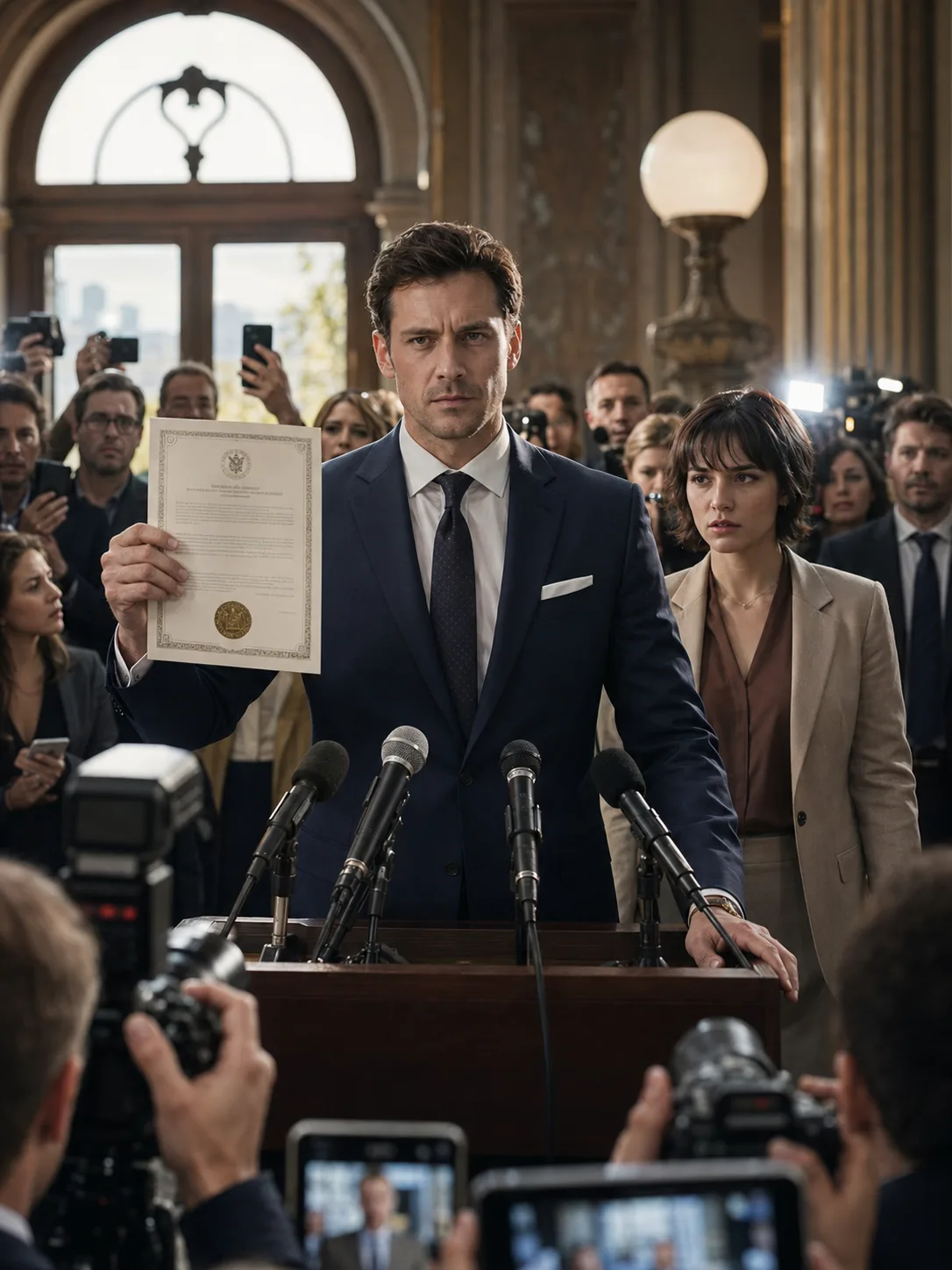
At noon, Alexander Crane walked into a press conference alone.
No publicist.
No Celeste.
No mother.
No board chairman.
Just him, a wall of cameras, and the cold stillness that made powerful men afraid to interrupt him.
Reporters shouted before he reached the podium.
“Mr. Crane, do you deny the affair?”
“Is your engagement to Celeste Whitmore over?”
“Was Isla Bennett suspended?”
“Did you abuse your position as CEO?”
Alex placed a document folder on the podium.
He looked directly into the cameras.
“No,” he said.
The room quieted.
“I will not deny the relationship.”
A roar of questions exploded.
He raised one hand.
“Because the scandal is not that I love Isla Bennett.”
The room went still again.
His voice sharpened.
“The scandal is that I hid her.”
He opened the folder.
Held up a certified document.
A marriage certificate.
Our marriage certificate.
My name beside his.
Isla Rose Bennett Crane.
Signed two years ago.
Stamped by the State of New York.
Alex looked back at the reporters.
“Isla Bennett Crane is not my mistress. She is my wife. She has been my wife for two years.”
The room went silent.
For one second, the whole world had no words.
Then he added:
“And every person who helped turn my wife into a public lie will answer for it.”
We married on a rainy Thursday in a courthouse that smelled like wet coats and old paper.
There were no flowers.
No family.
No photographer.
Just Alex, me, a clerk who mispronounced my middle name, and two witnesses from his legal department who signed confidentiality agreements before signing our certificate.
Romantic, I know.
I met Alex three years before the scandal, when I was hired as executive secretary at Crane Global.
He was thirty-four then.
Already CEO.
Already impossible.
He did not shout.
He did not need to.
A single raised eyebrow from Alexander Crane could make vice presidents reconsider their life choices.
I was good at my job because I understood silence.
Not submissive silence.
Strategic silence.
I knew when to speak, when to wait, when to place a document in front of him before he asked, and when to tell him he was about to make a stupid decision in a tone polished enough to survive HR.
The first time I corrected him, the room froze.
He had scheduled three investor calls back-to-back after a red-eye flight from Singapore.
I said:
“That is not a calendar. That is a medically assisted collapse.”
The CFO coughed.
Alex looked at me for five seconds.
Then said:
“Move the second call.”
After that, he trusted me.
Trust became late nights.
Late nights became dinners at his desk.
Dinners became him asking about my mother, my childhood, the books I kept in my bag.
The first time he laughed because of me, I forgot every rule I had made about men with corner offices.
The first kiss happened in his private elevator.
Of course it did.
Everything secret about us seemed to happen in spaces between floors.
He had just won a brutal board fight against his mother, Victoria Crane, who still chaired the family trust and considered emotion a governance risk.
I told him he looked like a man who had survived a knife fight in a suit.
He said:
“I was raised in one.”
Then he kissed me.
For six weeks after that, we tried to stop.
We failed with enthusiasm.
Then Victoria found out.
Not about the sleeping together.
About the way he looked at me.
That was enough.
She summoned me to her office, which was technically not an office but a private museum of expensive disapproval.
“Miss Bennett,” she said. “You are intelligent, so I will not insult you by pretending you don’t understand the danger of your current proximity to my son.”
“Your son is my employer.”
“For now.”
The threat was soft.
Precise.
“You will resign,” she said. “Quietly. With excellent references.”
“No.”
Her eyes sharpened.
“You think he will choose you over Crane Global?”
I should have said yes.
I did not.
That night, Alex came to my apartment.
Furious.
Not at me.
At her.
At himself.
At the family system that turned every human feeling into leverage.
“She can’t touch you if you’re my wife,” he said.
I stared at him.
“That is the least romantic proposal in American history.”
His jaw tightened.
“I know.”
“You want to marry me as a legal shield?”
“No.”
“Then why?”
He looked at me.
Really looked.
And for once, the CEO disappeared.
The man underneath looked terrified.
“Because I love you. And because I live in a world where love without legal protection becomes a target.”
I married him.
Not because it was wise.
Because he said love and looked like he had never trusted the word before.
That should have made me careful.
Instead, it made me brave in exactly the wrong direction.
At first, secrecy felt temporary.
Almost thrilling.
A ring worn on a chain under my blouse at work.
His hand finding mine under conference tables.
Him calling me his wife in the penthouse kitchen like the word was too precious to use outside.
Then months passed.
Then a year.
Then two.
The ring stayed hidden.
The public calendars stayed separate.
The world still saw me as Miss Bennett, the efficient secretary who worked too late and knew too much.
Every time I asked about going public, Alex had a reason.
The board was unstable.
Victoria was moving against him.
The trust clause could be challenged.
A workplace disclosure had to be handled carefully.
A CEO marrying his subordinate could trigger an ethics review.
All true.
All convenient.
The worst lies are often built from facts.
I was tired of living in the footnotes of his life.
One night, six weeks before the scandal, I stood in his closet holding my wedding ring.
His tuxedo was laid out for the Whitmore Foundation gala.
Celeste Whitmore would be there.
The press had already started calling her his future fiancée.
I looked at Alex in the mirror.
“Do you want me there?”
He stopped adjusting his cufflink.
“You know I do.”
“No. I know you want me near. That’s not the same as wanting me seen.”
His face tightened.
“Isla.”
“Don’t say my name like it’s an answer.”
He turned.
“I’m handling the Celeste situation.”
“There it is.”
“What?”
“Handling. Protecting. Timing. Strategy. All the beautiful words you use so you don’t have to say you’re scared.”
His jaw flexed.
“I am scared.”
That stopped me.
He continued:
“I am scared that if I reveal you before I control the board, my mother will turn our marriage into an ethics scandal, remove me, destroy your career, and make you the woman who cost thousands of employees their stability.”
I wanted that to be enough.
It almost was.
Almost is how women survive things they should not accept.
“And if they call me your mistress first?” I asked.
His face went still.
“They won’t.”
“They might.”
“I won’t let them.”
He believed it.
That was the tragedy.
Powerful men often think love is safe if they personally intend no harm.
They forget the world has hands too.
Celeste Whitmore was not stupid.
I could have respected her if she were.
Stupid cruelty is easier to survive.
Celeste was strategic cruelty in silk.
The first time we met, she smiled at me across Alex’s office like she was studying a chair she intended to replace.
“You must be Isla,” she said.
“Miss Bennett is fine.”
Her smile widened.
“Formal. I like that.”
Alex was on a call.
He did not hear.
Or pretended not to.
Celeste placed a white folder on my desk.
“For Alex.”
“You can leave it here.”
“Oh, I’d rather hand it to him personally.”
“He’s unavailable.”
“For me?”
“For anyone.”
Her eyes cooled.
“You’re very protective for an assistant.”
“And you’re very persistent for a guest.”
For one second, the mask slipped.
Then she laughed.
“I see why he keeps you.”
The words were poison wrapped in honey.
Later, after she left, I told Alex:
“She knows.”
His expression sharpened.
“What?”
“She knows I’m not just your secretary.”
“She suspects.”
“That’s worse. Suspecting people improvise.”
“I’ll handle it.”
I closed my eyes.
“Alex.”
“I will.”
He did not.
Celeste’s family pushed the merger.
Victoria encouraged the press.
Articles appeared.
Crane-Whitmore Alliance Could Become Personal
Is Alexander Crane Finally Ready to Settle Down?
Celeste Whitmore and Alexander Crane: A Power Match?
Alex issued no denial.
Because denying would raise questions.
Because timing.
Because strategy.
Because not yet.
Then The Daily Glass published the photos.
And Celeste cried on television.
I watched Alex’s press conference from my apartment sofa with Mara beside me.
Mara was my best friend, an employment attorney, and the only person outside Alex’s legal team who knew about the marriage.
She held a mug of tea in one hand and a legal pad in the other.
“I’m writing down everyone we sue,” she said.
“You seem excited.”
“I enjoy organized rage.”
On screen, Alex held up our marriage certificate.
Mara went still.
“He did it.”
I could not speak.
Reporters began shouting.
“Why was the marriage hidden?”
“Was Ms. Bennett forced to sign an NDA?”
“Is Celeste Whitmore your fiancée?”
“Did you mislead investors?”
Alex answered with the calm brutality that made him dangerous.
“No, Celeste Whitmore is not my fiancée. There was no engagement. There was a proposed strategic alliance between Crane Global and Whitmore Holdings. Any representation of a personal engagement was false.”
A reporter shouted:
“Did Miss Whitmore know you were married?”
Alex’s eyes turned cold.
“Yes.”
Mara whispered, “Oh, hell.”
Alex continued:
“Celeste Whitmore and Victoria Crane were aware of my marriage to Isla Bennett Crane. Evidence in our possession indicates the tabloid story was planted to publicly discredit my wife and force her resignation before the merger announcement.”
The room exploded.
I sat frozen.
Mara started writing faster.
A reporter asked:
“Why didn’t you disclose the marriage earlier?”
There.
The question.
The one that mattered.
Alex looked directly into the nearest camera.
“Because I was a coward and called it protection.”
My breath caught.
He did not stop.
“I believed I could shield my wife from my family by hiding her from the world. Instead, I made it easier for them to erase her. That failure is mine.”
Mara’s pen stopped.
I pressed a hand to my mouth.
Alex’s voice lowered.
“To Isla: I should have told the truth before lies became profitable.”
The camera flashes were constant.
His face did not move.
But I knew him.
I saw the break beneath the stillness.
“I will be stepping back from CEO duties pending an independent review of governance, workplace disclosure procedures, and the attempted reputational harm against my wife. Crane Global will also pursue legal action against The Daily Glass and any parties involved in the fabrication.”
A reporter shouted:
“Is your wife standing by you?”
Alex paused.
Then said:
“That is her choice. Not mine to announce.”
I turned off the TV.
Mara looked at me.
“Well?”
I stood.
“I need to leave before he comes here.”
“Do you want him to come?”
“Yes,” I said.
Then laughed because the answer hurt.
“That’s why I need to leave.”
I went to my mother’s house in Queens.
Not because it was strategic.
Because when your life burns down publicly, sometimes you need soup made by someone who loved you before men in suits complicated everything.
My mother opened the door and pulled me into her arms.
She did not ask why I had not told her.
Not immediately.
She let me cry first.
That was love.
Later, at the kitchen table, she placed tea in front of me and said:
“Two years?”
“Yes.”
“You married a billionaire and still let me pay for my own washing machine?”
I laughed through tears.
“I offered.”
“I thought it was assistant money.”
“It was wife money.”
She shook her head.
“I raised a dramatic child.”
“I know.”
Then her face softened.
“Did he make you hide?”
The question mattered.
“No,” I said slowly. “Not at first. I agreed.”
“And later?”
I looked into my tea.
“Later, I waited for him to choose daylight.”
My mother sighed.
“Men often enjoy the comfort of a woman’s patience until it becomes the place they store their fear.”
I stared.
“Where was that wisdom two years ago?”
“You did not ask.”
Fair.
Alex came that evening.
Of course he found me.
He did not knock like a CEO.
He knocked like a man who knew he might be turned away.
My mother opened the door.
“Alexander,” she said.
“Mrs. Bennett.”
“You broke my daughter’s heart in high definition.”
His face tightened.
“Yes.”
“Good. We’re starting with honesty.”
I stayed in the kitchen.
I heard every word.
He did not ask to come in.
He did not explain.
He said:
“I am sorry.”
My mother said:
“To me?”
“To Isla. To you for making her carry a marriage alone. To anyone who loved her and had to learn the truth from a press conference because I kept confusing secrecy with control.”
Silence.
Then my mother said:
“You may come in. But if she asks you to leave, you leave.”
“Yes, ma’am.”
He entered the kitchen.
No suit jacket.
Hair slightly disordered.
Eyes tired.
He looked at me like he had missed me for years, not hours.
I hated that I loved his face.
“They called me your mistress,” I said.
“I know.”
“You told them I was your wife.”
“Yes.”
“After they destroyed me.”
His throat moved.
“Yes.”
“That certificate proves I’m your wife. It doesn’t prove I was treated like one.”
Pain crossed his face.
“No. It doesn’t.”
Good answer.
Infuriatingly good.
“I’m staying here,” I said.
“I understand.”
“No, you don’t. I mean I’m not coming home because you finally did the minimum in public.”
His eyes lowered.
“I know.”
“I need space.”
“You’ll have it.”
“No security outside.”
His jaw tightened.
Then:
“Okay.”
“No legal team calling me unless Mara approves.”
“Yes.”
“No statements about my feelings.”
“Of course.”
“No flowers.”
“I already canceled them.”
I blinked.
“You ordered flowers?”
“Yes.”
“What kind?”
He looked guilty.
“White roses.”
My mother made a disgusted sound from the doorway.
Alex looked genuinely ashamed.
“I panicked.”
I almost laughed.
Almost.
Then I remembered Celeste in white.
The articles.
The comments.
The ring under my blouse.
“I don’t know if I can forgive you.”
His voice was quiet.
“I don’t know if I can forgive myself.”
“Don’t make that my problem.”
He flinched.
“You’re right.”
“Stop being agreeable.”
“I’ll try.”
“Bad start.”
For the first time, his mouth almost curved.
Then he sobered.
“I love you, Isla.”
I closed my eyes.
The words still hurt.
“I know.”
“I should have said it where everyone could hear before I needed to defend you.”
“Yes.”
“I will spend the rest of my life—”
“No,” I cut in. “Do not make a lifetime speech in my mother’s kitchen after one public apology.”
My mother said from the doorway, “She’s right.”
Alex nodded.
“I’ll go.”
He turned to leave.
I hated that he listened.
I loved that he listened.
Both things were inconvenient.
At the door, he looked back.
“Isla.”
“Yes?”
“I am not asking you to stand by me.”
“Good.”
“I am going to stand where I should have stood first. Beside the truth. Whether you come back or not.”
That was good.
Too good.
I waited until he left to cry.
My mother made more tea.
The investigation moved quickly because Alex made it impossible to move slowly.
He handed over emails.
Board memos.
Internal messages.
Security footage.
Tabloid payment records.
Victoria Crane had coordinated with Celeste’s media team.
Celeste had posed as betrayed fiancée while knowing Alex was married.
The Daily Glass had accepted doctored context around the photos, including cropped images that removed Alex’s wedding ring from one frame and misrepresented my address as his penthouse when I had legally shared residence rights.
HR had prepared a suspension notice for me before any internal review.
That part made me cold.
Before the press conference, while the world was calling me a mistress, Crane Global had been preparing to treat me like one.
The independent investigator asked me to give a statement.
I agreed.
Not because of Alex.
Because of every woman who had ever been turned into a liability by men who feared admitting the truth.
I entered Crane Global three weeks after the scandal.
The lobby went quiet.
People recognized me now.
Not as Miss Bennett.
Not exactly as Mrs. Crane.
As the woman they had already judged and were now unsure how to greet.
Mara walked beside me as counsel.
She enjoyed glaring at people.
In the conference room, I gave my statement.
I explained the marriage.
The secrecy.
The workplace structure.
The way I had removed my ring before entering the building.
The way gossip became weaponized.
The way HR protected executive optics before employee dignity.
Then the investigator asked:
“Did Mr. Crane pressure you to keep the marriage confidential?”
I paused.
“No,” I said. “At first, I agreed. Later, his reasons became a cage we both kept decorating.”
Mara wrote that down.
Probably because she liked the sentence.
When I left, employees stood in the hallway.
Some looked ashamed.
Some curious.
Some sympathetic now that sympathy was safe.
Then a young assistant named Nina stepped forward.
“I’m sorry,” she said.
The hallway froze.
“I shared one of the posts,” she continued, voice trembling. “I didn’t know. But I should have known better than to make a woman’s life into entertainment.”
That apology mattered more than most.
Because it did not ask me to excuse her.
It named what she did.
I nodded.
“Thank you.”
That was all.
Forgiveness, like truth, should not be rushed because people are uncomfortable.
Celeste’s downfall was not graceful.
It should have been.
She had the wardrobe for it.
But women like Celeste often confuse elegance with immunity.
She gave one final interview, trying to recast herself as a victim of “emotional ambiguity.”
Mara nearly threw a shoe at the television.
Alex sued The Daily Glass.
Then Celeste personally.
Then Victoria.
Civil claims.
Defamation.
Tortious interference.
Workplace conspiracy.
Securities misrepresentation around the proposed merger.
It was not romantic.
It was legal.
That made it better.
Celeste’s emails leaked during discovery.
If the secretary resigns before disclosure, Alex will have fewer options.
Make her look like the kind of woman boards fear.
Victoria says he will choose the company if the cost is public shame.
I read that line five times.
Not because it surprised me.
Because it explained the precision of the cruelty.
They had not simply lied.
They had selected the oldest story available.
Powerful man.
Innocent fiancée.
Ambitious secretary.
Mistress.
A costume cut to fit any woman too close to authority.
Victoria resigned from the Crane trust board before she could be removed.
Alex did not attend her resignation meeting.
He sent a statement:
The governance structure that required my wife’s erasure will no longer benefit from my silence.
Dramatic.
Effective.
Very Alex.
He did not send it to me first.
Good.
He was learning not to make every public truth a private audition.
Three months after the scandal, Alex asked me to dinner.
Not at his penthouse.
Not at a private club.
A small Italian restaurant near my mother’s house where the chairs were uncomfortable and the bread was perfect.
I said yes.
Then regretted it.
Then went anyway.
He stood when I arrived.
Old-fashioned.
Nervous.
Beautiful.
Annoying.
“You look well,” he said.
“You look underfed.”
His mouth curved.
“I deserve that.”
“It wasn’t punishment. It was observation.”
We sat.
For the first ten minutes, we talked like strangers who knew each other’s coffee order and worst fears.
Then I said:
“Do you miss being CEO?”
He looked at me.
“Yes.”
Honest.
Good.
“Do you regret stepping back?”
“No.”
“Do you regret the press conference?”
“No.”
“Do you regret marrying me?”
His face changed.
Pain, immediate.
“No.”
I looked down at the bread.
“Sometimes I wonder if you would have ever told the truth if the scandal hadn’t happened.”
He did not answer quickly.
That mattered.
Finally, he said:
“I want to say yes.”
I looked up.
“But?”
“But I don’t know. I had convinced myself timing was protection. I might have waited until there was no perfect time and called that sacrifice.”
The honesty hurt.
But it was the kind that healed around the edges.
“I hate that answer.”
“I know.”
“It’s the right answer.”
“I know that too.”
I almost smiled.
He leaned forward.
“I am not asking you to come back to the way we were.”
“Good. That way was killing me politely.”
His jaw tightened.
“Yes.”
“What are you asking?”
“To date my wife.”
I stared.
“That is ridiculous.”
“Yes.”
“Also technically adultery with myself.”
His mouth twitched.
“I’ll have legal review.”
I laughed before I could stop it.
He looked at me like the sound was sunlight after years underground.
That was unfair.
“Slowly,” I said.
“Slowly.”
“Publicly.”
“Yes.”
“No more hidden ring.”
“No.”
“No more ‘not yet.’”
His face sobered.
“Never again.”
“And if your mother sends me one more handwritten note beginning with ‘Dear girl’—”
“I’ll burn it myself.”
“Healthy.”
“My therapist would disagree.”
“You have a therapist?”
“Yes.”
“Good.”
“She says I use control to manage abandonment fear.”
“Your therapist is underpaid.”
He smiled.
A real one.
I missed it.
I hated how much.
Dinner did not fix us.
But it began something honest.
That was better.
We did not need a second wedding.
Legally.
Emotionally, we did.
Not because the first one had not counted.
It had.
That was the point.
The first wedding gave me legal status without public dignity.
The second gave me witnesses.
Six months after the press conference, after the lawsuits settled, after The Daily Glass printed a front-page correction so large Mara framed it, after Crane Global implemented new workplace relationship disclosure policies written partly from my testimony, Alex asked me again.
Not to marry him.
To let people see that I already had.
He asked in my mother’s kitchen.
Smart man.
Witness present.
Soup available.
“I would like to hold a ceremony,” he said.
My mother lifted an eyebrow.
“With flowers that are not white roses?”
“Yes, Mrs. Bennett.”
“With my daughter choosing the guest list?”
“Yes.”
“With no cameras unless she approves?”
“Yes.”
“With food that tastes like food?”
“Of course.”
I watched him pass the maternal interrogation with admirable terror.
Then he looked at me.
“No spectacle,” he said. “No business guests unless you want them. No merger implications. No family strategy. Just truth, in a room we choose.”
I looked at my mother.
She pretended not to cry into onions.
I looked back at Alex.
“Yes.”
His breath caught.
“But if you call it a vow renewal, I will leave.”
“Understood.”
We called it a public ceremony.
Mara called it “the anti-mistress gala.”
That name did not make the invitations.
The ceremony was held in a garden behind a small library.
Not at Crane Tower.
Not at a hotel ballroom.
No corporate flowers.
No press line.
My mother walked me down the aisle.
Alex cried when he saw me.
He denied it later.
Everyone saw.
Good.
This time, when the officiant said my name, it was the whole name.
Isla Rose Bennett Crane.
Not hidden.
Not whispered.
Not reduced to Miss Bennett.
Alex’s vows were short.
He had learned that too many words can become a hiding place.
“I loved you in secret and called secrecy protection. I was wrong. I promise to love you in truth, even when truth costs me more than silence. I promise never again to make you easy to erase.”
I cried.
Mara cried.
My mother cried.
Alex’s therapist, whom I had invited on principle, looked professionally satisfied.
When it was my turn, I said:
“I loved you when I should have demanded more. I forgive myself for that first. I choose you now because you learned to stand in daylight without asking me to pay for the sun.”
Alex closed his eyes.
Then we kissed.
Not as scandal.
Not as correction.
As husband and wife.
The way we had been all along.
The way we were finally allowed to be.
A year after the headline, I returned to Crane Global.
Not as executive secretary.
Never again.
I returned as Chief Ethics and Governance Officer, a title Mara said sounded fake but powerful.
It was both.
My job was to make sure no employee could be turned into a rumor because executives preferred silence.
Disclosure policies.
Power imbalance review.
Anti-retaliation protections.
Independent HR reporting.
Crisis response rules that began with the sentence:
Protect the person harmed before protecting the brand.
Alex returned as CEO after the independent review cleared him of financial misconduct and condemned the culture that made concealment seem useful.
Victoria never returned.
Celeste moved to Europe, gave one interview about healing, and was politely destroyed by Mara in a legal op-ed titled Weaponized Womanhood Is Still Misogyny.
I kept a copy.
Sometimes people still recognized me on the street.
Most apologized with their eyes.
Some with words.
A few asked for selfies.
Those people received nothing.
One evening, after a long board meeting, Alex and I stood in the private elevator where our first kiss had happened.
I wore my ring openly now.
No chain.
No hiding.
He looked at it.
Then at me.
“What?” I asked.
“I wasted time.”
“Yes.”
“I hate that.”
“Good.”
His mouth curved faintly.
“You enjoy my discomfort.”
“When educational.”
The elevator rose.
He took my hand.
Not secretly.
The cameras were on now.
Let them be.
“Do you ever wish none of it happened?” he asked.
I thought about that.
The headline.
The comments.
Celeste crying on TV.
The press conference.
The pain.
The ceremony in the garden.
The woman I had become because I stopped accepting love that required invisibility.
“No,” I said.
He looked surprised.
“I wish you had told the truth sooner. I wish they hadn’t hurt me. I wish the world didn’t know how to punish women with such enthusiasm.”
His fingers tightened around mine.
“But?”
“But the scandal showed me something.”
“What?”
“That I was never afraid of being public. I was afraid you would choose privacy if public cost too much.”
His face softened with pain.
“And now?”
“Now I know you can choose differently.”
The elevator opened into the penthouse.
Our penthouse now.
Not his.
Not the place I left in photographs.
The place where my books filled shelves, my mother’s soup containers took over the freezer, and Alex’s perfect kitchen contained one ugly mug Mara bought that said:
NOT THE MISTRESS.
He hated it.
I loved it.
That night, we cooked dinner badly.
Alex burned garlic.
I oversalted pasta.
Marriage, publicly recognized, did not improve culinary ability.
We ate on the sofa anyway.
His phone buzzed once.
He ignored it.
Progress.
I leaned against him.
He kissed my hair.
“You know,” I said, “when people tell our story, they always start with the mistress headline.”
“They shouldn’t.”
“No?”
He shook his head.
“They should start with the wife I failed to name.”
I looked up.
“And where should they end?”
His eyes held mine.
“With the woman who named herself.”
That was very good.
Suspiciously good.
“Therapy?” I asked.
“Partly.”
“Mara?”
“Mostly.”
“Figures.”
He smiled.
I touched his face.
“I love you.”
He closed his eyes for one brief second, still receiving the words like something undeserved but treasured.
“I love you,” he said. “In public. In private. In every room.”
This time, I believed him.
Not because of the certificate.
A document can prove a marriage.
It cannot prove a woman was honored.
Not because of the press conference.
A public correction can repair a lie.
It cannot undo every wound.
I believed him because of the days after.
The boundaries kept.
The truth told when silence would have been easier.
The way he stopped calling control protection.
The way he learned that love hidden too long becomes another person’s weapon.
The world had called me his mistress because it was the easiest story to sell.
But easy stories are often lazy lies.
I was his wife before the headline.
Before the cameras.
Before the certificate flashed across every screen in America.
And after everything, I became something even more important.
I became the woman who refused to let a man’s public truth be the only thing that saved her.
They invented a mistress.
They exposed a marriage.
But they also awakened a wife who had finally learned she deserved more than being loved in secret.
And this time, when the city woke up and the cameras waited outside, I did not leave before dawn.
I stayed.
With my ring on.
With my name whole.
With nothing left to hide.
Chapter complete
You have reached the end of this chapter.
Continue reading
A few more worlds to get lost in after this chapter.




